
A fence can add privacy, keep children or pets contained, improve security, and give a Canadian yard a more finished look. Choosing one is not simply a matter of finding the nicest panel at a building-supply store, because material, winter conditions, local bylaws, installation quality, and long-term maintenance all affect how well it performs. A fence that works beautifully on a wet British Columbia lot may face different stresses on the Prairies or through repeated Ontario and Quebec freeze-thaw cycles. This guide explains the main options, realistic 2026 costs, Canadian regulations, and practical installation decisions before you start digging.
Quick answer
A fence for a Canadian home should match four things: purpose, climate, budget, and local rules. Chain link is usually a lower-cost durable option, while wood provides traditional privacy and vinyl, composite, and aluminum offer lower-maintenance alternatives. Always confirm local bylaws, legal property lines, and underground utility locations before digging.
What Is a Fence and What Should It Do?
A fence is a permanent or semi-permanent barrier used to define a property, restrict access, create privacy, improve safety, or separate different outdoor spaces. Residential designs range from inexpensive chain link around a backyard to full-height cedar or vinyl privacy panels, ornamental aluminum, and composite systems. The right choice depends much more on what you need the barrier to accomplish than on which material happens to be popular.
Start by deciding whether your priority is privacy, pet containment, pool safety, security, curb appeal, or simply identifying a boundary. A solid six-foot-style privacy design has very different wind loads and maintenance requirements from an open chain-link or aluminum fence. Establishing the purpose first makes material, height, gate, and budget decisions much easier.
Fence Types Compared for Canadian Homes
Canadian homeowners have several practical materials to choose from, and there is no single option that wins every category. Wood remains popular because it is familiar and adaptable, while vinyl and composite appeal to owners who want less routine finishing. Chain link and aluminum are useful where visibility and durability matter more than complete privacy.
| Fence type | Best for | Privacy | Maintenance | Typical 2026 installed cost |
|---|---|---|---|---|
| Chain link | Budget, pets, utility areas | Low | Low | C$15 to C$25/linear ft |
| Pressure-treated wood | Affordable privacy | High | Medium to high | C$27 to C$45/linear ft |
| Cedar | Premium natural appearance | High | Medium | C$45 to C$85/linear ft |
| Vinyl/PVC | Low-maintenance privacy | High | Low | C$35 to C$65/linear ft |
| Aluminum | Decorative boundaries, open sightlines | Low | Low | C$45 to C$90/linear ft |
| Composite | Premium privacy and lower upkeep | High | Low to medium | C$55 to C$90/linear ft |
These cost bands are planning estimates based on current Canadian installation data rather than guaranteed contractor quotes. HomeStars reports that fence installation in Canada can range broadly from about C$25 to C$100 per linear foot once material, height, labor, terrain, and project complexity are considered. Labour can represent a large share of the total, so two fences made from the same boards may still produce substantially different quotes.
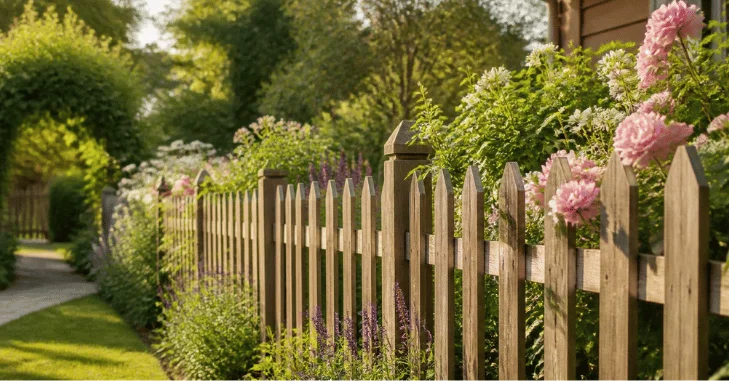
Wood Fence: Traditional Privacy With More Maintenance
Wood is still one of the easiest materials to customize because boards can be cut, spaced, stained, painted, repaired, or replaced individually. Pressure-treated lumber usually provides the more budget-friendly route, while cedar is chosen when natural color, appearance, and dimensional stability matter more. Both can create excellent privacy, but neither is maintenance-free in Canadian weather.
Moisture, UV exposure, snow, and repeated seasonal movement can cause wood to grey, check, warp, or deteriorate over time. Protective stain or sealer helps control moisture absorption and slows cosmetic weathering, although the maintenance interval varies with exposure and product. Homeowners who prefer the appearance of real timber should budget for future cleaning, finishing, and occasional board replacement rather than judging wood only by its initial installation price.
If you plan to build the sections yourself, accurate cutting matters because repeated errors become increasingly visible along a long run of boards. Homecraftly’s miter saw guide explains the cutting capacity needed for common deck, framing, and fence-board work. It is a useful companion before buying a saw solely for an outdoor project.
Vinyl Fence: Low Upkeep and Full Privacy
Vinyl or PVC fencing is popular with homeowners who want solid privacy without staining or painting every few seasons. It does not rot like timber and usually needs little more than periodic washing to remove soil, algae, or surface grime. The higher purchase price can therefore make sense for someone who places a high value on lower routine maintenance.
Quality matters in cold regions because fence products do not all use the same wall thickness, reinforcement, or formulation. Very low temperatures can make some vinyl products less forgiving of hard impacts, so homeowners in especially cold climates should confirm the manufacturer’s temperature and installation specifications rather than buying by appearance alone. Posts, rails, and gates also need correct spacing and support because a good panel cannot compensate for a weak installation.
Chain-Link Fence: Practical, Durable, and Budget-Friendly
Chain link is one of the most straightforward choices for enclosing a yard without blocking sightlines. Galvanized or coated mesh is particularly useful for dog runs, side yards, rental properties, utility areas, and large perimeters where the cost of a solid privacy system would climb quickly. It also allows wind to pass through rather than placing the full wind load on a continuous panel.
The obvious compromise is privacy, although privacy slats or landscaping can reduce visibility through the mesh. Current Canadian cost guides consistently place basic chain link toward the lower end of professionally installed fencing options. For homeowners who care more about containment and durability than creating a solid visual screen, that trade-off can be difficult to beat.
Aluminum Fence: Low Maintenance With Open Sightlines
Aluminum fencing provides the decorative appearance of traditional metal fencing without the same rust concerns associated with untreated ferrous metal. Powder-coated systems are common around landscaped front yards, gardens, and locations where maintaining a view matters. The material is also attractive to homeowners who do not want regular staining or painting.
The main limitation is that standard picket-style aluminum offers little privacy. It can also cost considerably more than basic chain link, particularly after gates and custom sections are included. It makes the most sense when appearance, corrosion resistance, and open sightlines are priorities rather than the lowest possible cost per meter.
Composite Fence: Premium Privacy With Less Routine Finishing
Composite fencing combines wood-derived fibers and polymers or other manufactured components to create solid boards or panels with relatively low routine upkeep. It can provide the substantial appearance of a wood privacy fence without the same recurring staining schedule. Color, texture, construction method, and reinforcement vary considerably among manufacturers, so product specifications deserve close attention.
The major disadvantage is upfront cost, which currently places composite among the more expensive mainstream residential fencing choices in Canada. Heavy panels can also require robust posts and careful installation, making this a less forgiving system for an improvised DIY build. Homeowners comparing composite with wood should evaluate lifetime maintenance and appearance rather than expecting composite to win on initial price.
How Much Does a Fence Cost in Canada in 2026?
A professionally installed residential fence in Canada commonly falls somewhere within a broad C$25 to C$100 per-linear-foot range, although simple chain link can fall below it and premium ornamental work can exceed it. Material is only one part of the quote because labor, excavation, gates, demolition, access, slope, soil, height, concrete, disposal, and local market conditions all affect the final number. A straightforward rectangular suburban yard is therefore much cheaper to fence than a steep lot with difficult machine access and several custom gates.
| Example project | Approximate installed range |
|---|---|
| 100 ft chain-link fence | C$1,500 to C$2,500 |
| 100 ft pressure-treated wood fence | C$2,700 to C$4,500 |
| 100 ft cedar fence | C$4,500 to C$8,500 |
| 100 ft vinyl fence | C$3,500 to C$6,500 |
| 100 ft aluminum fence | C$4,500 to C$9,000 |
| 100 ft composite fence | C$5,500 to C$9,000 |
Treat multiplication by the per-foot rate as a starting budget rather than a finished quote. Gates can add disproportionate cost because they need hinges, latches, stronger posts, accurate alignment, and more installation time, while removing an old fence creates another labor and disposal charge. Taxes and regional labor differences also matter, so compare written quotes that specify materials, post construction, gates, removal, and cleanup instead of comparing only the final total.
Do You Need a Permit for a Fence in Canada?
There is no single Canada-wide residential fence permit or height rule because these requirements are largely controlled at the municipal level. The legal height can change according to whether the fence is in a front, side, or rear yard, whether it is near a driveway or street corner, and whether it encloses a swimming pool. A design that complies in one Canadian city can therefore require a permit, relaxation, or height change in another.
The differences are easy to see in current municipal rules. Calgary generally allows residential fencing up to 1.2 m in the front portion and 2.0 m elsewhere before specified permit issues arise. Vancouver states that fences up to four feet around a front yard and six feet along side and rear property lines can be erected without a permit for qualifying detached homes and duplexes. Ottawa limits residential fences to 1 m in a front yard and 2.13 m in other yards, demonstrating why copying a neighbor or an online drawing is not a substitute for checking your own municipality. More from us: Water Hammer Arrestor Guide for Canadian Homes.
Toronto provides another useful example because its rules change according to the fence location and surrounding features. Its fence bylaw regulates height, materials, and visibility around driveways and pool enclosures, and a pool enclosure requires additional municipal approvals. These examples are not rules for all Canadians, so check your municipality’s current zoning, fence, pool, and sightline requirements before purchasing materials.
Confirm the Property Line Before You Build
An existing fence, hedge, worn path, or row of trees should not automatically be treated as proof of the legal boundary. If there is uncertainty, review the property survey or other applicable legal survey documents and obtain professional surveying help where necessary. Vancouver, for example, specifically directs owners to a Registered BC Land Surveyor when they need the location of a property line established.
A boundary error becomes expensive after concrete footings and a complete fence are already in place. It can also turn what should be a straightforward home-improvement project into a disagreement with the adjacent property owner. Confirming the line first is usually much easier than relocating posts after construction.
Request Utility Locates Before Digging Fence Posts
Fence posts are exactly the kind of excavation that can encounter buried gas, electricity, telecommunications, water, or other services. Canada’s Click Before You Dig portal directs homeowners and contractors to the appropriate provincial or regional notification service so buried utilities can be identified before excavation begins. The service specifically includes fence and deck installation among the projects for which homeowners should obtain licenses.
Do this before post-hole digging starts, not after the first hole is open. Marked utilities can affect post locations or require changes to the layout, and the applicable locate instructions need to be followed throughout the project. A few extra planning steps at the beginning are far less disruptive than discovering a conflict once materials and equipment are already in the yard.
Why Canadian Weather Changes Fence Installation
Canadian fences deal with more than simply cold temperatures because the ground itself changes through the seasons. Water in soil freezes, expands, and later thaws, which can contribute to movement around shallow or poorly supported posts. Wet coastal conditions, Prairie cold, heavy snow, summer UV, wind, and repeated freeze-thaw cycles create different stresses in different regions.
This is why post construction matters as much as the panel material between the posts. Footing depth and design should suit local frost conditions, soil, fence height, exposure, and the installation system specified for the product. A beautiful privacy panel attached to posts that begin leaning after several winters is still a failed fence.
Backfill and surrounding soil also need attention because poorly consolidated material can settle unevenly. Homecraftly’s Measuring Tape guide explains why compaction matters around bases and notes the special challenges of narrow excavations and clay soils around fence posts. It is useful background when deciding whether a hand tool is enough or whether site conditions justify different compaction equipment.
Measure the Fence Run Before Ordering Materials
Measure every straight run, corner, gate opening, obstruction, and change in grade before calculating materials. Long outdoor measurements are easier with a longer construction tape or reel than with a short household tape, especially when checking property-length dimensions. Homecraftly’s measuring tape guide specifically recommends longer tools for decks, fences, and property lines.
Draw the proposed fence line and mark every gate before ordering posts or panels. A gate that moves by even a meter can change traffic flow, post count, and the usability of the yard, so walk the layout as if the fence already exists. Measure twice after that walkthrough and calculate a modest material allowance for cuts, damaged boards, and project-specific waste.
Solid Privacy Fences Need Wind in the Plan
A solid fence behaves differently from open chain link or widely spaced pickets because wind cannot simply pass through it. Taller panels create more force on posts, fasteners, rails, and footings, especially across exposed yards and properties beside open fields. Strong posts and correct spacing therefore become increasingly important as the fence becomes taller and more solid.
Snow should also be considered when planning gates and lower clearances. Drifting snow can block a gate that swings too close to grade, while snow piled against panels adds moisture and seasonal stress. Local climate and yard exposure should influence the details instead of relying on one standard design for every Canadian property.
DIY Fence or Professional Installation?
DIY installation can save labor costs when the site is level, the layout is simple, the material is manageable, and the homeowner already owns or can rent the necessary tools. The job becomes less attractive as soon as it involves rocky soil, significant slopes, unknown boundaries, numerous gates, very long runs, or large solid panels. Post layout errors also multiply across a long fence, so an inaccurate first few holes can create problems that remain visible at the final corner.
Professional installation costs more but transfers much of the excavation, layout, material handling, and alignment work to a crew that already has suitable equipment. When comparing contractors, ask what the quote includes for post-construction, concrete, old-fence removal, gates, cleanup, utility-locate coordination, and warranty coverage. A lower headline quote is not necessarily cheaper if several essential parts of the job appear later as extras.
How to Choose the Best Fence for Your Yard
For maximum privacy, wood, vinyl, and composite are the most obvious starting points because they can create a continuous visual barrier. Wood offers the natural look and easier individual-board repairs, vinyl emphasizes low maintenance, and composite targets homeowners willing to pay more for a substantial finished appearance. Compare them on ten-year ownership effort as well as installation-day cost.
For a limited budget, chain link deserves serious consideration because it encloses a large area using relatively little material. Pressure-treated wood is the next logical comparison when privacy is necessary but premium cedar, vinyl, or composite would stretch the budget. Adding landscaping later can soften the utilitarian appearance of chain link without replacing the entire fence.
For low maintenance, vinyl and aluminum are strong choices, with composite also requiring less regular finishing than conventional wood. Low maintenance does not mean no inspection, because gates, fasteners, posts, damage, and vegetation still need periodic attention. The most useful question is how much recurring washing, staining, painting, and repair you realistically want to do.
For pets, focus on height, gap size, the ground-level opening, gate latches, and the animal’s behavior rather than choosing a material by name alone. Small dogs can exploit gaps that are irrelevant for larger animals, while strong or athletic dogs may need a more substantial enclosure. Local fence and animal-control rules should also be checked where they apply.
Fence Maintenance Through Canadian Seasons
A wood fence benefits from regular inspection for loose boards, failed fasteners, rot, splitting, and posts that have begun to move. Clean dirt and biological growth when needed, then maintain the finish according to the stain or sealer manufacturer’s instructions instead of waiting until the boards are badly weathered. Repairs made while damage is localized are normally simpler than rebuilding an entire section after rails or posts deteriorate.
Vinyl and composite generally require less finishing, but both should still be washed and inspected. Check gates for sagging, verify that posts remain stable, and look for impact damage after winter storms or yard work. Avoid assuming that a maintenance-free marketing claim means the structure never needs attention.
Chain link and aluminum should be checked for loose fittings, damaged coatings, bent sections, unstable posts, and gate alignment. Galvanized and coated components are durable, but physical damage can still create weak points or an untidy appearance. Keeping soil, aggressive vegetation, and accumulated debris away from the base also makes inspection easier.
Common Fence Planning Mistakes
| Mistake | Why it causes trouble | Better approach |
|---|---|---|
| Building from an assumed property line | The fence may be placed on the wrong land. | Verify legal boundaries first. |
| Digging before utility locates | Buried services may cross the fence line. | Request locates before excavation |
| Ignoring municipal height rules | The fence may require alteration or approval. | Check current local bylaws. |
| Choosing only by upfront cost | Maintenance can change long-term value. | Compare ownership costs. |
| Using shallow or weak posts | Seasonal movement can cause leaning. | Design posts for local conditions. |
| Forgetting gate locations | Yard circulation becomes awkward. | Walk the proposed layout first. |
| Buying panels before measuring | Creates shortages or excess waste | Measure the complete run first. |
| Ignoring wind exposure | Solid panels place greater loads on posts. | Match structure to exposure. |
Frequently Asked Questions About Fences in Canada
What is the cheapest fence in Canada?
Basic galvanized chain link is generally one of the least expensive professionally installed permanent fence options in Canada. Current national pricing guides commonly place it below wood, vinyl, aluminum, and composite on a per-foot basis. The final price still changes with height, gates, coating, soil conditions, and the length of the project.
What is the best fence for privacy?
Wood, vinyl, and composite are all strong privacy choices because they can be constructed with little or no visible gap between boards or panels. Wood provides the most traditional appearance, while vinyl and composite reduce recurring finishing work. The best option depends on budget, climate, desired appearance, and how much maintenance you are willing to perform.
What fence requires the least maintenance?
Vinyl and aluminum are among the lowest-maintenance mainstream residential choices because they do not require the routine staining normally associated with wood. Composite is another lower-maintenance privacy option, although products and construction systems differ by manufacturer. Every fence still needs periodic inspection for post movement, loose hardware, gate problems, and accidental damage.
How tall can a fence be in Canada?
Canada does not have one national residential fence-height limit because municipal rules determine most local restrictions. For example, current residential rules differ among Calgary, Vancouver, Ottawa, and Toronto, and additional requirements may apply near streets, driveways, corners, and pools. Check the rules for your exact municipality and property before finalizing the height.
Do I need a permit to build a fence?
Many ordinary residential fences can be constructed without a permit when they remain within local height and location rules, but the details vary by municipality. Over-height fences, special locations, pool enclosures, and other circumstances may require a development permit, exemption, zoning approval, or another municipal process. Always confirm requirements locally before purchasing materials because a rule from another Canadian city may not apply to your property.
Should fence posts go below the frost line?
Post depth needs to account for local frost, soil, fence design, and the installation system rather than following one universal Canadian depth. In cold climates, insufficient footing design can leave posts vulnerable to seasonal movement as surrounding soil freezes and thaws. Follow local requirements and manufacturer specifications, and use qualified professional advice when site conditions or structural loads make the appropriate footing uncertain.
Is wood or vinyl better for a Canadian fence?
Wood is usually better for homeowners who want natural appearance, easy customization, and the ability to repair individual boards, while vinyl is attractive when lower routine maintenance is the priority. Wood requires ongoing protection from moisture and UV exposure, whereas vinyl quality and cold-weather performance deserve attention in very cold regions. Neither material is automatically better for every Canadian property.
Final Verdict
The best fence for a Canadian home is the one that balances privacy or security needs with local climate, maintenance expectations, bylaws, and a realistic total budget. Chain link delivers strong value for straightforward containment, wood remains versatile for traditional privacy, and vinyl, aluminum, and composite provide compelling lower-maintenance alternatives for homeowners willing to spend more upfront. Confirm the property line, municipal rules, utility locations, and installation requirements before digging, because those planning decisions matter just as much as the material you eventually choose.