Electricity gives you almost nothing to look at. A multimeter turns it into a number, and that number tells you whether a circuit is dead, a wire is broken, or a battery is finished. Learning how to use a multimeter takes an afternoon and saves you from guessing at every future repair. We cover this in more depth in Steel Wool Grades.
Quick answer: Plug the black lead into COM and the red lead into the V port. Turn the dial to the setting you need. Touch the black probe to one test point and the red probe to the other, then read the display. Pick AC volts for house wiring and DC volts for batteries.
TL;DR: the short version
- Black lead goes in COM. Red goes in the V port for volts, ohms, and continuity.
- Canadian outlets read close to 120 V AC. Range and dryer circuits read close to 240 V.
- Continuity mode beeps when a path is complete, which is how you find a broken wire.
- Never leave the leads in the 10 A port while you test voltage. That mistake blows fuses and can flash.
- Buy a tool rated CAT III 600 V for panel work. Expect 40-120 CAD for a solid one.
What are the dial settings? Actually Mean
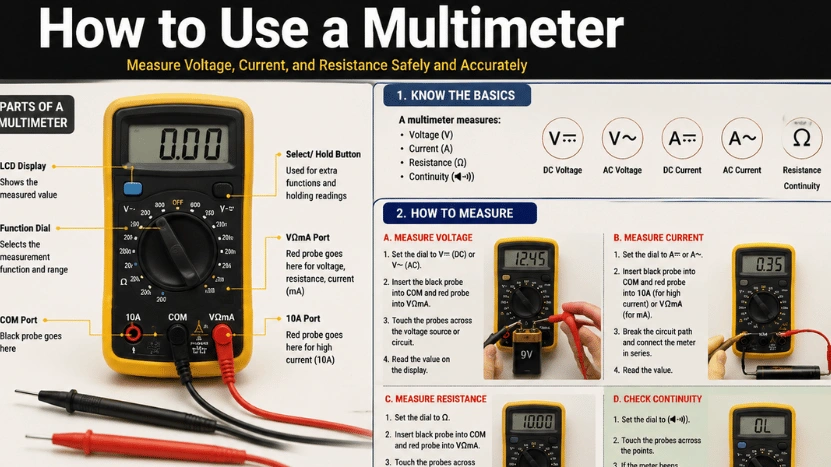
Most dials look crowded because one tool replaces four. Ignore most of it. You only need a handful of positions for household jobs, because the rest of that crowded face is aimed at people repairing circuit boards. Here is the short translation.
| Dial position | Symbol | What it reads | Typical home job |
| AC voltage | V~ or VAC | Alternating voltage | Outlets, switches, light fixtures |
| DC voltage | V with a straight line | Direct voltage | Batteries, doorbell transformers, vehicles |
| Resistance | Ω | Ohms | Heating elements, thermostats, sensors |
| Continuity | Sound wave icon | A complete path | Extension cords, fuses, switch contacts |
| Current | A~ or A with a line | Amps | Battery drain, small DC loads |
| Diode | Arrow into a bar | Junction drop | Circuit boards, LED strips |
Cheaper models also ask you to pick a range, so 200 V and 600 V fall under the same symbol. Choose the range above what you expect, then work down if the display shows almost nothing. An auto-ranging design skips that decision for about 20 CAD more.
What You’ll Need Before You Start
- A digital multimeter with probe leads that are not cracked or taped.
- A CAT rating that suits the work, covered further down this page.
- Safety glasses and dry hands on a dry floor.
- A known live outlet nearby for proving the tool.
- A phone light, since panels and crawl spaces are dim.
One habit is worth building early. Keep the dial parked in a voltage position when you put the tool away, because the next person who grabs it may not check. Our home improvement guides follow the same rule for every tool that can bite.
How to use a multimeter, step by step

- Insert the leads. Black into COM, red into the port marked VΩmA. The 10 A port remains empty unless you are deliberately measuring high current.
- Pick the mode. Turn the dial to AC volts for anything fed by the panel. Choose DC volts for batteries and low-voltage gear.
- Prove the tool. Read a circuit you know is live first. A multimeter that reads zero on a working outlet is broken, and you need to learn that now.
- Take the reading. Touch one probe to each test point. Hold the plastic grips, keep fingers behind the guards, and let the number settle for a second.
- Read the display carefully. Note the unit. A screen reading of 0.62 in the ohms position means less than 1 ohm, not 62.
- Prove the tool again. Go back to the known live outlet. If it still reads about 120 V, your zero reading was real.
That loop of live, dead, live is the whole discipline.
Skip it, and a flat battery inside the tool can quietly convince you that a hot wire is safe. Electricians repeat the routine on every service call, and it costs about fifteen seconds.
Testing a wall outlet in a Canadian home
Standard receptacles here run at nominal 120 V, and anything between roughly 110 V and 125 V is normal. Set the dial to AC volts. Slide the black probe into the wider left slot (neutral), then the red probe into the narrow right slot.
Now check the ground. Move the red probe to the round hole below and leave the black probe in the narrow slot. You should see close to 120 V again. A reading near zero indicates the ground is missing, and in an older Canadian home with two-prong wiring, that answer comes up more often than people expect.
How to use a multimeter: Range and dryer receptacles are rated at 240 V, so pick a range that covers that voltage before you probe. Testing a 240 V circuit on a 200 V range gives you an overload display, not an answer.
Continuity, resistance, and current

Continuity: The Setting You’ll Use Most
Continuity asks one question. Is there a path between these two points? Unplug the item first, because this mode sends a tiny current from the multimeter, and mains voltage ruins the reading. Touch the probes together and listen for the beep. Then test your target: both ends of a cartridge fuse or the two terminals of a switch you press. Silence on a fuse means it is finished, and a two-dollar part has just explained a dead appliance.
Resistance in Ohms
Resistance is continuity in detail. A baseboard heater element might read 12 ohms, while a broken one reads OL (open circuit). Compare your reading to the number stamped on the part or listed in the manual.
Keep your fingers off the metal probe tips. Your body has resistance, too, and quietly pinching both tips adds to the result.
Current in Amps
Current is the awkward one, because the multimeter has to sit inside the circuit rather than across it. You break the path, then bridge the gap with the probes so everything flows through the tool. Move the red lead to the 10 A port for anything above a few hundred milliamps.
Do this on battery-powered gear, not on house wiring. Placing an ammeter across a 120 V circuit creates a near short through the instrument, and the flash that follows is exactly what the internal fuse is trying to prevent.
Testing Batteries and Vehicle Circuits
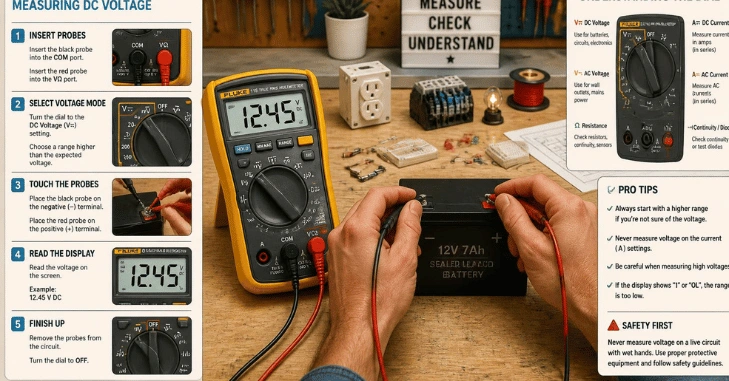
Batteries are the friendliest practice target. Try one now. Set DC volts, and red the probe to the positive end and black to the negative end. A healthy AA reads about 1.5 V, and anything under 1.3 V belongs in the recycling bin at your municipal depot.
Car batteries follow the same principle on a larger scale. Around 12.6 V indicates a full charge at rest, while 12.2 V is roughly half-charged. Start the engine and a working alternator pushes the reading up near 14 V.
Safety Rules that Matter More Than the Multimeter
Test tools carry a category rating, printed as CAT II, CAT III, or CAT IV with a voltage beside it. That marking is not decoration. CAT III 600 V is the sensible floor for anything at a breaker panel. Those ratings describe how much energy the tool can survive, not just what it can display. Probes carry their own rating, so a cheap replacement lead quietly downgrades a good multimeter.
A pen-style tester that beeps is a hint, not proof. Health Canada recalled the Klein Tools NCVT-1 non-contact voltage tester on 9 June 2021, after approximately 67,808 units had been sold in Canada. According to that Government of Canada recall notice, the device could show it was ready to detect voltage while missing voltage that was present. That is a documented failure, and it is why a pen tester alone should never be the final answer.
Three more habits are worth building. Work one hand at a time where you can, so current has no easy route across your chest. Treat every conductor as live until your own reading says otherwise. Stop when you feel rushed, because tired hands are the ones that slip.
What a Decent Multimeter Costs in Canada
Entry-level models sit around 25 to 40 CAD at hardware chains, and they handle batteries and continuity well enough. A CAT III-rated model with fused current inputs runs closer to 60-120 CAD. Professional units climb past 250 CAD, mostly for accuracy you will not miss at home.
Spend the middle amount if you plan to open a panel cover, because the fused inputs and better probes protect your hands rather than your readings. If you are budgeting for a larger project, our renovation planning articles can help you decide what to hire out and what to keep in-house.
When to Call a Licensed Electrician

Reading a circuit is not the same as changing one. Across Canada, electrical work follows the Canadian Electrical Code as adopted by each province, and permits plus licensed contractors are required for most new or altered wiring. In Ontario, that oversight sits with the Electrical Safety Authority. Rules differ elsewhere, so check your own provincial authority before you cut anything.
Call a professional if you find scorch marks, a warm breaker, aluminum branch wiring, or an outlet with no ground. Those are diagnosis jobs, and your reading has already done its part by showing that something is wrong.
Your Next Step
How to use a multimeter Grab your multimeter tonight and read three things: a fresh AA cell, an extension cord in continuity mode, and the outlet behind your sofa. Ten minutes of that turns the tool from a mystery into a habit. For more practical repair walkthroughs, browse the latest Homecraftly posts and pick the project you have been putting off.
Frequently Asked Questions
Yes, with a properly rated tool and dry conditions. Start on batteries, move to continuity on unplugged cords, and only then test a live receptacle.
OL means over-limit or open-loop. In ohms, it usually means no path exists. In volts, it means your selected range is too low for the circuit.
No. This tool needs contact at two points. A non-contact tester does that job, and you should still confirm its result with a real reading.
Roughly 120 V between the narrow slot and the wide slot, and roughly 120 V between the narrow slot and ground. Both numbers should be steady.
Not for basic house checks. True RMS earns its price when you measure dimmers, variable speed motors, or electronics that chop the waveform.