Eleven working hours. That is what it takes to strip back a standard two-car bay to bare concrete, zone properly, and reload, split across a Saturday and a Sunday. Mounting shelving is the easy part. Deciding what leaves the property eats the clock.
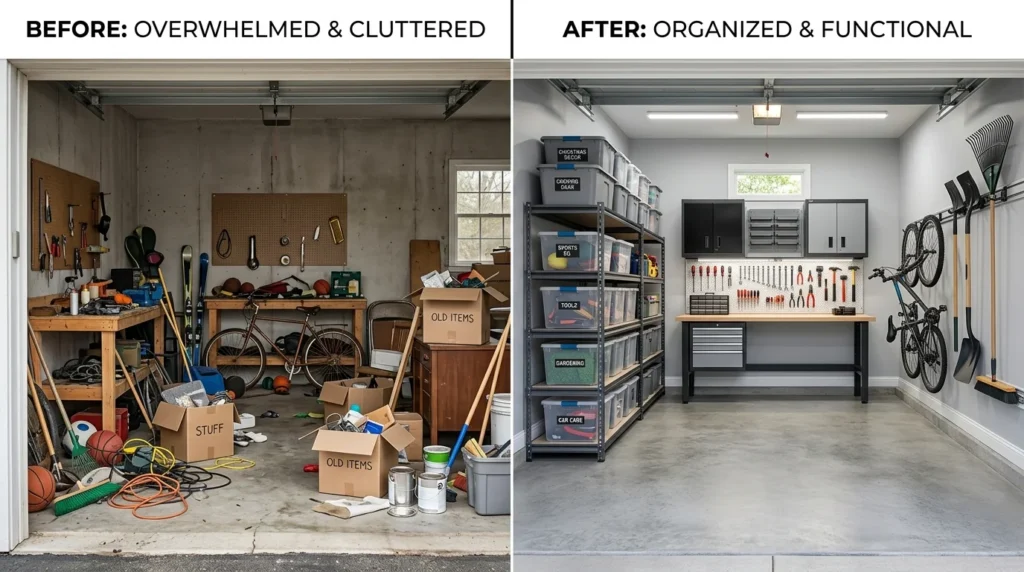
Quick answer: Here is the short version of how to organize garage space. Empty it completely, sort everything into keep, donate, and dispose piles, then mark zones on the floor before buying storage. Mount shelving and hooks on the walls, lift light seasonal bins overhead, and keep the slab clear for vehicles, winter tires, and the snowblower.
TL;DR
- Empty the whole space first. Sorting around piles you never move simply relocates the mess.
- Mark zones on the floor before you spend anything on storage.
- Budget CA$400 to CA$900 for a two-car bay, or under CA$300 for steel shelving and hooks alone.
- Latex paint and alkaline batteries will not survive an unheated Canadian winter. Neither will aerosols or canned food.
- Reserve about half a square metre for a winter tire set and 1.5 m by 1 m for the snowblower.
The weekend timeline at a glance
| Stage | Time | What happens | Rough cost (CAD) |
|---|---|---|---|
| Saturday morning | 3 hours | Carry everything onto the driveway and sort into four piles | CA$0 |
| Saturday afternoon | 3 hours | Donation run, hazardous waste depot drop-off, sweep the slab | CA$0 to CA$40 in fuel |
| Sunday morning | 3 hours | Mount the track and shelving, hang hooks, then tape zone lines | CA$250 to CA$700 |
| Sunday afternoon | 2 hours | Load each zone, label bins, park the car to test clearance | CA$40 to CA$120 for bins |
What you need before the first box moves

Two hours of preparation saves a full afternoon of improvising. Gather this the night before:
- Work gloves, a dust mask, and a stiff shop broom
- Painter’s tape and a marker for zone lines and labels
- A tape measure and a stud finder
- A cordless drill with a driver bit set
- Clear stacking bins with lids, roughly CA$12 to CA$20 each at Canadian Tire
- A folding table for sorting loose hardware
Measure before you shop. A single bay usually runs about 3 m wide, and a mid-size SUV is about 1.9 m across, leaving roughly 55 cm on each side. Any wall unit deeper than 40 cm at door height will eventually get clipped. Our other home improvement projects follow the same order because measuring first keeps a return trip off your Sunday.
How to Organize Garage Space in Seven Steps

Work in this order. Each step depends on the one before it, and skipping the sorting stage is why most attempts collapse by March.
- Empty the room completely. Carry everything out on a dry morning so you can see the entire inventory at a glance.
- Sort into four piles. Keep, donate, sell, and dispose. Anything untouched through two winters goes in a pile that is not “keep”.
- Clear the dispose pile the same day. Old paint and dead batteries go to a municipal household hazardous waste depot, never the curb. Solvents go with them.
- Sweep and inspect the slab. Check for cracks, salt staining, and damp corners while the floor is bare and easy to see.
- Tape out the zones. Draw the parked vehicle first, then the walking lanes, then divide the remaining strip.
- Mount the storage. Anchor the shelving and wall track into studs. Hang bikes and ladders, then fit overhead racks for light seasonal bins.
- Reload zone by zone, labelling as you go. Daily items sit at chest height, and rarely used bins go up top.
How to decide what actually stays
Most people stall at step two, so give yourself a rule instead of a debate. If an item has not earned its keep through two full winters, it leaves. Duplicates lose too: one hammer, one hand saw, one half-empty tin of driveway sealer.
Broken things get a deadline, not a maybe. Write today’s date on masking tape and stick it on the item. If it is still unfixed in 30 days, it goes to the depot or the curb. Good tools and kids’ bikes sell quickly on local listings in September. Anything still unsold by the first frost goes to a donation depot.
Zone the floor before you buy anything
Storage bought before zoning ends up in the wrong wall. Draw the car first. Leave a walking lane of 75 cm to 90 cm along the driver’s side so nobody has to squeeze past a mirror with an armful of groceries. Whatever remains becomes your storage strips, usually the back wall and one side wall.
Six zones cover almost every household garage: lawn and snow equipment, automotive, tools and workbench, sports and recreation, seasonal bins, and garbage and recycling. Keep the snow zone nearest the overhead door in winter and swap it with the lawn zone in May.
Winter tires and a snowblower are the two loads Canadian households carry that American garage guides never plan for. Four winter tires on rims stack about 1 m high in a footprint near 70 cm by 70 cm, so roughly half a square metre. A single-stage snowblower needs about 1.5 m by 1 m parked, plus swing room to get it out. Each one sits idle half the year, so give both a permanent corner rather than shuffling them every season.
Get it off the floor: walls first, ceiling second
Every object on the slab costs you parking. Walls are the cheapest square metres you own, and a stud-anchored rail carries far more than a freestanding rack of the same price.
Shelf load ratings are the number almost nobody prints, and they decide what you can actually buy. A pair of wire floating shelves at Home Depot Canada runs about CA$227, and each shelf holds close to 68 kg. A four-tier wall shelf sells for near CA$73, a steel cantilever rack for lumber and ladders for near CA$204, and a hanging ceiling unit for around CA$248. Check the rating in kilograms and size the unit to the heaviest thing you will ever load onto it.
Overhead racks belong above the hood of the parked vehicle, never above the walking lane. Keep what goes up there light: holiday bins, camping gear, empty coolers. Bikes and ladders hang better on wall hooks. You want them reachable without a step stool. If the walls need patching or a coat of paint before the track goes up, our renovation guides for walls and floors cover that prep.
What an unheated Canadian winter destroys
An unheated bay in Winnipeg or Sudbury can sit below minus 20 °C for weeks, and storage advice written for California skips this entirely. Some of what people park out there quietly ruins itself by February.
| Item | Safe below zero? | What happens |
|---|---|---|
| Latex and acrylic paint | No | The emulsion breaks after two or three freeze cycles and dries lumpy |
| Alkaline and lithium batteries | No | Cold cuts capacity, and condensation on the thaw corrodes the contacts |
| Canned food and bottled drinks | No | Water expands as it freezes, splitting seams and glass |
| Aerosols, including spray paint | No | Pressure drops in the cold, and a summer bay above 50 °C risks a rupture |
| Propane cylinders | Outdoors only | Cylinders never belong inside a closed structure, warm or cold |
| Electronics, photos, paperwork | No | Humidity swings and condensation do more damage than the cold |
| Tires, hand tools, fasteners, lumber | Yes | Cold is harmless as long as they stay dry and off the concrete |
That short list belongs indoors. One basement shelf or a lidded bin under the stairs will hold the paint safely until spring, along with the batteries and anything in a tin. Everything else can freeze. It will not complain.
What this costs in CAD
We checked prices at Home Depot Canada and Canadian Tire in August 2026. A realistic two-car fit-out lands between CA$400 and CA$900. The spread is mostly wall track versus plain shelving.
- Steel wire shelving unit, four or five tiers: CA$90 to CA$150
- Wall-mounted shelf, four tiers: about CA$73
- Steel cantilever rack: about CA$204
- Overhead ceiling rack, roughly 1.1 m square: about CA$248
- Clear stacking bins: CA$12 to CA$20 each
- Wall track or slatwall panels with a hook kit: CA$150 to CA$400 for one wall
Rona carries the same track systems, and Costco Canada discounts heavy shelving through the fall. Industrial racks above CA$449 are built for warehouses, not houses. You can finish the whole job under CA$300 with two steel shelving units, a pegboard panel and a box of hooks.
Keeping it tidy after the first weekend
Systems fail at the door, not on the shelf. Put a labelled landing bin where you walk in, and empty it every Sunday. Nothing homeless gets to sit on the floor for a month.
One in, one out keeps the volume flat: a new sled means an old sled leaves. Book a 10-minute reset on the first Saturday of each month, and a longer one each May when the lawn zone and the snow zone trade places. Label every bin on two sides, since you will read whichever side faces you. The same labelling habit works indoors, and our interior design storage ideas cover that half of the house.
Your next step
Book two mornings and start this Saturday. Measure your bays tonight, write the shopping list from those numbers, and buy only what your zones call for. Browse more of our home projects when you are ready to sort the next room.
FAQs
Start by emptying it onto the driveway on a dry day. A packed room cannot be sorted in place, because every decision needs somewhere to put the item. Once the slab is bare, sorting takes about three hours for a two-car bay.
About 11 working hours, split across two days. Sorting takes the first day, and mounting plus reloading takes the second.
Stack them flat on a low shelf or a rack against the coldest wall, out of direct sun and off the bare concrete. Cold does not hurt rubber, but sunlight and standing moisture do.
It is worth it if your needs change often. Track lets you move a hook or a basket in seconds, which suits growing families and shifting sports gear. Fixed shelving costs less and suits storage that rarely moves.
Latex paint tops the list, with batteries and aerosols close behind. Canned food fails, too, as do electronics and paperwork. Freezing does some of the damage, and the condensation that follows a thaw does the rest.