One light, or every light in the house? That single answer separates a bulb you can tighten in ten seconds from a wiring fault you should not touch. Any honest guide on how to fix flickering lights has to start there. Work outward from the bulb, and stop at the point where the job belongs to a licensed electrician.
Short answer: Start at the bulb and move outward. Reseat the bulb, then match it to the dimmer, then check the switch and the fixture. If the flicker affects the whole house, or you smell hot plastic or hear buzzing, shut off the circuit and book a licensed electrician. Most causes are cheap. Some are not.
Key takeaways
- A loose or failing bulb accounts for most single-fixture problems and costs almost nothing to rule out.
- Dimmers designedned for incandescent bulbs cannot hold an LED steady, so a compatible dimmer can resolve many complaints.
- Brief dips while a motor starts are normal. Deep or repeated dips are not.
- Flicker across the whole house points at the neutral or the service, and that is urgent.
- Expect CA$100 to CA$200 for an electrician’s first hour on site in most of Canada.
Read the pattern before you touch anything
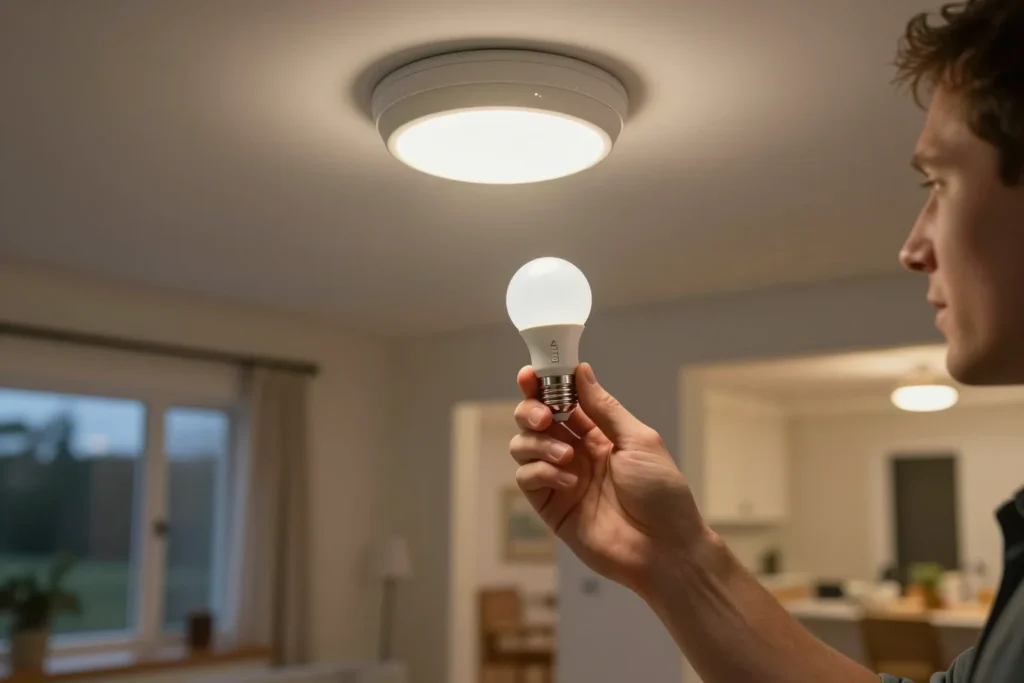
The symptom tells you where the fault sits. Match what you see against the table below, then work the steps that follow.
| What you see | Most likely cause | Who fixes it | Typical cost (CAD) |
|---|---|---|---|
| One bulb, one fixture | Loose bulb, or a bulb the fixture cannot drive | You | CA$5 to CA$20 |
| One fixture, only while dimmed | Dimmer not rated for LED loads | You, or an electrician | CA$25 to CA$60 |
| Several rooms on one circuit | Loose connection in a switch, a box or a breaker | Licensed electrician | CA$130 to CA$250 plus labour |
| Whole house dips when an appliance starts | Motor surge on a shared service | Often normal, worth one check | CA$100 to CA$200 |
| Whole house, random and repeating | Loose neutral at the panel or the service | Licensed electrician, treat as urgent | CA$100 to CA$200 to diagnose |
What the flicker is actually telling you
Canadian homes take a 240 V split service at the panel. Lighting and outlets are on 120 V branch circuits fed from either side, and a shared neutral carries the return current. When that neutral loosens, the two sides stop balancing each other. One half of the house brightens while the other half dims, and both wobble every time a load switches on.
That pattern deserves a phone call the same day. A loose connection does more than move the voltage around. It heats, and it can arc. Fire incident data published by Statistics Canada in June 2023 covered the years 2015 to 2021. It found that mechanical or electrical failures or malfunctions were a factor in 18% of residential fires, 15% of injuries, and 10% of deaths in homes. A flickering fixture is one of the few warnings a house gives you first.
Timing narrows it down further. If the trouble began right after work in the house, the connection disturbed during that work is your first suspect. Think back through recent renovation projects and rewiring jobs before you start pulling bulbs out of sockets.
What you’ll need
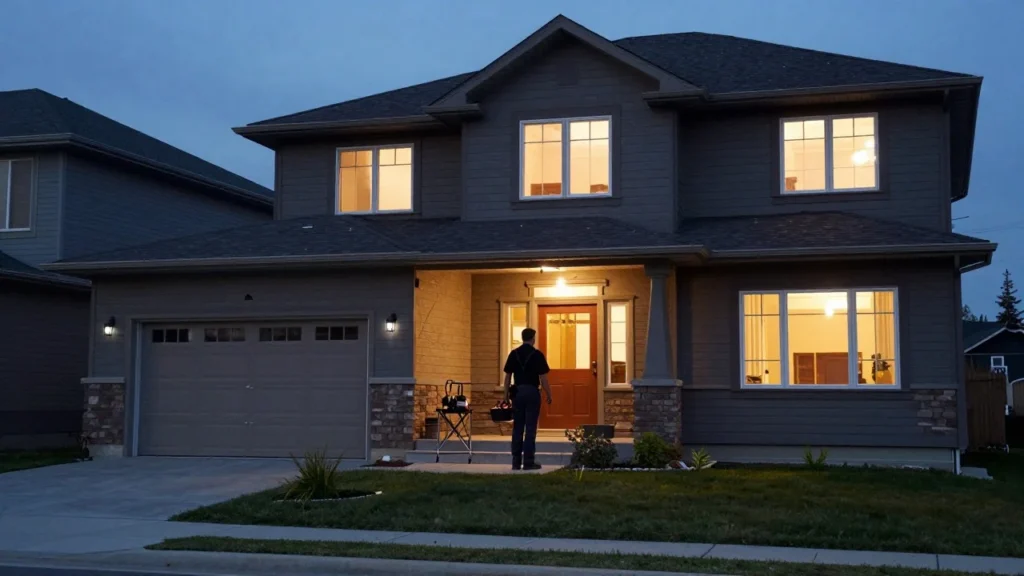
- One known good replacement bulb, same base and voltage rating
- A dimmer marked as LED compatible, if the room has dimmers
- Non-contact voltage tester
- Screwdriver set
- Stable step ladder, plus dry hands
Nothing below needs specialist test gear. The tester is the one purchase worth makingbecause it confirms a circuit is dead before your fingers go near a fixture.
How to fix flickering lights, step by step
The sequence below is how to fix flickering lights without guessing. Each step rules out one cause before the next begins, and the cost climbs only as far as the fault forces it.
- Map the pattern. Write down which lights misbehave, in which rooms, at what time of day, and what else was running. Note whether it happens on a dimmer, at startup, or at random. That page of notes is what an electrician bills against later.
- Kill the power at the breaker. Switch off the breaker feeding that room and confirm the fixture is dead with your voltage tester. The wall switch on its own proves nothing.
- Reseat or swap the bulb. Let it cool, then turn it a quarter turn tighter in the socket. If the problem survives that, fit a bulb you know works elsewhere in the house.
- Match the bulb to the dimmer. Older dimmers expect an incandescent load of 40 W or more, and an 8 W LED never meets that requirement. Fit a dimmer marked LED-compatible, or a bulb the dimmer maker lists as tested. Budget CA$25 to CA$60.
- Move heavy loads off the lighting circuit. A freezer, a compressor, or a space heater pulls a surge when its motor starts, and everything on that circuit dips for a moment. Basements and garagesaccount fore most of these call, because one circuit ends uppoweringg a fridge, a battery charge,r, and a shop light. If yours looks like that, a weekend spent working out how to organize garage storage and power pays for itself.
- Inspect the switch and fixture connections. With the breaker still off, pull the switch plate and look for browning, melted insulation, or a screw that has backed off. Any scorch mark or burnt smell ends your involvement. Leave the breaker off and phone a licensed electrician.
- Hand the panel and service over. A loose neutral, a tired breaker, a corroded service head, or a failing utility connection is not homeowner work in Canada. Book a licensed contractor and read out the notes from step 1.
When the flicker points at aluminum wiring
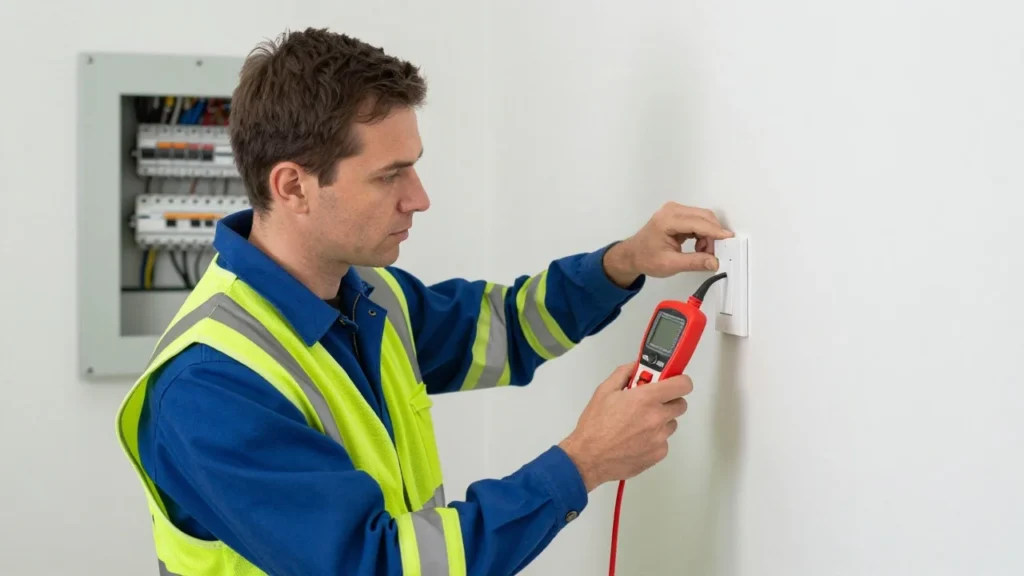
Many Canadian houses built between roughly 1965 and 1978 carry aluminum branch conductors. Aluminum expands more than copper as it heats and cools, so terminations at switches, outlets,, and fixtures work loose over the decades. A loose termination arcs. From the living room, an arcing termination looks exactly like a light that will not settle.
The repair rarely means a full rewire. A licensed electrician installs certified connectors, usually a short copper pigtail joined to a connector approved for aluminum-to-copper, at every device on the affected circuits. Plan on a full day of labour or more. Keep the paperwork, because insurers in most provinces ask about aluminum wiring directly.
What the repair costs in Canada
| Job | Typical cost (CAD) |
|---|---|
| Replacement LED bulb | CA$5 to CA$20 |
| LED compatible dimmer, fitted yourself | CA$25 to CA$60 |
| Electrician, first hour on site | CA$100 to CA$200 |
| Electrician, each hour after that | CA$80 to CA$150 |
| Replacing a failed breaker | CA$130 to CA$250 |
| 200 A panel upgrade | CA$1,500 to CA$4,500 |
| Permit fees, where the work needs one | CA$75 to CA$250 |
Permits and inspections are provincial, not federal. In Ontario,, the Electrical Safety Authority receives the notification and inspects the work. British Columbia routes it through Technical Safety BC, and Alberta through Alberta Municipal Affairs and its accredited municipalities. Each province enforces its own adopted version of the Canadian Electrical Code, and a licensed contractor files the paperwork as part of the job.
When to call a licensed electrician
Stop and phone a professional if any of these describe your house:
- Every light dips at once, or one half of the house brightens while the other half dims.
- You smell hot plastic, or hear buzzing or crackling at a switch, an outlet, or the panel.
- Breakers trip repeatedly, or the panel cover feels warm.
- The wiring is aluminum, and the trouble moves from room to room.
- Two or three fixtures on one circuit went bad in the same week.
Have your step 1 notes in front of you when you call. Which lights, which rooms, what time, what else was running. Clear detail often turns a two-hour diagnostic visit into a one-hour one, which is real money at Canadian labour rates.
Your next step
Start at the bulb, work outward, and stop at the panel. Knowing how to fix flickering lights is mostly knowing where your half of the job ends. Ten minutes with a spare bulb and a screwdriver settles most cases, and the rest earn a phone call rather than an experiment. Once the lighting is behaving, our home improvement guides cover the rest of the maintenance list, from seasonal checks to jobs worth booking a trade for.
Frequently asked questions
One unsettled bulb usually is not. Trouble across a whole circuit or the whole house can mean a loose or arcing connection, and that carries a genuine fire risk. Treat the second case as urgent and leave the circuit off until someone qualified looks at it.
The dimmer almost certainly predates LED lighting. It needs a minimum load your bulbs never reach, so it drops in and out. Swapping in a dimmer-marked LED-compatible one clears it up in about fifteen minutes.
Motors draw a heavy surge in that first moment, and voltage sags briefly across the circuit. An occasional shallow dip is normal in a Canadian home. A deep dip, or one that lasts more than a blink, means the circuit or the service needs checking.
Usually, it means a loose neutral at the panel, at the service head, or on the utility side of the connection. It is the one symptom on this page that should never wait. Shut off what you can, and call a licensed electrician or your utility today.
Bulbs, lamp cords, and swapping a dimmer are ordinary homeowner jobs. Anything inside the panel, and anything involving aluminum terminations, belongs to a licensed contractor working to the provincially adopted code.