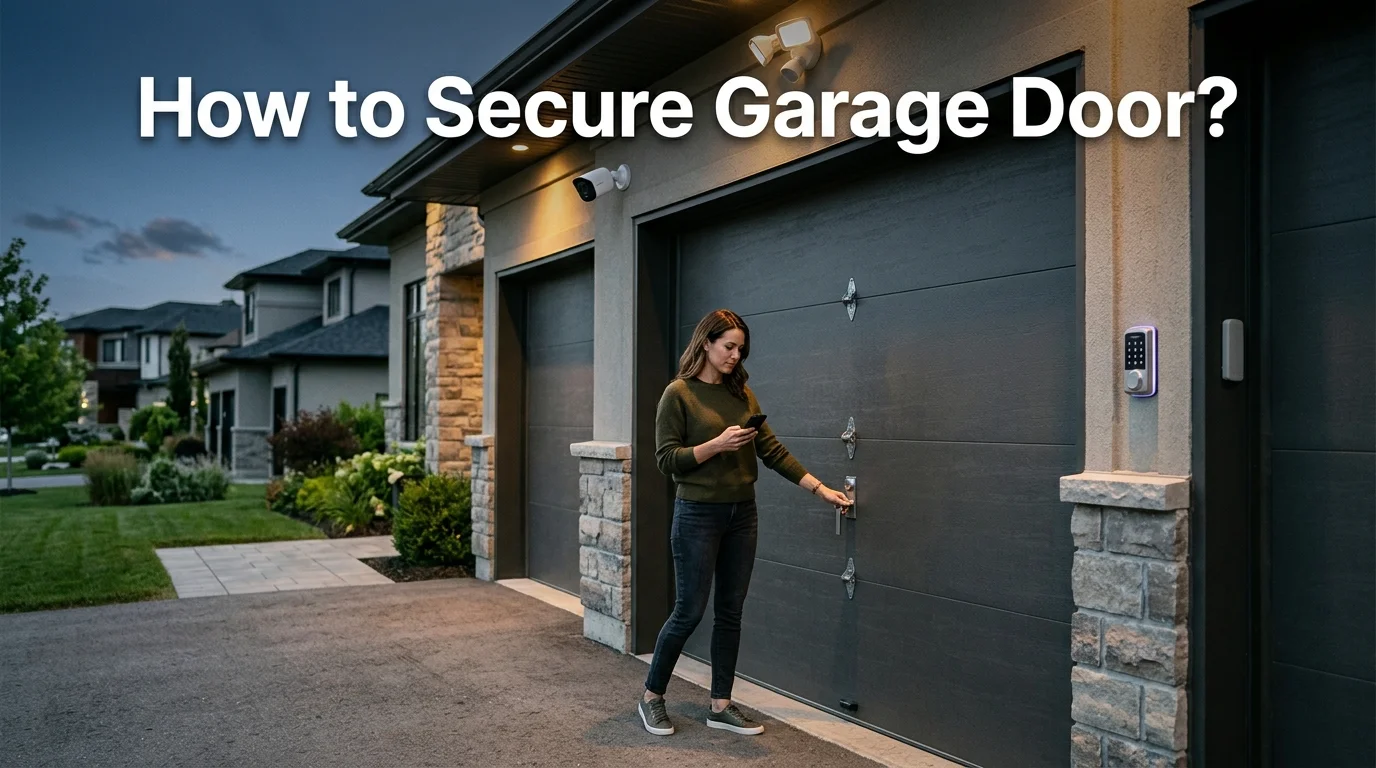
Most security advice for the overhead starts with cameras and floodlights. Yet the weakest point sits lower down, costs almost nothing to fix, and gets one passing line in nearly every guide. It’s the emergency release cord, and a bent coat hanger reaches it through the gap at the top of the panel.
The short answer to how to secure garage door entry: block the emergency release with a zip tie or a shield. Keep the remote out of your parked vehicle and deadbolt the service door. Lock the overhead when you travel, and replace any opener built before 1993.
The weak points, ranked by what they cost to close
| Weak point | What an intruder does | The fix | Cost (CAD) |
|---|---|---|---|
| Emergency release cord | Wedges the top corner, hooks the cord with wire | Zip tie, shield, or shorten the cord | CA$0 to CA$50 |
| Remote clipped to a visor | Breaks a car window, presses the button | Carry the remote, or fit a keypad | CA$0 to CA$70 |
| Opener made before 1993 | Captures or guesses a fixed DIP switch code | Rolling-code replacement unit | CA$200 to CA$400 |
| Service door and windows | Kicks a hollow frame, or reaches through glass | Deadbolt, 75 mm screws, frosted film | CA$25 to CA$90 |
| Door left part-open | Ducks under and walks in | Close it, and fix the iced bottom seal | CA$0 to CA$50 |
Key takeaways
- The release cord is the attack that really happens. Everything else is a distant second.
- Zip ties cost pennies, but somebody in the house still needs to open the panel by hand.
- An interior slide lock beats any electronic gadget for a week away.
- If your remote has small switches inside, the opener is older and should go.
- In an attached build, this is your house’s front door, not a shed latch.
- Budget roughly CA$40 for the layer that matters, or CA$350 including a new opener.
An attached garage is a door into the house

In most new Canadian subdivisions, the garage is attached, sharing a wall and a doorway with the living space. That changes what a breach means. An intruder who gets past the overhead is standing inside, out of the weather and out of sight of the street. They have a closed door and can stay as long as they like.
Statistics Canada counted 121,033 police-reported breaking and entering incidents in 2024, a rate of 293 per 100,000 people and 11% below 2023. That trend is down. Even so, the count is large enough that the cheapest fixes here pay for themselves the first time they work.
Take a minute to think about what’s in there. Snow tires, a snowblower, a mitre saw, the good bike, a chest freezer. For most households, that’s four figures of gear sitting behind a 2.4 m panel with a spring on it. A weekend plan for organizing the garage is worth pairing with this job, because knowing what’s on which shelf tells you how hard the space is worth defending.
The release cord trick, explained properly
Every opener has a manual release so you can raise the panel during a power cut. It hangs from the trolley on a red cord, usually about a metre back from the opening. Pull it, and the carriage disengages from the motor.
Here’s the problem. The top of most residential doors leaves a gap of a few millimetres against the header. Wedge it with a pry bar, and that becomes a hand’s width in seconds. A coat hanger, straightened and bent into a hook at one end, goes through that gap, catches the cord, and pulls. Now the panel lifts by hand. People who do this for a living are through in under ten seconds, and nothing is broken, so nothing looks wrong afterwards.
The three real fixes are a zip tie through the release carrier, a metal shield bolted over the trolley, or simply removing the dangling cord so there’s nothing to hook. Each has a trade-off, covered in the steps below.
How to Secure Garage Door Entry in 9 Steps, Cheapest First
Free: habits that close most of the gap
- Close it, every time. Check the panel is fully down before bed and before you leave. Opportunists cruise streets looking for an open bay, and no hardware helps a door that’s up.
- Take the remote out of the vehicle. Leaving a visor clip in a car on the driveway is like taping a key to the doorframe. Move it to your keys or a pocket.
- Block the view. Frosted film or a curtain over the bay windows stops anyone from confirming there’s a truck, tools, or nobody home. Film runs about CA$15-CA$30 at Canadian Tire.
CA$10 to CA$30: the layer that stops the hanger
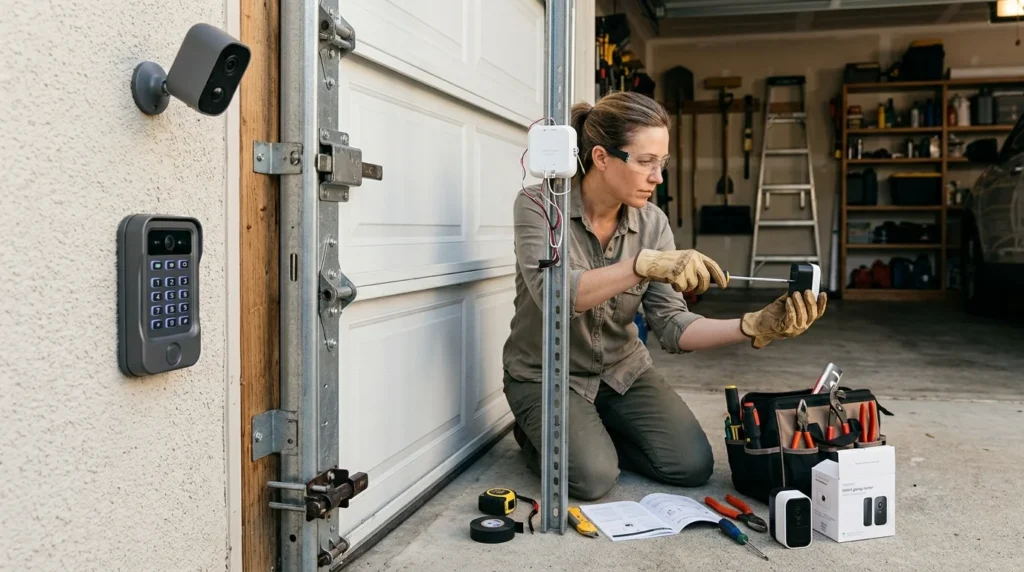
- Zip-tie the release carrier. Run a single nylon tie through the hole the cord passes through, so the lever can’t drop when it’s tugged. Use one tie only, and choose a light-duty one you can snap by hand from a stepladder. Plastic becomes brittle in an unheated garage at temperatures below about -20 °C, so recheck it each spring.
- Or fit a shield instead. Purpose-made steel shields bolt over the trolley and block a hook while leaving the lever usable from inside. Expect roughly CA$30 to CA$50 delivered in Canada. This is the better choice if anyone in the house might need the manual release in a hurry.
- Shorten or reposition the cord. If a zip tie worries you and a shield is out of budget, cut the handle off and tie the remaining cord up short against the rail. Nothing dangles, and an adult on a step can still reach it.
- Deadbolt the service door. Both the side door into the yard and the door into the house deserve a real deadbolt, with 75 mm screws through the strike plate into the stud. Budget CA$25 to CA$60 each at Home Depot Canada or Rona.
CA$200 and up: the hardware upgrades
- Add an interior slide lock for trips away. A spring-loaded side lock, around CA$16 at Home Depot Canada, drops a bolt into the track so the panel physically cannot rise. Throw it when you fly out, and remember the opener will strain against it if someone presses a remote, so unplug the motor too.
- Replace a pre-1993 opener. Open the remote. Rows of tiny switches mean a fixed code that never changes and can be captured or guessed. Rolling code was introduced in 1993 and generates a new code on every press. Belt-drive units run CA$200 to CA$400 at Canadian Tire or Home Depot Canada, plus CA$120 to CA$250 if a technician fits it.
Do not attempt spring work while you’re up there. Torsion springs hold enough stored energy to break an arm, and adjusting one is a job for a technician with winding bars.
Winter changes the math

Slush runs off a vehicle, pools at the base of the panel, and freezes overnight. By morning, the rubber seal is welded to the slab. Force the opener, and you tear the seal or strip the gear, so plenty of people give up and leave the door 30 cm open all winter. That single habit undoes every fix above.
Sweep the base clear before the temperature drops and keep grit away from the seal line. During a deep cold snap, lift the panel by hand once to break any bond. Usually, a cracked seal is the root cause, and it’s a cheap swap at roughly CA$25-CA$50. Measure the full width first. Single bays are usually 2.44 m and doubles 4.88 m, so choosing a tape measure that lasts saves you a second trip.
Cold hits the electronics too. Remote batteries lose voltage fast below freezing, which is why a keypad on the exterior frame, about CA$40 to CA$70, is worth more in January than any app.
Where to start this weekend
Give it twenty minutes. Walk out and look at the top of the panel for daylight. Then look up at the trolley and see whether a red cord hangs where a wire could reach it. Fix that one thing today, and check the service door lock while you’re holding the screwdriver. When you’re ready for the next job on the list, browse the rest of our home improvement guides.
Frequently asked questions
It’s safe if you pick a tie you can break by hand and everyone in the house knows it’s there. It is not safe if a child, an older parent, or anyone who can’t yank hard might need to raise the panel during a power failure. In that case, use a shield.
Yes. An interior slide lock or a simple C-clamp on the track above a roller both stop the panel from rising. Neither is meant for daily use, because you’ll eventually forget and run the motor against a locked track.
Look for “Security+” or “rolling code” printed on the remote or the motor housing. If the remote opens up to reveal a bank of small DIP switches, it’s fixed code and predates 1993.
Free, then about CA$40. Steps one to three cost nothing, and a zip tie plus a deadbolt closes the two openings burglars actually use. Anyone working out how to secure the weak points in a garage door on a tight budget should stop there and spend the rest on lighting.
They tell you the panel is open, which is genuinely useful. They do nothing about a hook through the top gap, so treat an app as a monitor rather than a lock.