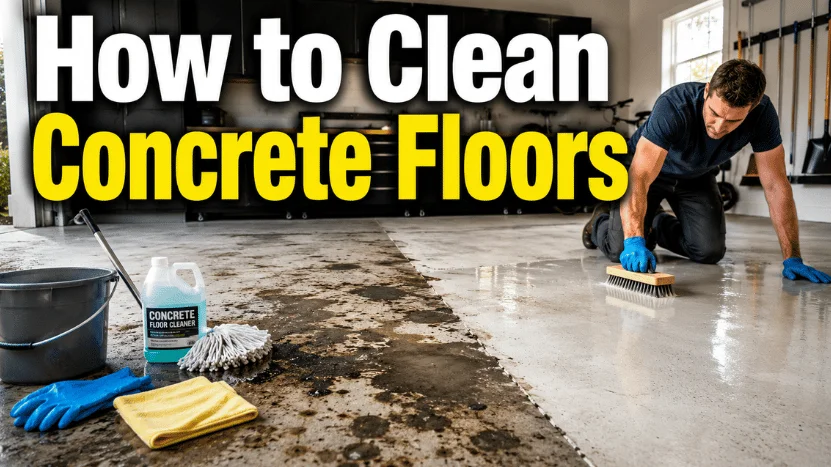
Sort the slab into one of two groups before you fill a bucket. Sealed floors hold water on top and wash up with mild soap. Bare ones drink whatever you pour, so they want a stronger cleaner, real scrubbing, and far more drying time. Settle that one question and everything after it gets easy.
Quick answer: how to clean concrete floors follows one sequence, whatever the room. Clear and sweep the slab, then mix a pH-neutral cleaner. Pre-treat oil spots with a degreaser, scrub in sections with a stiff nylon brush, then rinse and dry it fast. Sealed surfaces require less water and less muscle than bare ones.
What you’ll need, and what it costs in Canada
None of this is specialty gear. The prices below are what we saw in Canadian stores in 2026, and a full kit costs near 120 CAD if you own nothing.
| Item | Typical price (CAD) | Notes |
|---|---|---|
| Stiff nylon deck brush, long handle | 15 to 25 | Canadian Tire. Never a wire brush; the flecks rust |
| pH-neutral floor cleaner, 4 L | 12 to 20 | Right for any sealed or polished slab |
| Concrete cleaner and degreaser concentrate, 3.78 L | about 23 | Home Depot Canada. Makes roughly 19 L of solution |
| Oil absorbent or plain clay cat litter | 10 to 15 | Rona |
| Wet and dry shop vacuum | 80 to 200 | For the fine dust a broom leaves |
| Rubber floor squeegee, 60 cm | 25 to 40 | Halves the drying time |
| Nitrile gloves and eye protection | under 20 | Degreasers are alkaline |
Sealed or bare? Let it settle for a minute
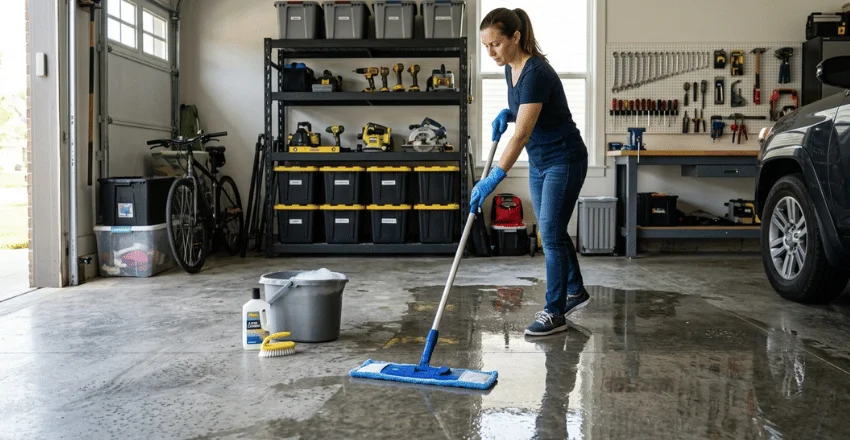
Dribble a spoonful of warm water into an out-of-the-way corner and watch it for half a minute. Bare masonry pulls it straight in and turns a darker grey at the edges. Sealed floors hold a shallow puddle that wipes away without leaving a mark at all.
Sheen is the second tell, and it reads best from a low angle with a work light on the floor. Sealed and polished surfaces carry a soft gloss. Bare ones stay flat and slightly chalky to the touch.
Bare slabs also stain from oil rather than from water, which is why a garage bay usually looks far worse than a basement of the same age. That single distinction shapes everything else about cleaning concrete floors, from the cleaner you buy to how long the fans run.
How to clean concrete floors in eight steps
Work one bay or one room at a time. Nothing below is hard.
A 20 m² garage takes roughly two hours of actual work, plus a drying period you cannot rush.
- Clear the floor completely. Shelving, bins, the snow tires in the corner, all of it. If the garage is where you’re working, an afternoon spent sorting the garage into zones first means you only move things once.
- Sweep, then vacuum. Push broom first, shop vacuum second. Skip the vacuum, and the fine grey dust it would have caught turns to slurry the moment water hits it.
- Mix the cleaner to strength. The metric dilution ratios worth remembering are about 15 mL of concentrate per litre, so roughly 60 mL in a 4 L pail of warm water. Double that for a slab nobody has touched in a year. Read the jug, since concentrates vary.
- Pre-treat the grease first. Pour undiluted degreaser onto oil shadows, tire marks, and drips, then leave it for 10 to 15 minutes to soften the deposits.
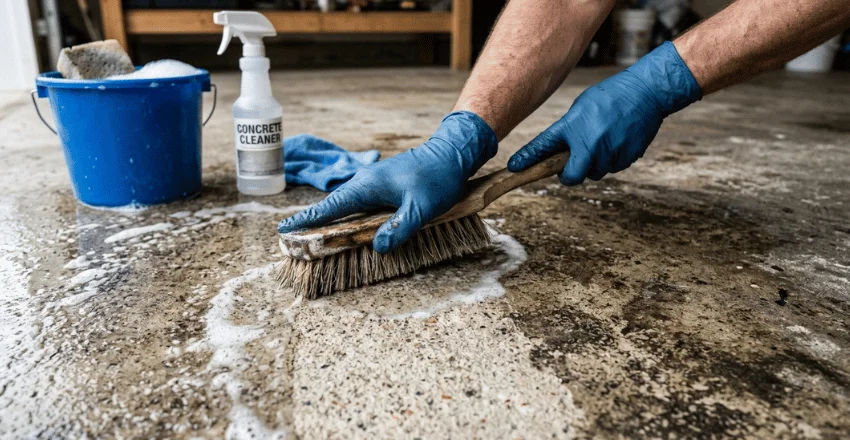
- Scrub in sections. Flood about 3 m² at a time, work the brush in overlapping passes, and don’t let the solution dry on the surface. Dried cleaner leaves its own film.
- Rinse with clean water. Residue attracts dirt and goes tacky underfoot. On bare masonry, rinse twice.
- Squeegee the water out. Push it to the drain, the door, or a shop vacuum. Don’t leave puddles. Standing water on bare masonry soaks straight in, adding a full day to drying.
- Dry it with airflow. Two box fans and an open door beat waiting. Give it 24 hours before the bins go back down.
The spring salt wash a Canadian garage needs
This is the job the American guides never mention. From November to April, boots and tires carry road salt and de-icer onto the slab. The brine soaks into the pores, the water evaporates, and the salts stay put. By March, you have a chalky white film that looks like efflorescence and behaves like it, since both are mineral deposits in and on the surface.
Sweep the loose crystals away dry first, or you’ll just paint them around the slab in a grey smear. It takes two minutes. Then wash with a mild acid: about 250 mL of white vinegar in 4 L of warm water works on a bare slab, left for 5 minutes, then rinsed thoroughly. Repeat once rather than scrubbing harder, since salt often sits in two layers.
One caution, and it’s the one people skip. Keep vinegar and every other acid off sealed, stained, or polished floors, where it can dull and etch the finish. Those get the pH-neutral cleaner and nothing stronger. Run the salt wash each spring, and again in late fall before the salt season starts, and the deposits never build into a deep haze.
Cold slabs and damp basements: timing the job
Temperature plays a bigger role here than most people expect. Below about 5 °C, detergents lose their bite, rinse water lingers, and any of it that reaches a crack can freeze and widen it. So, an unheated garage in January gets only sweeping and spot cleaning. Wait for a thaw and a forecast of two dry days.
The opposite problem arrives in July. An unfinished basement slab stays cool while the air above it warms and becomes humid, so moisture condenses on the surface, and the floor appears to sweat on its own. Wash it in that weather, and it can stay damp for the better part of a week.
Here’s a check worth doing first. Tape a 45 cm square of clear poly to the slab, sealing all four edges, and leave it for 24 hours. Beads beneath the slab mean moisture is rising through it. Beads on top mean condensation from the room. Either way, run a dehumidifier until the relative humidity is down to about 55% before you wash.
Stains, one by one
| Stain | What actually shifts it |
|---|---|
| Fresh oil or fuel | Clay absorbent for 30 minutes, sweep up, then degrease |
| Old oil shadow | Degreaser and baking soda paste, covered with plastic for 24 hours |
| Rust from tools or a bike | Oxalic acid wood bleach, 10 minutes. Bare slabs only |
| Dried paint | Plastic scraper, then a citrus-based stripper |
| Salt and efflorescence | Dry brush, then the diluted vinegar wash above |
| Pet urine | Enzyme cleaner, left wet to work |
| Black tire marks | Undiluted degreaser and a nylon brush |
Four things not to do
Never mix bleach with ammonia, and never mix bleach with an acid cleaner such as vinegar or muriatic acid.
Both combinations give off toxic gas within seconds in a closed garage or basement. One product per bucket. Rinse between products, and open a door before you start pouring anything at all.
Skip the pressure washer inside a finished basement. Outdoors on a driveway, or in an open bay with a floor drain, it earns its keep. Indoors, it drives water into walls and framing that nobody can dry.
A wire brush or steel wool pad is a false economy. The fragments they shed rust into orange freckles a month later. Nylon bristles and a bit more patience get there without the souvenir.
One more, and it catches people out. This routine does not travel to the boards in the next room. Water that a slab shrugs off will lift and cup a wood floor. Our routine for finished hardwood is a different method with much tighter limits on how wet the mop can be.
Should you seal it afterward?
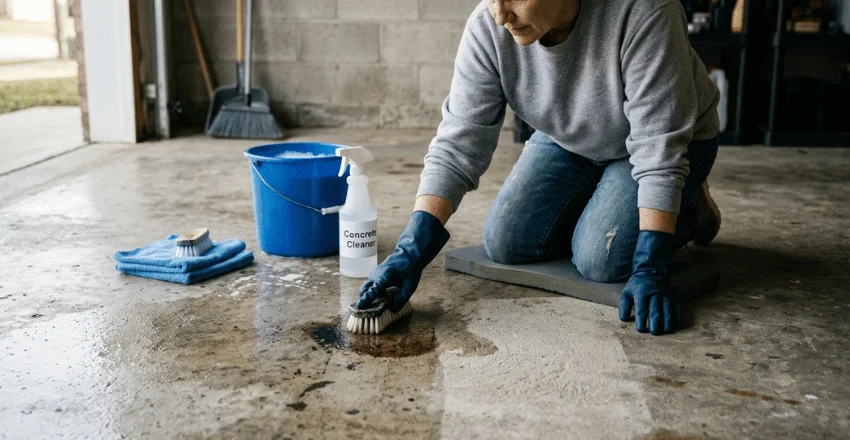
On a bare interior slab, yes. The clean floor you’re standing on is the moment to do it. Sealer keeps oil, salt, and spills sitting on top instead of soaking in. That turns next year’s two-hour wash into a 20-minute one.
Expect 40 to 90 CAD for 4 L of penetrating or acrylic sealer, which covers 20 to 35 m² per coat depending on how thirsty the surface is. The slab has to be genuinely dry, so give it a full 48 hours after washing, and longer if the basement test above showed moisture pushing up. Most sealers recommend reapplying every two to four years, sooner in a bay that sees winter tires.
Key takeaways
- Sealed slabs take pH-neutral cleaner and light water. Bare ones take a degreaser and a proper rinse.
- Sweep and vacuum before anything gets wet, or you make slurry.
- Roughly 60 mL of concentrate per 4 L of warm water is sufficient for a routine wash.
- Wash the winter salt film out each spring with diluted vinegar, on bare surfaces only.
- Below 5 °C, or in humid August basement air, wait for better conditions.
- Seal a dry bare slab and next year’s clean takes a fraction of the time.
Your next step
Pick the nearest dry weekend above 5 °C and block out an afternoon. Start with the bay or room that bothers you most. Do the sealing while the surface is still clean, because you will not want to wash it twice. For more projects in the same weekend-sized shape, browse our other home improvement guides and pick the next one.
FAQs
Twice a year for a garage bay: once after the salt season, once before it. Indoor living space is fine with a monthly damp mop and one deep clean a year.
Diluted vinegar is fine on bare, untreated surfaces and useful against salt deposits. It’s the wrong tool on sealed, stained, or polished floors. Repeated acid exposure dulls the finish, and enough of it will permanently etch the surface.
Warm humid air is condensing on cool masonry, or groundwater is wicking up through the slab. The taped poly square sorts out which. Run a dehumidifier for the first. For the second, seal it and check the grading outside.
You can spot-clean around obstacles, but a full wash requires a clear floor. Anything left in place gets a dirt ring and traps moisture underneath.