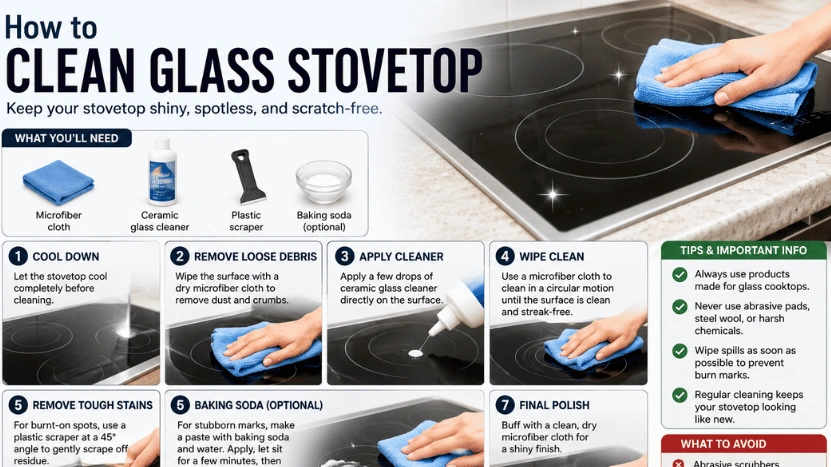
How to clean a glass stovetop A steel razor blade will not scratch a ceramic glass cooktop. A dry scouring pad will. That inversion explains most of what goes wrong when people try to clean glass stovetop surfaces. The routine below takes twenty minutes, mostly waiting. There is more on this in install cabinet handles.
Quick answer: let the cooktop cool, then spray it with white vinegar and sprinkle baking soda over the top. Lay a hot, wrung-out towel across the glass for 15 minutes, then wipe away the softened residue. Lift anything stubborn with a single-edge razor at a 30-degree angle, then buff dry with microfibre.
| What you’re looking at | What it is | What removes it? | When to do it |
| Brown halo around an element | Cooked grease and food film | Vinegar, baking soda, hot towel | Once cool |
| Hard, dark crust | Carbonized food | Cooktop cream, then a razor at 30 degrees | Once cool |
| Chalky white spots that wipe off | Mineral scale from hard water | Undiluted white vinegar, five-minute dwell | Any time |
| Dull haze that will not wipe off | Thousands of micro-scratches | Nothing. The damage is permanent. | Prevent it instead. |
| Sticky sugar or melted plastic | Molten sugar or softened polymer | Scrape it off hot, wearing an oven mitt. | Right away, while hot |
Key Takeaways
- Sugar spills come off while the surface is still hot. Cooled sugar pits the ceramic permanently.
- A single-edge razor at roughly 30 degrees is safe. Tipped up to 60 degrees, it can chip the glass.
- Scouring powder and green abrasive pads leave a haze; no cleaner reverses.
- Chalky white marks are mineral film from hard water, not burnt food. Vinegar clears them; cooktop cream does not.
- Induction uses the same glass but stays cool enough that most spills wipe straight off.
Two Different Messes End Up on the Same Glass
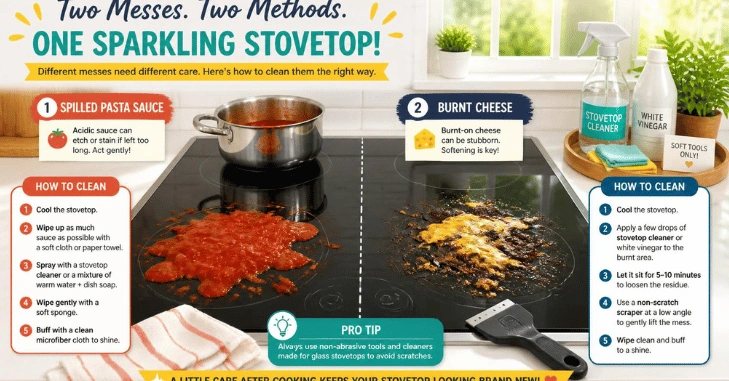
Burnt residue is organic. Sugar, starch, oil, and protein are heated enough to carbonize, and the result sits on the ceramic as a hard brown crust. Alkaline baking soda plus a long damp soak breaks it down.
How to clean a glass stovetop: Mineral film works the other way. Boil-overs and steam leave calcium and magnesium behind, and every drop that dries adds a chalky layer. Acid dissolves it. Cooktop cream can leave you convinced the appliance is ruined, while a splash of vinegar can clear the same marks in a minute.
Tell them apart with a fingernail. Burnt residue has height and catches the nail. Mineral film is flat and feels like nothing at all.
How to Clean a Glass Stovetop
- White vinegar in a spray bottle
- Baking soda
- Two or three microfibre cloths, plus one bath towel
- A cooktop cream such as Cerama Bryte or Weiman, around CA$6.50 for 414 mL at Home Depot Canada
- A single-edge razor scraper, roughly CA$10 to CA$15 on its own
- Or a Cerama Bryte kit at about CA$11, which bundles cream, two pads, and a blade
- An oven mitt for the sugar emergency below
None of this is exotic. Microfiber is the one item worth buying properly, since it lifts residue instead of pushing it around. That is the same reason it turns up in our steps for cleaning hardwood floors without dulling the finish.
How to Clean Glass StovetopRresidue in 7 Steps

Work in order. Steps 4 and 5 do the labor while you get on with something else.
- Let the cooktop cool. Test the back edge with the back of your hand. Cleaner flashes off hot glass and streaks, and a cold cloth on hot glass risks cracking it.
- Sweep off the loose crumbs. A dry paper towel does it. Skip this, and you drag grit under your cloth the whole job.
- Spray the whole surface with undiluted white vinegar. Cover the cool glass edge to edge, not only the rings. This step is also what clears mineral film.
- Sprinkle baking soda in a thin, even layer. Aim for a light dusting rather than a paste. Roughly 30 mL, or two tablespoons, covers a standard four-element surface.
- Lay a hot, wrung-out towel over everything. Run a bath towel under the hottest tap, wring it hard, and drape it flat. Leave it for 15 minutes.
- Wipe in small circles. Start with the damp towel, then switch to a clean microfibre cloth. Most of the brown ring lifts away with it.
- Buff the surface dry. A dry cloth takes off the last of the powder and the streaks. Any pale smear left behind is baking soda, not damage.
The One Time You Should Not Wait For It to Cool
Sugar is the exception, and most cleaning guides bury it. Molten sugar, jam, syrup, and melted plastic bond to the ceramic as they cool. Let them set, and they pit the glass. You replace a pitted cooktop; you do not repair it.
So when a pot of jam boils over, deal with it hot. Turn the element off and pull on an oven mitt. Push the sugar off the hot zone with your scraper straight away. Move it to a cool part of the glass or into the bin, then clean properly later.
A plastic bread bag that touched a live element follows the same rule. Scrape while it is soft, because once it hardens, it takes a piece of the surface with it.
Using a Razor Scraper Without Chipping the Glass
Manufacturers put a single-edge blade in their own kits, so the fear of scratching is misplaced. Angle is what matters. Hold the scraper at about 30 degrees, closer to flat than upright. At that angle, the edge shears under the crust and lifts it clear. Tip the handle toward 60 degrees, and the corner digs in, which is how people chip a cooktop and blame the tool.
Three habits keep it safe:
- Wet the glass first, because a dry blade skips and skids.
- Use a fresh blade. A nicked or rusty edge scores a line you cannot buff out.
- Push one way only. Sawing back and forth grinds loose grit into the ceramic.
Hard Water Film Is a Different Problem
If a chalky bloom returns a day after you clean, your water is doing it. Boiling water spits onto the glass, evaporates, and leaves dissolved calcium behind. Nothing burned, so scrubbing harder achieves nothing.
This is a genuine issue across much of the country, and no American cleaning guide will mention it. Calgary’s own water quality reporting puts hardness between 169 and 212 mg/L depending on which plant serves your side of the city, well inside the hard band. Regina runs near 290 mg/L. Guelph and the Waterloo region climb past 350 mg/L. Ottawa, by contrast, is soft, so two Ontario kitchens can behave nothing alike.
The fix is acid and patience. Spray undiluted white vinegar, leave it five minutes, then wipe and buff dry. Drying is half the job, because every drop left to evaporate rebuilds the film.
When the same bloom shows up weekly on your kettle and shower screen, the cooktop is a side effect rather than the cause. Softening the water at its source is a larger job, and our home improvement projects archive is a sensible place to start reading.
What Never Touches Ceramic Glass
Most permanent damage is not the result of a single dramatic mistake. It is a scouring pad used weekly for a year.
- Scouring powder and green abrasive pads. They cut thousands of micro-scratches. Light hits each one and scatters, which your eye reads as a dull grey haze. No product on the shelf reverses it.
- Ammonia glass cleaner. It streaks on warm glass and does nothing for burnt residue.
- Bleach. It can discolour the markings on the printed element.
- Steel wool and melamine sponges. Abrasives wearing a friendlier name.
- A cold, wet cloth on hot glass. Thermal shock can crack the surface outright.
- Cast iron dragged rather than lifted. Rough casting sand scores the glass in one push.
Radiant Ceramic and Induction Are Not the Same Job
Both have a smooth glass-ceramic top, which is why readers mix them up. The difference is where the heat goes. A radiant element heats the glass, which in turn heats the pan, so the surface around the pot stays hot. Induction heats the pan directly, and the glass only picks up warmth from the base.
| Behavior | Radiant ceramic | Induction |
| Surface heat while cooking | Very hot across the whole ring | Warm only under the pan |
| Do spills bake on? | Yes, and quickly | Rarely; most wipe off. |
| Sugar boil-over | Scrape it hot, real pitting risk | Wipe once, cool, low risk. |
| Razor scraper | Often needed | Seldom needed |
| Cool-down wait | 20 to 30 minutes | A few minutes |
| Hard water film | Same problem | Same problem |
Every abrasive rule applies to both. The glass is identical, so a scouring pad hazes an induction cooktop just as fast. Induction only spares you the scraping.
A Rhythm That Keeps It Easy

Deep cleans take less time when the daily habit is right. Once the surface cools each evening, wipe it with a damp microfibre cloth and dry it. Thirty seconds, and the film goes before it bakes.
Run the vinegar routine above weekly. Monthly, add a cooktop cream and buff it out, leaving a polish that stops the next boil-over gripping.
If the kitchen is on your list this season, the rest of our home cleaning and repair how-tos cover the surfaces around it.
Conclusion
Knowing how to clean a glass stovetop properly is less about scrubbing harder and more about identifying the type of residue you are dealing with. Burnt food, mineral deposits, baking-soda residue, and melted sugar each require a different approach. For everyday buildup, let the surface cool, use white vinegar and baking soda, apply a warm towel, and finish with a microfibre cloth to restore a clean, streak-free appearance.
For stubborn burnt-on food, a dedicated cooktop cleaner and a fresh single-edge razor scraper can help when used carefully at a low angle. However, sugary spills and melted plastic should be addressed while they are still hot, following the appliance manufacturer’s guidance. Most importantly, avoid steel wool, abrasive pads, harsh powders, and dragging rough cookware across the surface, as scratches and haze may be permanent.
Frequently Asked Questions
For weekly work, white vinegar and baking soda under a hot towel. For a stubborn crust, a dedicated cooktop cream such as Cerama Bryte. The short version of how to clean glass stovetop residue is vinegar and baking soda, given dwell time under heat.
Yes, and appliance makers ship one in their own kits. Keep the blade fresh and wet the glass, then hold it at about 30 degrees. Steep angles and dry glass cause the chips people blame on the blade.
Two causes. A layer that wipes off is mineral film or leftover baking soda, so vinegar and a dry buff clear it. Cloudiness that never shifts is micro-scratching from abrasives, and it is permanent.
Not when wet and used as a thin slurry, as the routine above does. Rubbed on dry, it behaves like any other powder abrasive. Keep it damp.
Wipe it down after cooking, deep clean weekly, and polish monthly. Sugary spills are the exception and get dealt with immediately, while hot.