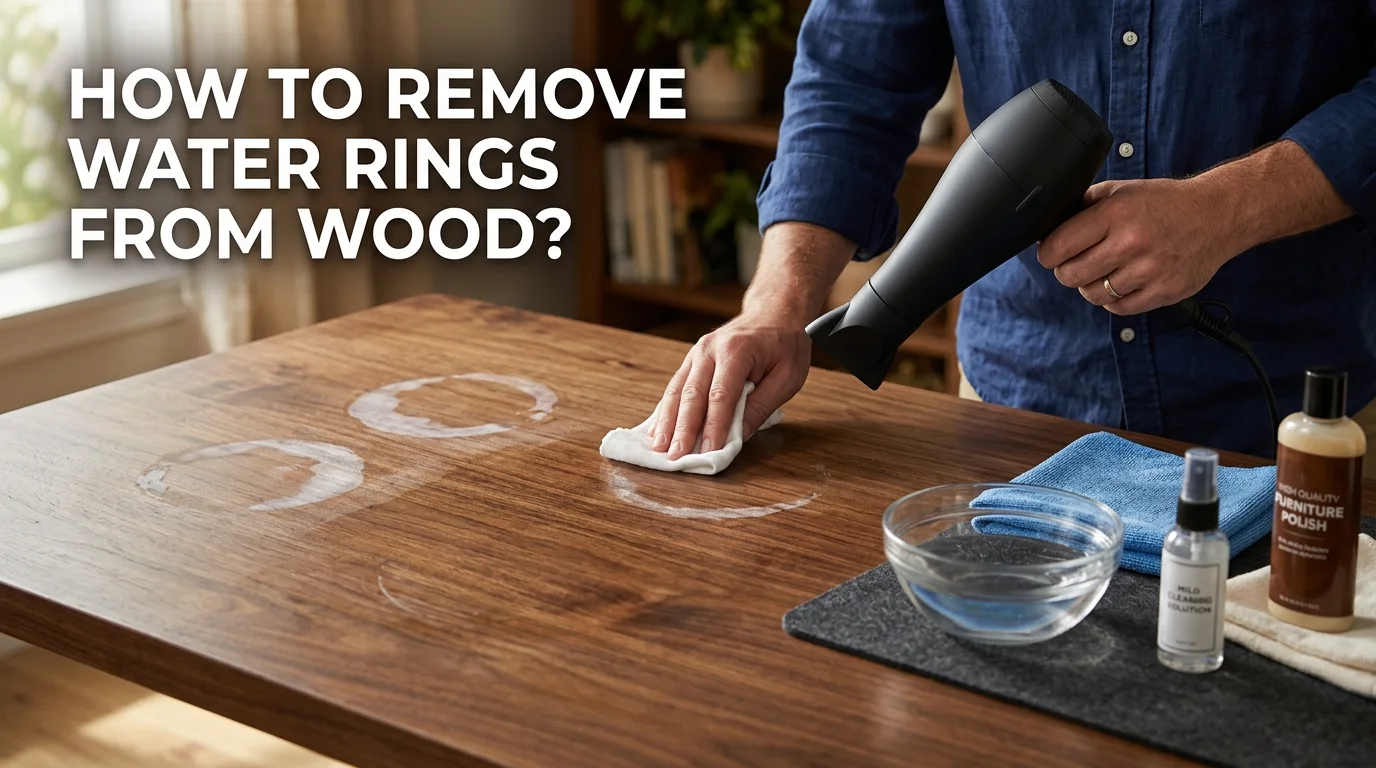
Most white rings are trapped moisture sitting inside the finish, not damage to the wood underneath. That one fact decides whether your repair takes ten minutes or a weekend. Knowing how to remove water rings from wood starts with the colour of the mark, since a milky ring and a black one are separate problems.
The Short Answer
Start by naming the mark. A white or cloudy ring is moisture trapped inside the finish, and gentle heat or an oil poultice usually lifts it within an hour. A dark brown or black ring means water reached the wood itself, so the repair means sanding, bleaching, or refinishing that spot.
TL;DR: Key Takeaways
- White or cloudy means finish damage. Fixable at home, usually in under an hour.
- Dark or black means wood damage. The tannins have reacted with iron and water, and no oil or heat trick reaches that deep.
- Your finish sets your method. Heat blooms some lacquers, alcohol dissolves shellac, and abrasives flatten a satin sheen.
- Work up the ladder, never down. Start with dry heat, finish with abrasives, and test on a hidden edge every time.
- Budget under CA$25 for supplies on a white ring, and expect refinishing quotes in the hundreds for a dark one.
First, Read the Mark
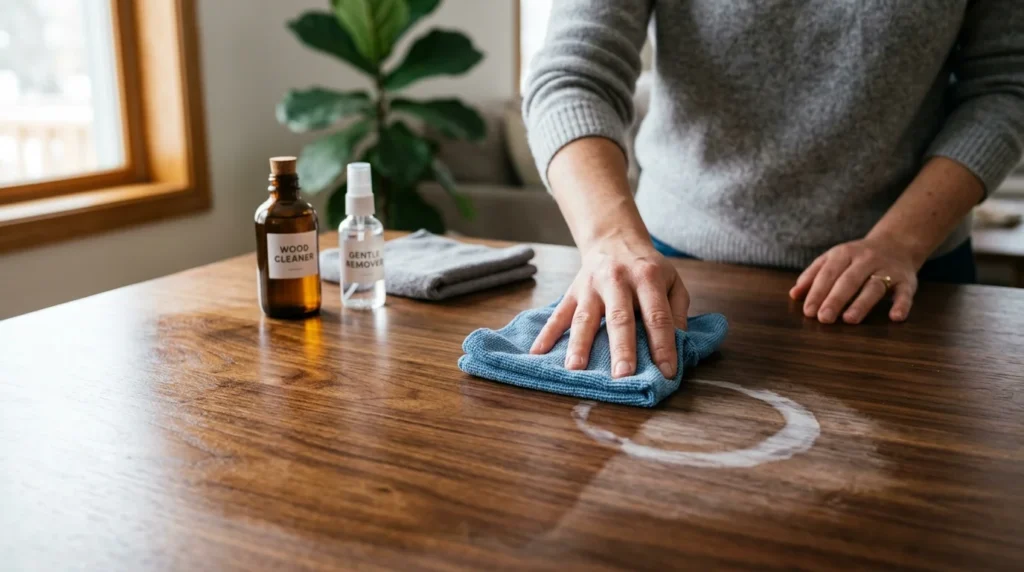
Pull a lamp low and sideways so the light rakes across the surface. Raking light shows depth, and depth is what separates a surface haze from a stain down in the grain. Then run a fingernail across the edge of the ring. A mark you can feel as a ridge or a dip has lifted the finish, which rules out the abrasive fixes below.
| What you see | What happened | Where the moisture sits | Realistic outcome |
|---|---|---|---|
| Milky white or cloudy ring | Damp air got trapped as the finish cooled | Inside the finish layer only | Usually gone within an hour |
| Grey or bluish haze | Trapped damp plus early finish breakdown | Finish, plus the top of the grain | Fixable, often needs polishing after |
| Dark brown or black ring | Water reached the wood and reacted with its tannins | Down in the wood fibres | Sanding, bleaching or a refinisher |
| Rough, lifted, or bubbled patch | Veneer or the glue under it swelled | Below the finish | Glue-and-clamp repair, or professional help |
One more test settles borderline cases. Dab mineral oil on the mark with a cotton swab. If the haze vanishes while the oil sits there and returns as it dries, a white-ring method will work.
Where the mark landed matters too.
A ring on a plank floor under a plant pot reads the same way as one on a table. The aftercare differs, though, and weekly upkeep belongs in our guide to safely cleaning hardwood floors. On furniture, you can work one small patch. On a floor, you have to blend the repair into a much larger sheet of finish. How to Build a Bookshelf is a useful companion read here.
What You’ll Need
- Two soft cotton cloths, ideally an old pillowcase or a plain tea towel
- A hairdryer, or a dry iron with the steam switched off
- Petroleum jelly or full-fat mayonnaise, roughly CA$5 a tub at any grocery store
- Mineral oil or a bottle of furniture oil, about CA$10 to CA$14
- 0000 steel wool, sold in 16-packs at Canadian Tire for around CA$10
- Paste wax to restore the sheen afterwards, CA$15 to CA$20
- Methyl hydrate, about CA$12 a litre, only if you have confirmed a shellac finish
That last item deserves a note. American guides all reach for denatured alcohol, which is awkward to buy here. Canadian hardware and paint aisles stock methyl hydrate instead, and it does the same job on shellac. Wear gloves, open a window, and keep the bottle away from any heat source.
How to Remove Water Rings From Wood, Step by Step
- Clear the surface and wipe it with a barely damp cloth, then dry it fully.
- Identify the mark under raking light using the table above.
- Test your chosen method on a hidden edge, such as the underside of a leaf or the back of a leg.
- Aim a hairdryer on low at the haze from about 15 cm away, moving constantly for five to ten minutes.
- Iron through a folded cotton cloth for 3 seconds at a time; if the haze persists, check after each pass.
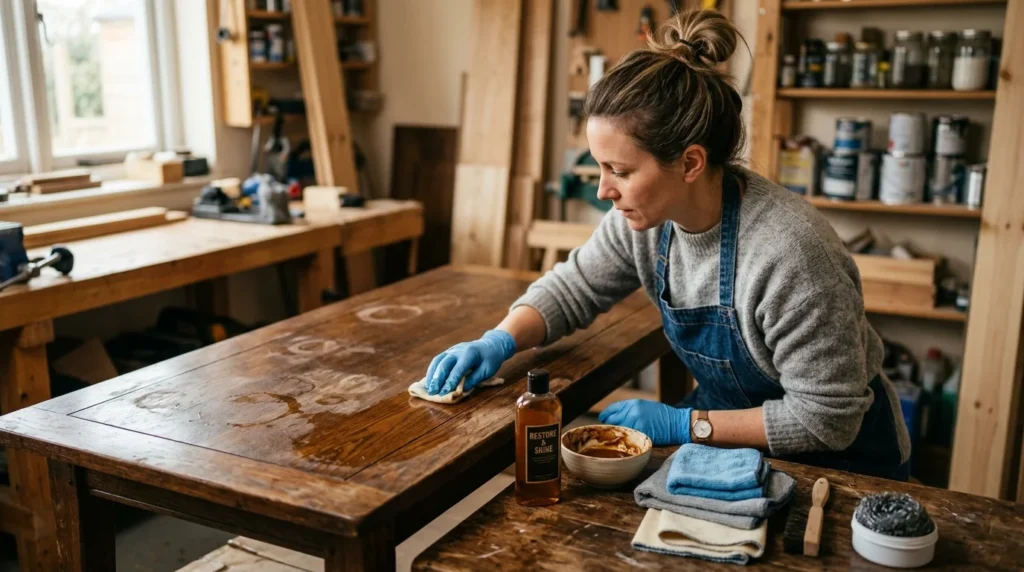
- Spread an oil poultice over the ring and leave it overnight when the surface is waxed or oiled rather than varnished.
- Rub with 0000 steel wool, dipped in mineral oil, along the grain, using almost no pressure, as a last resort.
- Rewax the patch and buff the whole panel so the repaired area matches its surroundings.
Do not skip the third step. Every method below carries some risk to some finish, and the underside of a table leaf is where you find out the cheap way.
The Ladder, Gentlest to Most Invasive
| Fix | Time | Suits | Main risk | Cost |
|---|---|---|---|---|
| Hairdryer on low | 5 to 15 min | Polyurethane, varnish, most lacquer | Very low | Free |
| Iron through cotton | 1 to 3 min | Polyurethane and varnish | Blooms lacquer, melts wax | Free |
| Oil poultice | 8 to 12 hours | Wax and oil finishes | Softens a wax coat | About CA$5 |
| Baking soda paste | 2 to 5 min | Gloss polyurethane | Dulls a satin sheen | About CA$3 |
| 0000 steel wool and oil | 5 min | Satin polyurethane, varnish | Leaves a fine scratch pattern | About CA$10 |
| Methyl hydrate wipe | Under a minute | Shellac only | Dissolves the finish if you linger | About CA$12 |
| Oxalic acid bleach | 1 to 2 days | Bare wood, dark stains | Needs rinsing and neutralizing | CA$15 to CA$25 |
What the Famous Tricks Actually Do
Iron and cloth. Heat drives the trapped damp back out through the finish, and on a modern polyurethane table it works in seconds. It is also the method most likely to ruin something. Lacquer can bloom to a permanent white fog, wax melts and prints the cloth weave into the surface, and shellac softens instantly. Three seconds per pass, lowest setting, steam off.
Mayonnaise and petroleum jelly. The oil creeps into the micro-gaps where the moisture sits and displaces it, which is why both work and why neither works quickly. Give either one a full night. They suit antique wax and oil finishes, exactly the pieces you should never iron. Mayonnaise adds nothing petroleum jelly lacks, and it goes rancid in a warm room.
Toothpaste and baking soda. These are abrasives, not solvents. They cut the top few microns of finish away along with the haze, so a shinier patch appears where you rubbed. On gloss, that blends in. On satin or matte, you have swapped a cloudy patch for a glossy one, and the second mark is harder to hide.
Vinegar mixed with oil. Popular, harmless, and largely pointless. Acid on an already stressed finish is a poor idea on anything old, and the oil half is the part doing the work. Use the oil alone.
Dark Rings: When the Water Got Into the Wood
A black ring is a chemical reaction, not a coating problem. Water carries iron from a can, a nail, or the water supply into oak, walnut, or cherry, and the tannins in those species turn it dark. Heat cannot reverse it. Oil cannot reach it. The colour lives in the fibre.
Strip the finish over the stain, sand back to bare wood with 150-grit, then brush on an oxalic acid solution and let it dry. The colour lightens as the crystals form. Rinse the area, neutralize it with a weak baking soda wash, dry it for a day, then sand it with 220-grit before refinishing. Expect the patch to take stain a little differently from the surrounding wood.
Sometimes the sanding leaves a shallow dip or opens grain that will not close again. That is a filling job, not a finishing job, and the choice of product matters more than people expect. Compare the options in our guide to choosing a wood filler that takes stain before you buy.
The Stop Rule: When to Quit and Pay a Refinisher
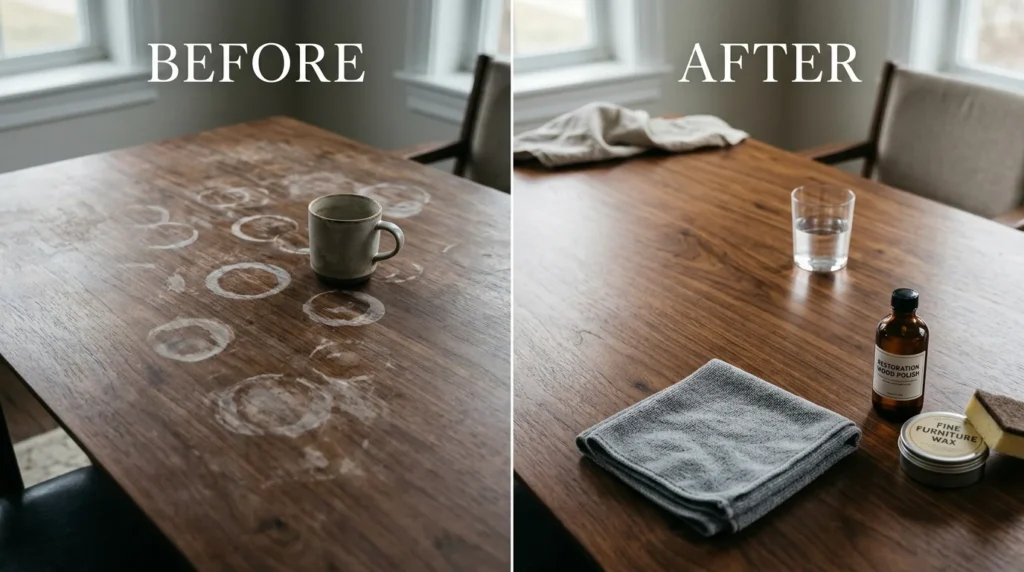
Nobody writing about this topic gives you a stop rule, so here is one. Each extra attempt costs you more than the repair is worth once the finish starts fighting back. Quit escalating at any of these:
- The piece is veneered, and the surface has lifted or bubbled.
- You cannot identify the finish, and the hidden-edge test softened it.
- The mark is on an antique with original shellac or French polish.
- Two methods have failed, and a dull halo now surrounds the ring.
A refinisher will usually quote CA$150 to CA$300 to spot-repair a single ring. Stripping and refinishing a full dining table costs between CA$400 and CA$1,000. On a piece you actually care about, that first number beats a fourth failed attempt.
Keeping New Marks Off
Canadian homes make this worse than the American guides assume. Forced-air heat can drop indoor humidity below 20 per cent by January, which shrinks a tabletop and opens hairline gaps in the finish. Then July arrives, a cold glass sweats for an hour, and the damp goes straight in.
Coasters help, but felt-backed ones trap condensation against the surface instead of the glass. Cork or hard plastic sheds it better.
Wipe spills within a few minutes rather than at the end of the evening. Keep a humidifier running through the cold months. Refresh the paste wax on solid-wood furniture twice a year, since a waxed surface beads water long enough for you to notice.
Your Next Move
Take thirty seconds with a lamp before you take anything else to the surface. Read the colour, feel the edge, test on a hidden spot, then start at the gentlest rung of the ladder. That order protects the finish you still have. When this job is sorted, our home improvement repair guides cover whatever is next on the list.
Frequently Asked Questions
White ones do, once the trapped damp has left the finish, and they do not reappear unless new moisture gets in. Dark ones come out only when the stained fibre is removed or bleached.
Yes, on white marks in wax or oil finishes, given eight hours or more. Petroleum jelly does the same job without the smell.
Often. A mark less than a day old sometimes clears in a week in a dry room. Leave it alone before you reach for anything abrasive.
Almost always, if it is white, every guide on how to remove water rings from wood pushes sanding too early, and heat plus oil resolves the large majority of these marks.
Heat pulled moisture toward the surface without releasing it all. Repeat the hairdryer step for longer, then wax the area to seal it.
Not really. It cleans the surface, and any improvement comes from the oil it is usually mixed with.