Look under any sink in your home, and you will find a curved section of pipe holding a small pool of water. That pool is all that separates your kitchen from the drain system below it. That curve is a P-trap, written as P-trap almost everywhere else on this page. Lose the water and the room starts to smell like a sewer.
Quick answer: The P-trap is the U-shaped bend in a drain line that holds a small volume of standing water. That water seal blocks sewer gas from rising into the room, while waste still flows through freely. Canadian plumbing codes require a trap on nearly every fixture, and the seal has to be at least 38 mm deep.
Key takeaways
- The bend holds a water seal, and Canadian plumbing codes set the minimum depth of that seal at 38 mm.
- Sink traps come in two nominal sizes: 1-1/4-inch, labelled 32 mm, and 1-1/2-inch, labelled 38 mm.
- Most smells from a spare bathroom or a basement floor drain trace back to one dry bend.
- Replacement parts run roughly CA$8 to CA$60 depending on the material you choose.
- An S-trap siphons itself empty, no longer meets code, and deserves to be replaced when you find one.
The fitting at a glance
| Detail | What Canadian homeowners need to know |
|---|---|
| Also called | Sink trap, drain trap, J-bend, water trap |
| Job | Holds a water seal that blocks sewer gas |
| Where you find it | Sinks, tubs, showers, laundry standpipes, floor drains |
| Common sizes | 32 mm (1-1/4-inch) bathroom, 38 mm (1-1/2-inch) kitchen and tub |
| Minimum seal depth | 38 mm under Canadian plumbing codes |
| Usual materials | Polypropylene, ABS, PVC, chrome-plated brass |
| Typical part cost | CA$8 to CA$60 |
| Most common fault | An empty seal, then a leaking slip-joint washer |
How the water seal actually works
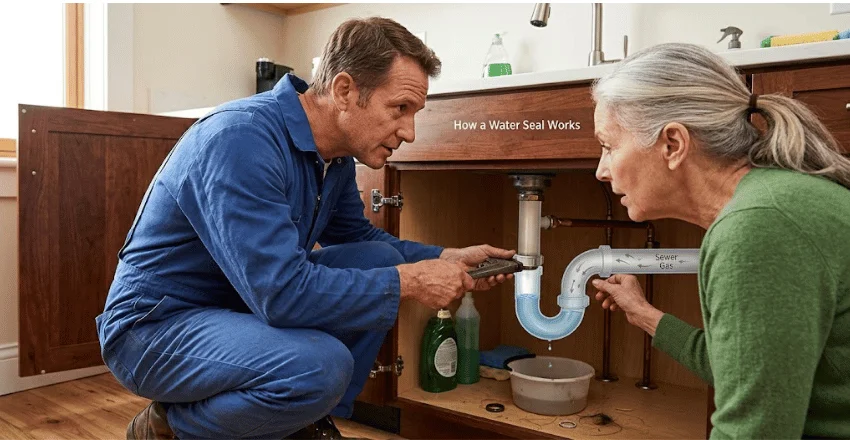
Water runs down the tailpiece, through the bend, and out along the trap arm into the branch drain. Gravity does the rest. When the faucet shuts off, the low point stays full, and that plug of water is the seal.
Sewer gas sits under slight pressure on the far side. It cannot push through standing water, so it stops at the bend and vents through the roof stack instead. Each time you use the fixture, fresh water pushes the old seal over the weir.
The bend does a second job nobody designs for: it catches things. Wedding rings, contact lenses, and a decade of hair all settle in the same low spot. Grease and mineral scale collect there too, and in hard-water regions, that scale slowly narrows the passage. If your water leaves white crust on the faucet, the same buildup is forming out of sight. It is worth knowing what a water softener system costs before you fight slow drainage every spring.
The parts of a P-trap, named
Naming the pieces makes ordering a replacement far easier. Most kits sold in Canada use the same parts, and here is what each one is called.
- Tailpiece: the straight tube dropping from the sink strainer or the pop-up drain body.
- J-bend: the U itself, which holds the water seal.
- Trap arm: the horizontal run from the bend to the wall fitting, which needs a slight fall.
- Slip nuts and washers: the plastic or brass rings clamping each joint, and the first suspects behind a drip.
- Cleanout plug: a threaded cap under some bends, so you can empty one without taking the assembly apart.
Sizes, materials, and what a replacement costs in Canada
Two nominal sizes cover almost every house. Bathroom sinks take a 1-1/4-inch trap, printed as 32 mm on metric packaging. Kitchen sinks, laundry tubs and bathtubs take a 1-1/2-inch trap, printed as 38 mm. Canadian shelves carry both labels, sometimes on one box, so buyers should read the millimetre figure and skip the inch argument entirely. Two sizes. That really is the whole story for household sinks.
Measure the tailpiece diameter and the distance from the drain outlet to the wall stub before you leave the house. Thirty seconds with a tape beats a second trip across town. Our guide to reading a measuring tape properly covers the fractions people misread on the imperial edge.
| Material | Best suited to | Typical price (CAD) | Worth knowing |
|---|---|---|---|
| Polypropylene | Most hidden sink installs | CA$8 to CA$18 | Hand-tight joints, easy to remove |
| ABS | Matching existing black Canadian drain lines | CA$12 to CA$25 | Rigid, often solvent welded |
| PVC | General replacement work | CA$10 to CA$20 | Widely stocked, fine on any fixture |
| Chrome-plated brass | Exposed pedestal sinks | CA$25 to CA$60 | Looks right on show; thin walls corrode |
Home Depot Canada, RONA, Home Hardware, and Canadian Tire all stock the common sizes, so prices across those retailers stay close. Labour is the real cost. Expect a licensed plumber’s minimum call-out to be closer to CA$120-CA$250 in most cities. Swapping a slip-joint assembly takes about twenty minutes, so the part is rarely the expensive half of the job.
P Trap vs S Trap: Why the S Version Fails Today
The difference between the two is the direction of the outlet. A P-trap turns sideways into a vented branch. An S-trap drops straight down, and that vertical drop causes the trouble.
Empty a full sink into an S-trap, and a falling column of water forms. The column pulls the seal out behind it, the bend runs dry, and gas follows within minutes. Codes across Canada stopped permitting the arrangement in new work decades ago, though older houses and cottage renovations still hide plenty of them.
Found one under a vanity? The proper repair ties a P-trap into a vent. Where opening the wall is impractical, some provinces allow an air admittance valve; ask your municipal building department first.
Five ways a trap seal disappears
Most guides say the trap dried out and stop there. Five separate mechanisms empty a bend, and the fix depends on which one you have.
- Evaporation. A fixture nobody uses loses water to the air. Dry winter heating speeds that up, and a guest bathroom can empty in a month.
- Self-siphonage. The fixture’s own discharge drags the seal out with it, which is the classic S-trap failure.
- Back pressure. Water falling down a stack compresses air below it and blows the seal into the room, usually with a gurgle.
- Capillary action. A strand of hair or a rag draped over the weir wicks water out one drop at a time.
- Wind effect. Gusts across a roof vent create suction that tugs at seals on the top storey.
Basement and garage floor drains are the ones that catch Canadian homeowners out. Nothing sends water down them for months, so the seal quietly evaporates and the basement starts to smell. According to a 2023 plumbing bulletin from Alberta Municipal Affairs, provisions must be made for maintaining the trap seal of a floor drain. The province accepts an automatic trap seal primer or a device certified to ASSE 1072 as acceptable methods.
Fixing a smelly or dry bend
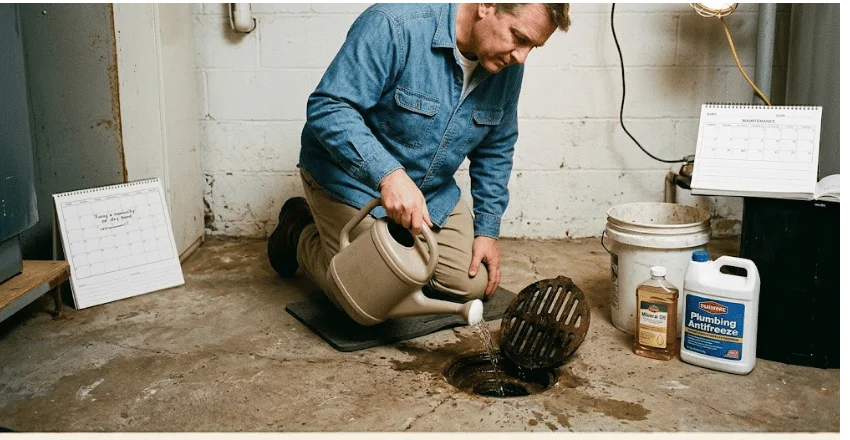
- Run the fixture for thirty seconds. A seal that was merely low refills itself, and the odour clears within the hour.
- Pour about 2 litres of water slowly into a floor drain so the bend fills rather than splashing through.
- Float a capful of mineral oil on top. Oil sits above the water, slowing evaporation for months in a drain nobody uses.
- Closing a cottage for the winter? Use non-toxic plumbing antifreeze instead, because an unheated bend can freeze and split.
- Still smelling gas the next day? Look past the seal, at the joints, the vent stack, and the toilet’s wax ring.
Memory fails at this. A maintenance schedule does not. Set an interval of three to four weeks. On that day, run every guest bathroom fixture briefly, then tip 2 litres of water into each basement and garage floor drain. Unheated cottages and seasonal properties need the same treatment before a long winter absence, since nobody is there to notice the smell.
Cleaning the bend without wrecking it
Slow drainage in a kitchen usually means grease and scale inside the bend, not a blockage further down the line. Clearing it takes a bucket, pliers, and ten minutes.
Slide the bucket underneath first. Loosen both slip nuts by hand, lift the J-bend clear, and tip the contents out. Scrub the walls with a bottle brush and hot soapy water. Skip caustic drain cleaner, which pools in the bend and waits there for your hands.
Reassemble by hand, then give each nut a quarter turn with the pliers. Run water for a minute and watch every joint. While the cabinet is empty, deal with the fixture above. One quick routine for keeping a stainless steel sink spotless beats restoring a neglected one later.
When to call a licensed plumber
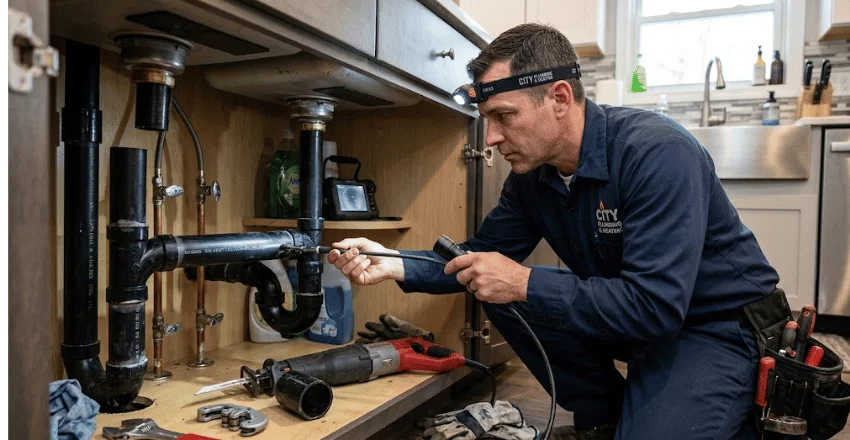
Swapping a slip-joint assembly is homeowner work. Three situations are not.
- Solvent-welded ABS with no union nearby, which means cutting the branch drain.
- A missing or blocked vent, since that is a system fault and a permit question.
- Sewer gas you can smell while every seal is full, which points to a cracked line.
Persistent sewer gas is a health matter rather than a nuisance. Anyone getting headaches, nausea, or eye irritation should open windows, leave the area, and have the drainage system inspected by a professional. Do not wait it out.
Your next step
Give this five minutes tonight. Open the cabinet under each sink, check the slip nuts for drips, and pour a couple of litres into each basement floor drain. Set a four-week reminder on your phone. That habit costs nothing and prevents the very problem a P-trap is meant to prevent.
Frequently asked questions
It is the curved fitting under a drain that holds a small pool of water. Every fixture needs one because that pool is the only barrier between your living space and the drainage system. Take it away, and the room connects directly to the sewer.
Yes, if the joints are slip nuts rather than glued fittings. Buy a kit in the matching size, tighten by hand, then finish with a quarter turn with pliers.
Every three to four weeks in a heated house. Dry furnace air pulls water out of the bend faster than people expect, and a basement floor drain goes first.
Gurgling means air is dragging through the seal, and that almost always points to a vent problem. Blame a partly blocked vent stack or a missing air admittance valve.
They do. Laundry standpipes carry their own trap behind the wall, and floor drains have one cast into the body, which is exactly why they go dry so often.