


Walk through any new subdivision, and you will see coils of red and blue tubing where copper used to run. PEX pipe is now the default supply line for most new builds and renovations in Canada. It costs less, goes in faster, and tolerates a cold basement better than rigid metal. It also has limits that the sales counter rarely mentions.
What is PEX pipe, exactly?
PEX is crosslinked polyethylene tubing used for hot and cold water supply lines. Heat, pressure, or radiation locks its molecular chains together, making it flexible and unusually quiet. In Canadian homes, it runs from a manifold or a trunk line out to each fixture, joined with crimp, clamp, expansion, or push-fit fittings.
| Detail | What to expect in a Canadian home |
|---|---|
| Material | Crosslinked polyethylene, sold in coils and straight lengths |
| Common sizes | 1/2-inch branches, 3/4-inch trunk lines, 3/8-inch fixture drops |
| Outside diameter | About 16 mm for the 1/2-inch size, about 22 mm for 3/4-inch |
| Pressure rating | 690 kPa at 82 °C, and 1105 kPa at 23 °C, under CSA B137.5 |
| Colour coding | Red for hot, blue for cold, white for either |
| Material cost | Roughly CA$1.25 per metre in the 1/2-inch size |
| Service life | Warranties often run 25 years, with 40 to 50 years expected |
| Weak point | Sunlight, rodents, and the fittings rather than the tubing |
Key takeaways
- Type B is the practical default here, and every big Canadian retailer stocks it.
- Look for a CSA B137.5 mark printed along the tubing before you buy anything.
- It survives freezing better than copper, but the joints still split.
- Budget about CA$1.25 per metre for 1/2-inch material at Home Depot Canada.
- Keep it out of daylight, off the water heater nipples, and out of exposed outdoor runs.
PEX-A, PEX-B and PEX-C: what actually differs
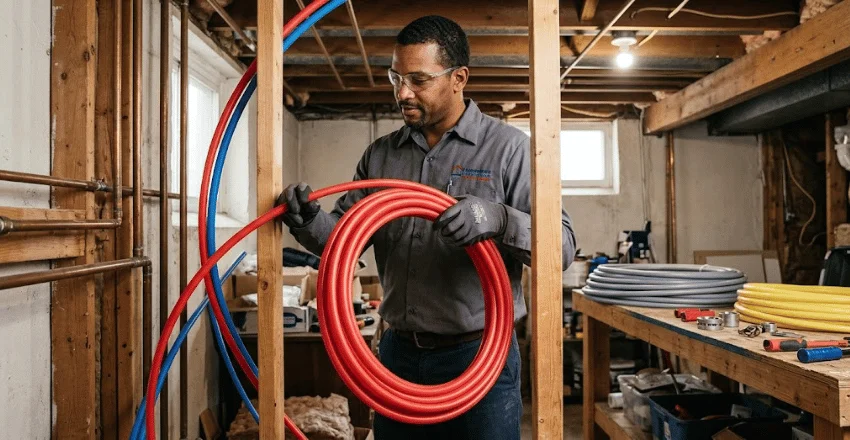
All three start as the same polyethylene. What changes is how and when the chains get linked.
Type A uses a peroxide process during extrusion. Type B uses a silane moisture cure afterwards, and Type C uses electron beam irradiation. Marketing makes that gap sound enormous. In a house, it is small.
| Type | Crosslinking | Handling | Usual fittings | Best fit |
|---|---|---|---|---|
| Type A | Peroxide (Engel) | Most flexible, and a kink relaxes out with a heat gun | Cold expansion, crimp, push-fit | Tight retrofits and long pulls |
| Type B | Silane moisture cure | Stiffer, holds its shape, slightly better chlorine numbers | Crimp, clamp, push-fit | Most Canadian homes |
| Type C | Electron beam | Stiffest of the three, kinks are permanent | Crimp and clamp | Short runs and budget jobs |
Our recommendation for a typical house is Type B. It is stocked at every Home Hardware and RONA; the crimp tool is cheap, and its chlorine resistance rating is competitive. Choose Type A when you are fishing tubing through finished walls, because the extra flexibility saves real time.
Is it certified for drinking water in Canada?
Yes, when it carries the right mark.
Plumbing work here follows the National Plumbing Code of Canada 2020, published by the National Research Council of Canada. That edition sets the technical requirements for new plumbing systems and incorporates over 50 technical changes. Provinces adopt it outright or with amendments, so your local inspector has the last word.
Certification is the part homeowners skip. Tubing meant for potable water in Canada carries CSA B137.5, the crosslinked polyethylene standard whose 2020 edition sets a maximum working pressure of 690 kPa at 82 °C. That mark, the size, the type, and a chlorine class all print along the outside of the coil. Read the print line at the store, not after the drywall goes back up.
What it costs in Canada
Prices we checked at Home Depot Canada put a 30 m coil of 1/2-inch Type B at CA$37.95. The same length in 3/4-inch was CA$64.98. That works out to near CA$1.25 and CA$2.15 per metre.
Fittings are the quiet expense. Crimp rings run a few cents each, while push-fit couplings can cost CA$10 or more per joint.
Measure before you buy, because coils come in fixed lengths and offcuts add up fast. Run a string along the actual route, include every vertical rise, then add ten percent. Our guide to reading a measuring tape accurately covers the fraction marks that trip people up on plumbing layouts.
Does it burst when it freezes?
Water expands by roughly 9% as it turns to ice. Copper has almost no give and splits along the seam. This tubing stretches instead, and a straight run will often take one freeze-and-recover.
Freeze-proof is a different claim, and it is false. The brass and copper fittings at every joint do not stretch, so a frozen line usually lets go there. Repeated freeze cycles also fatigue the wall. Insulate anything in a rim joist or crawl space, keep runs on the warm side of the insulation, and drain outdoor hose bibbs before the first hard frost. When the forecast hits -30 °C, a trickle at the far faucet is cheap insurance.
Fittings and tools that actually join it
- Copper crimp rings. The cheapest reliable joint. A crimp tool and a go/no-go gauge cost under CA$120.
- Stainless cinch clamps. Easier in tight bays, since the pincer tool works from one side.
- Cold expansion. Uponor ProPEX and similar systems suit Type A. Strong joints, pricier tool.
- Push-fit couplings. No tool at all, so they earn their keep on repairs rather than whole rough-ins.
Availability follows the fitting system. Crimp, clamp, and push-fit parts sit on the shelf at Home Depot Canada, RONA, and Home Hardware. Expansion systems from Uponor and Canadian-made tubing from IPEX usually come through a plumbing supply house such as Wolseley. Buy the tool and the rings from one brand family and stop there.
Water quality, chlorine and service life

Chlorine ages this material from the inside, and heat speeds that up. Every coil prints a chlorine class, so pick the highest one your supplier stocks if you are on treated municipal water. A recirculating hot loop running flat out is the harshest case a home can create.
Hard water is a separate problem that hits the fittings and the water heater rather than the tubing. If you are already opening walls, price the treatment side at the same time, since what a water softener system costs is often a fraction of the repipe. Expect 40 to 50 years of service under normal conditions, with manufacturer warranties commonly limited to 25 years.
Places to avoid: where not to use it
- Outdoors where it sits exposed, or anywhere daylight lands on it for weeks. Sunlight degrades it, and the print line states the exposure limit.
- The first 450 mm off a water heater, where metal transition pieces belong.
- Beside recessed lights, flue pipes, or a chimney chase.
- Unsleeved crawl spaces with mouse activity, because rodents chew it.
- Any job your province requires a licensed plumber to certify.
Repiping from copper or galvanized steel
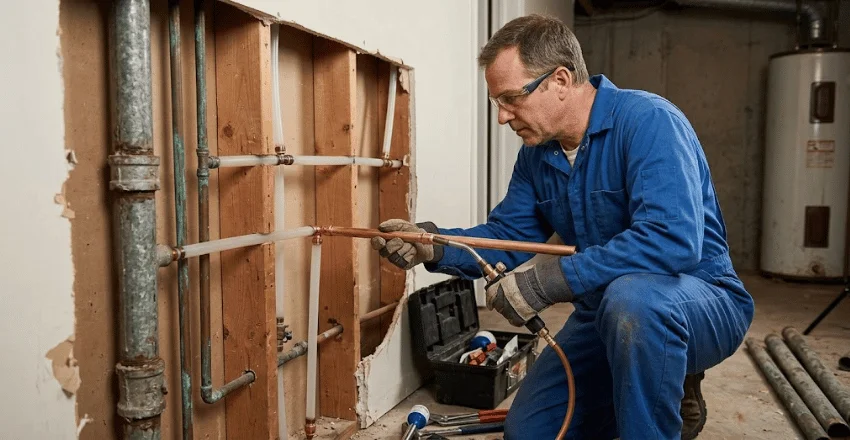
Most Canadian repipes replace 1960s galvanized steel or thin copper that has started weeping at the joints. Quotes we reviewed ran from about CA$3,500 for a small condo to CA$20,000 or more for a large two-storey house. Materials are the small share of that. Labour, access, and drywall repair carry the bill.
While the old lines are out, sort the hardware you plan to reuse. Hangers and valve bodies come out grimy, and removing rust from metal brackets before reinstalling them saves a callback. Leave the old copper stub at the water heater in place unless your plumber says otherwise.
Your next step
Measure your longest run this weekend, then price a 30 m coil and a crimp kit at your nearest Home Depot Canada or Home Hardware. Book a licensed plumber for the water heater connection and the pressure test.
Keep the offcut with the print line on it. Your inspector and the next owner will want to read it.
PEX pipe FAQ
Certified tubing is. Look for the CSA B137.5 mark and a potable water designation on the print line. New coils can give the first few litres a plastic taste, so flush the system well before anyone drinks from it.
Not exposed. Sunlight breaks it down, and the coil states its exposure limit in days. Buried service lines need tubing rated for that use, along with proper bedding and burial depth below your local frost line.
Type B for most projects, on price and availability. Type A earns the premium when you are threading long runs through finished walls, or when a kink needs to be heated out rather than cut out.
Yes. Transition fittings with a threaded or sweat end handle it cleanly. Keep the metal section at the water heater, and support both sides so the joint carries no weight.
Plan on 40 to 50 years in normal municipal water, with 25-year warranties common. Water chemistry and daylight exposure move that number more than the brand does.

![How to Use a Stud Finder: 7 Accurate Steps [2026]](https://homecraftly.ca/wp-content/uploads/2026/08/How-to-Use-a-Stud-Finder.webp)