You want a bike rack on the basement wall, and the tool already in your garage might be the wrong one. That is the whole problem. Three tools sit side by side at Home Depot Canada, looking nearly identical. Only one of them puts an anchor into poured concrete without a fight.
Short answer: A hammer drill spins a bit while tapping it forward thousands of times a minute, chipping masonry as it turns. That makes it right for concrete block, brick, and light poured concrete. An impact driver hammers sideways to drive screws and cannot bore masonry at all. For deep or repeated holes, rent a rotary hammer.
Three tools, three jobs
| Tool | How it makes the hole | Where it wins | Canadian price, 2026 |
|---|---|---|---|
| Cordless drill/driver | Rotation only | Wood, metal, drywall, screws | CA$100 to CA$180 kit |
| Hammer drill | Rotation plus a rapid forward tap, rated in blows per minute | Block, brick, mortar, occasional poured concrete up to 1/2-inch | CA$70 corded, CA$128 to CA$428 cordless |
| Impact driver | Rotation plus sideways hammer blows on the shaft | Long screws, lag bolts, deck framing | CA$120 to CA$250 |
| Rotary hammer, SDS-plus | A piston fires the bit like a small jackhammer | Poured concrete, holes over 16 mm, volume work | CA$150 to CA$600, or about CA$60 a day to rent |
TL;DR
- Rotation alone will not cut cured concrete at any useful speed. You need percussion.
- An impact driver’s blows go around the shaft, not down it, so it drives fasteners and never bores masonry.
- Concrete block, mortar joints and brick veneer give way to a percussion drill happily. Poured concrete is where it starts to struggle.
- Past roughly a dozen holes, or anything wider than 16 mm, an SDS-plus rotary hammer is the honest answer. Renting one beats buying for a single weekend.
- Your battery platform decides which Canadian retailer you shop at for the next decade, so pick it before you pick the tool.
What a hammer drill actually does
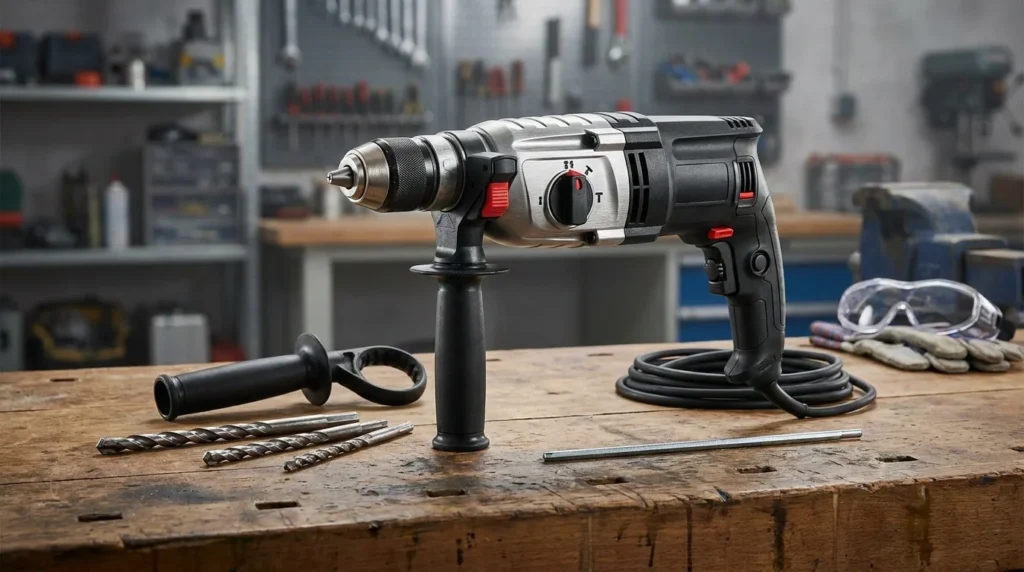
Inside the housing sit two ridged steel discs. Press the tool against a wall and the discs ride over each other, slamming the chuck forward and back. On a decent cordless unit, that happens 25,000 to 30,000 times a minute. The bit is spinning the entire time. Rotation scrapes the dust out, percussion cracks the aggregate, and the two together bore a clean hole.
Take the pressure off and the tapping stops. That is why the same tool works fine on pine or steel once you flip the collar to plain drilling mode. You are not carrying a specialist that lives in a drawer. You are carrying an ordinary driver with a second setting.
The catch is that the percussion is weak by design. All of the force comes from you leaning on it. Lean harder and you get a faster hole, until your shoulders give out around hole number eight.
Start with the wall, not the tool
Most people buy percussion they never needed, because the surface they were staring at was not concrete. Walk over and tap it first.
Drywall or plaster over studs. No masonry tool required. Your ordinary driver and the right fastener carry more weight than people expect, and choosing between toggle, sleeve, and self-drilling types matters far more than the tool spinning them. Our guide to picking the right drywall anchors covers the load ratings that actually apply.
Concrete block. Common in Canadian houses built before the 1970s and in garage foundations everywhere. The block itself is soft and hollow. Percussion goes through it quickly, and even a plain cordless model gets there eventually. Aim for the solid web between cavities so an anchor has something to grip.
Brick veneer. Drill the mortar joint, not the brick face. Mortar is softer, and a joint can be repointed later if you ever move the fixture.
Poured concrete. Standard for basement walls and slabs in anything built since the 1960s. This is where the tool choice stops being academic. A 3/16-inch hole for a Tapcon is manageable. Go to a 1/2-inch hole 90 mm deep for a wedge anchor, and you are looking at several minutes and a very hot bit.
Condo owners have one more step. Poured slabs and shear walls may carry post-tensioned cables, and many corporations set depth limits or ban ceiling penetrations outright. Read your rules before the bit touches concrete, because a cut cable is not a repair anyone wants to be responsible for.
The impact driver mix-up, and the wrench that is neither
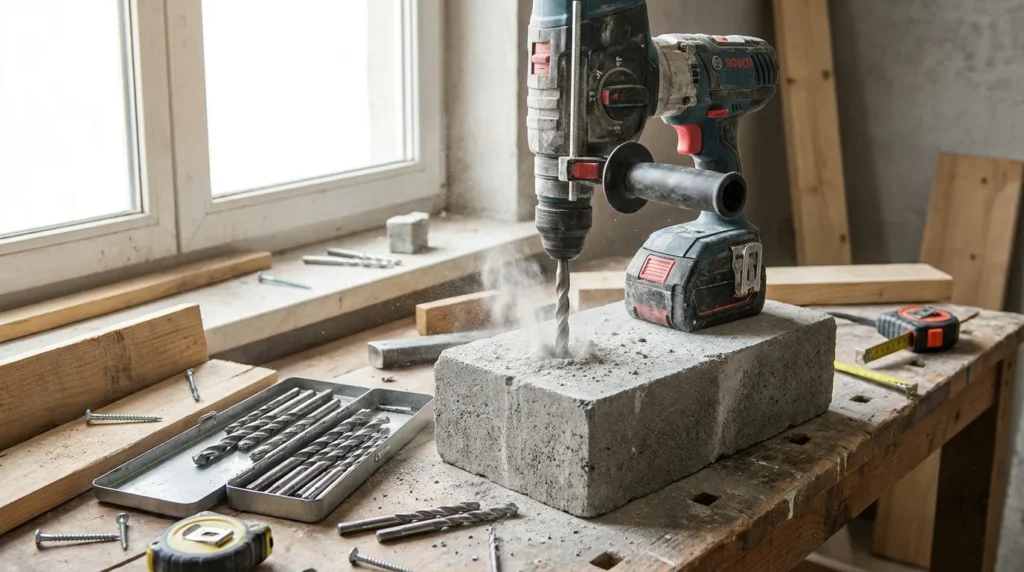
This confusion costs people a Saturday, so it is worth being precise. Both tools hammer. They hammer in different directions.
An impact driver’s mechanism strikes rotationally, adding sudden bursts of twist to the bit. That is superb for sinking a 100 mm structural screw into a joist without stripping the head or wrenching your wrist. Applied to concrete, it does nothing useful, because nothing is pushing the carbide tip forward into the material. The driver just spins and polishes the hole.
People also mix in a third tool with a similar silhouette. An impact wrench and what it is built for is a fastener tool too, sized for lug nuts and heavy bolts rather than holes of any kind. Three tools, three verbs: bore, drive, torque. Sort the verb first, and the shopping gets simple.
One genuinely useful overlap: an impact driver with a 1/4-inch hex shank will accept small hex-shank masonry bits. For a couple of shallow holes in soft block, it will limp through. Treat that as a field repair, not a plan.
When you have outgrown it
A rotary hammer is not a bigger version of the same idea. It uses an electro-pneumatic piston, so a burst of compressed air drives the bit forward with real force measured in joules. Nothing depends on how hard you push. The bit sits in an SDS-plus chuck with grooves that let it slide back and forth while it turns. That transfers far more energy than a keyless chuck ever could.
The practical threshold is easy to state. Switch tools if you are making more than about a dozen holes in poured concrete. Same if the hole is wider than 16 mm, or you are anchoring a ledger board. What takes a percussion tool two minutes takes an SDS-plus machine fifteen seconds.
Buying is often the wrong move. Rental counters at most Canadian building centres charge roughly CA$60 for a day, and one day covers the shelving job that was making you consider a purchase. Buy only if you have a finished basement, a workshop build, or a rental property in your future. That is also the calculation behind most concrete anchoring jobs, from a French cleat storage wall in the garage to a bench bolted to the slab.
What you will pay in Canada
Prices we tracked at Canadian retailers in 2026 start lower than most people assume. Corded units run near CA$70 for a 6.5-amp Black & Decker and around CA$118 for an 8.5-amp DeWalt. Cordless kits open at roughly CA$128 for a RIDGID subcompact and CA$148 for a Ryobi ONE+ or a Milwaukee M12 FUEL. Premium territory is CA$298 for an M18 FUEL bare tool and CA$428 for the same in a two-battery kit.
The number that matters is not on the tag. Canadian retail is fenced. Ryobi and RIDGID are Home Depot exclusives here; Mastercraft 20V Max is Canadian Tire exclusive; and DeWalt, Makita, and Bosch are available across all the big chains. Whichever battery you commit to determines where you buy every future tool and every replacement pack. Someone with four Ryobi batteries in the garage should buy the Ryobi, even if a review preferred something else.
Corded still earns its place. A corded model never sags on the eighth hole and costs half as much. It also weighs about the same, once you factor a 5.0 Ah pack into the cordless figure. If it lives in a basement near an outlet, the cord is not a real inconvenience.
Bits and technique

The bit does more work than the tool. Use carbide-tipped masonry bits, not the black twist bits from your wood set, and match the diameter to the anchor exactly rather than to the screw.
- Mark the spot through two layers of masking tape so the tip cannot wander.
- Start in rotation-only mode for the first three or four seconds to seat the hole, then engage percussion.
- Pull the bit out every 20 mm or so to clear dust. Packed dust is the main reason an anchor will not seat fully.
- Go 6 mm deeper than the anchor length so debris has somewhere to fall.
- If the bit stops advancing and the tool bogs down, you have hit rebar. Move 50 mm and start a new hole rather than forcing it.
- Vacuum the finished hole before setting the anchor. Wear eye protection and a dust mask throughout.
Let the tool cool if the bit turns blue. Overheated carbide loses its edge permanently, and a dull tip is the usual reason someone concludes their machine is underpowered when the machine was fine.
Where to go from here
Tap the wall, count the holes, then decide. Drywall means an anchor and the tool you already own. Block or brick means percussion, and CA$70 to CA$150 buys enough of it. Poured concrete in volume means an SDS-plus machine, borrowed for a day before you consider owning one. Match the tool to that answer, and the job takes an afternoon instead of a weekend.
FAQs
Yes, in block or soft mortar, at roughly half the speed and with far more effort. In cured poured concrete it is genuinely painful past a 6 mm hole. Use a sharp masonry bit and keep steady pressure.
Yes. Switch the collar to the plain bit icon and the percussion disengages completely. It works normally on wood and metal, just a little heavier in the hand.
A 1/2-inch chuck is the sensible default and accepts nearly every masonry bit a homeowner will buy. Go with a 3/8-inch chuck only if you want the lighter body and stick to small anchors.
Yes, and use it. When a bit catches on aggregate, the body twists hard in your hands, and the second handle is what keeps that from becoming a sprained wrist.
No. SDS-plus shanks only fit SDS chucks. Adapters exist, and they defeat the point, since the piston can no longer strike the bit properly.