Three separate faults produce the same result, and only one of them is the furniture’s fault. How to fix wobbly chair joints. Most advice on how to fix wobbly chair problems opens with glue, which is the wrong first move about half the time. A one-minute test on a flat floor tells you which fault you have. Get that right, and the repair takes an afternoon instead of three failed attempts.
Quick answer: Set the piece on a flat, level surface and press each corner in turn. If it rocks there, the joints are loose and need to be knocked apart, cleaned, and reglued. If it sits solid but rocks at your table, blame the floor. Uneven wear on one leg rocks in a steady rhythm.
Key Takeaways
- Diagnose first. Loose joints, a short leg, and an uneven floor feel identical beneath you and have no fix.
- Glue squeezed into a joint you never opened will not hold, and it makes the proper repair harder later.
- A real reglue means disassembly, scraping the old glue off the tenon, fresh adhesive, and a strap clamp overnight.
- Dry winter air is why dining seats across Canada come loose every January and firm up again by July.
- Wedges, screws through the joint, and steel brackets are last resorts, never shortcuts.
| What you notice | Most likely cause | The fix | Rough cost |
| Rocks on a flat slab, joints creak | Loose glue joints | Knock apart, clean, reglue, clamp | CA$15 to CA$40 |
| Solid on the slab, rocks in the dining room | Uneven floor | Felt pads or screw-in levellers | CA$6 to CA$20 |
| Rocks the same way everywhere, one leg lifts | One leg short or worn | Scribe and trim the long legs. | CA$0 to CA$15 |
| Bolts turn but never tighten. | Stripped threads or blown-out holes | New hardware, or plug and redrill | CA$5 to CA$25 |
Start on a Flat Floor, Not Under the Table
The test costs a minute. Move the piece to a floor you trust: a garage slab, a tiled entry, or a sheet of plywood laid flat. Sit down and shift your weight from corner to corner. There is more on this in How to Install a Thermostat.
Feel movement where a leg meets the seat rail, or hear a dry creak? The joints are loose, and the rest of this guide is about fixing that once. If the frame sits dead still on flat ground, the wood is fine, and your floor is not.
How to fix wobbly chair joints: Old hardwood in a Canadian house rarely stays perfectly flat after a decade of heating seasons. Pads or screw-in levellers sort that out in ten minutes, and they spare the finish you protect every time you go through the routine for caring for hardwood floors.
Why Your Dining Seats Loosen Every January
Forced-air heat pulls moisture out of the air all winter. An unhumidified Canadian house routinely sits at 15 to 20 percent relative humidity in January, and wood follows the air it lives in. A tenon that measured tight in August shrinks across the grain, the glue line opens, and the frame racks under you by February.
Come July, the same piece often feels firm again. That swing is useful information. If yours tightens up over the summer, the joints have come loose rather than broken, and a reglue will hold.
Health Canada sets the target indoor range at a minimum of 30 percent in winter, rising toward 50 percent in milder weather. A furnace humidifier or a portable unit keeps you inside that band and slows the whole cycle down. It will not rescue a joint that has already let go.
Why Squirting Glue Into a Loose Joint Fails
Glue needs bare wood on both faces. A joint that has already failed is lined with a hard, glazed film of old hide or PVA glue. Fresh adhesive bonds to that film instead of the timber underneath. The film is also what blocks the glue from reaching the gap you are aiming at.
So the repair feels solid for a fortnight, then rocks again. You have now filled the joint with cured adhesive, which someone has to scrape out before the job can be done properly. The syringe kits sold for this get the same verdict: they inject thin glue into a contaminated, not empty, space.
How to Fix Wobbly Chair Joints the Way That Lasts

Set aside an evening, plus the following day for curing. None of it is difficult. The discipline lives in the cleaning and the waiting.
What you’ll need:
- PVA wood glue, roughly CA$10 to CA$16 for a 400 mL bottle at Canadian Tire or Home Depot Canada
- Liquid hide glue instead, around CA$20 to CA$30 at Lee Valley, if the piece is old or you want the joint reversible
- A strap or web clamp. Lee Valley’s 4.9 m web clamp starts at CA$18.50, and rope with a stick makes a free tourniquet
- A rubber mallet or dead-blow hammer, plus a scrap block
- An old chisel, a scraper, or 100-grit sandpaper wrapped around a dowel
- Masking tape and a pencil
- Label every joint. Mark the front left leg and the rail it meets, then work around. Parts that look identical rarely are, and a swapped rail never seats.
- Knock it apart. Tap the loose members free with the mallet against your scrap block. Leave any joint that is genuinely tight alone.
- Clean both halves. Scrape the glazed glue off the tenon and out of the mortise until bare wood shows. This step decides whether the repair holds.
- Dry fit the frame. Push everything together with no glue and check that it stands square. Solve any gap now, before the clock runs.
- Glue and assemble. Brush a thin coat onto both surfaces, then bring the frame together in one movement. PVA gives you roughly five minutes.
- Clamp with a strap. Run the web clamp around all four legs, pull it snug, then set the frame on flat ground and confirm it no longer rocks. Wipe the squeeze-out with a damp cloth.
- Leave it completely alone. Twenty-four hours in a warm room, then another day before anyone sits down. Glue reaches handling strength fast and full strength slowly.
If a screw hole blew out or a gap remained open after clamping, address it once the glue has cured. Picking the right wood filler for the job matters more than matching the color exactly, because a filler that shrinks reopens the gap by spring.
Quick Fixes That Are Honest Repairs

Not every how-to-fix-wobbly-chair job calls for a teardown. Three shortcuts are legitimate repairs rather than badges.
Felt pads. Self-adhesive multipacks run about CA$6 to CA$15 at Canadian Tire, and a thicker pad on the short leg cancels a small dip in the floor. They compress and wear, so check them each spring.
Screw-in levellers. These beat pads are for a floor that shifts with the seasons. Drill a pilot hole, tap in the T-nut, thread the leveller, and turn it down until the rocking stops.
Bolted hardware. Knock-down furniture and office chairs usually wobble because the fasteners backed off, not because anything failed. Tighten in a cross pattern, in small turns, and stop at snug. An office chair that still moves after that has a worn gas cylinder or a cracked base, both of which require a parts swap.
Trimming a Long Leg Without Guessing
Cutting by eye turns a rocking piece into a shorter rocking piece. Scribe instead. Sit the frame on a flat surface with the three good legs down, then slip shims under the short one until the seat sits level. Check it with a spirit level. Tape a pencil to a small block, run the block flat across the surface and around all four legs, and draw a line on each.
Every line now sits the same height off the floor. Saw the long legs down to their lines with a fine-tooth blade; take less than you think, and test between cuts. Confirm the finished lengths with a measuring tape you can trust, because two millimeters of error still rocks.
Wedges, Screws, and Brackets: The Last Resort
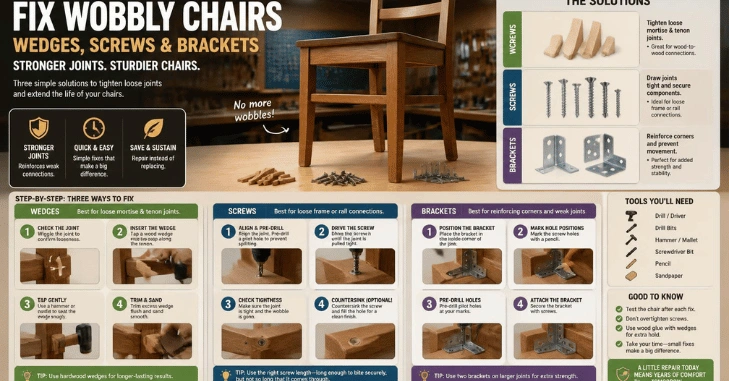
Each of these three appears in every quick-tip list, and each trades a repairable joint for a permanent scar.
- A wedge driven into a loose tenon splits the mortise wall from the inside, and the split surfaces months later.
- Screws through the joint hold on threads alone, and the hole one leaves must be plugged before anyone can reglue.
- Steel brackets shift the load onto four small fasteners that bite into the end grain, which is the weakest place to put it.
Reach for them when the alternative is the curb. If a leg has cracked through or a mortise wall has broken away, a furniture repair shop is the honest call. Quoted repairs on a dining set usually cost less than replacing it.
Your Next Hour
Carry it out to the flattest floor in the house and rock it properly. How to Fix Wobbly Chair Joints: That single test decides whether you are buying a bottle of glue or a packet of felt pads, and it takes only a minute. If the joints turn out to be the problem, buy the glue and the strap clamp in the same trip so the repair does not stall halfway through a Saturday.
FAQ
Only when the movement comes from hardware or the floor. Bolts you can tighten. Pads and levellers you can add. The rest of the guidance on fixing a wobbly chair assumes disassembly, because a glued joint that has let go will not come back any other way.
PVA is stronger, cheaper, and the right pick for something you plan to use hard. Hide glue is reversible, so a restorer can open the joint in thirty years without wrecking it. Anything genuinely antique gets hide glue.
A tourniquet works. Loop rope twice around the legs, slide a scrap of wood under the loop, and twist until the joints pull tight. Tape the stick down so it cannot unwind overnight.
Somebody’s favorite. Every lean-back racks the joints slightly, and the one nearest the kitchen door absorbs the most of it.