If the driver spins and the fastener stays put, the head is stripped. If it turns forever without ever tightening, the hole is stripped instead. Both are fixable with tools you probably own already. Knowing how to remove stripped screw heads is mostly about escalating slowly, one rung at a time.
Quick answer: Pack the recess with a rubber band or a wad of steel wool, then press hard and turn slowly. If it still slips, strike a manual impact driver, cut a fresh slot with a rotary tool, then bite in with an extractor bit. Drilling the head off is the last resort.
Key takeaways
- Work from least destructive to most. Skipping ahead costs you the options below you.
- Friction fixes, such as a rubber band or steel wool, solve a surprising number of cases for free.
- A manual impact driver is the cheapest real upgrade, around CA$25 at Princess Auto.
- Canadian fasteners are mostly Robertson. They round out rather than cam out, and an undersized bit is nearly always the cause.
- A hole that no longer grips needs glue and wood, not a bigger driver.
Stripped head or stripped hole? Check which one you have

Fit the correct bit and press down firmly. The bit turns, the fastener does not move, and the recess has lost its edges. That is a stripped head.
Now the second case. The whole thing spins smoothly and rises no further, so the wood around it has given up its grip. That is a stripped thread, and no driver on earth will cure it.
Everything that follows on how to remove stripped screw heads assumes the first case. The hole repair gets its own section further down, and mixing the two up wastes an afternoon. Plenty of people buy an extractor set for a problem that could have been fixed with a toothpick and some glue.
What you’ll need
Nothing here is exotic. Most of it already sits in a drawer somewhere.
- A wide rubber band, or a pad of fine steel wool
- The correct bit, checked against the sizing chart below
- Locking pliers, for any head that stands proud of the surface
- A manual impact driver, roughly CA$25 at Princess Auto
- A rotary tool with a thin cutting disc, about CA$65 to CA$90 at Home Depot Canada
- An extractor set, somewhere between CA$15 and CA$40 at Canadian Tire
- Penetrating oil for anything that has spent a winter outdoors
Cold changes the job. Hardware in an unheated garage or a deck board at minus 15 °C becomes shrunken, brittle material that splits rather than releases. Warm the area with a heat gun for a minute first. If half these tools are missing because the shelves are chaos, a weekend plan for sorting out garage storage is the honest place to start.
Why the head stripped in the first place
Almost every ruined recess traces back to one of four causes, and none of them are bad luck.
- Undersized bit. A #1 bit inside a #2 recess only touches the corners, then shears them off.
- Wrong drive type. A Phillips bit in a Pozidriv head sits shallow and slips the moment torque rises.
- Cam-out. The Phillips design deliberately pushes the driver back out under load. That was the point originally, and it chews the recess every time.
- Clutch set too high. A cordless drill on setting 20 keeps driving long after the head has seated.
Here is where Canadian advice parts company with the American guides. Most fasteners sold at Canadian Tire, Home Depot Canada, and Rona use Robertson square drive, invented in Milton, Ontario. A Robertson recess does not cam out, which is exactly why it strips so rarely.
It fails a different way. Force a #1 bit into a #2 socket and the square corners round into a circle. After that, no Robertson bit will ever grip again. The colour coding on decent bits exists to stop this happening.
| Robertson size | Bit colour | Fits gauge | Typical job |
|---|---|---|---|
| #0 | Yellow | #3 to #4 | Small hinges, electronics |
| #1 | Green | #5 to #7 | Cabinet hardware, trim |
| #2 | Red | #8 to #10 | Framing, decking, most household work |
| #3 | Black | #12 to #14 | Heavy timber, ledger boards |
Lee Valley lists individual colour-coded bits from about CA$1.35, with a twelve-piece set near CA$13. That is less than one extractor set, and it prevents the problem rather than treating it.
How to Remove Stripped Screw Heads, One Rung at a Time
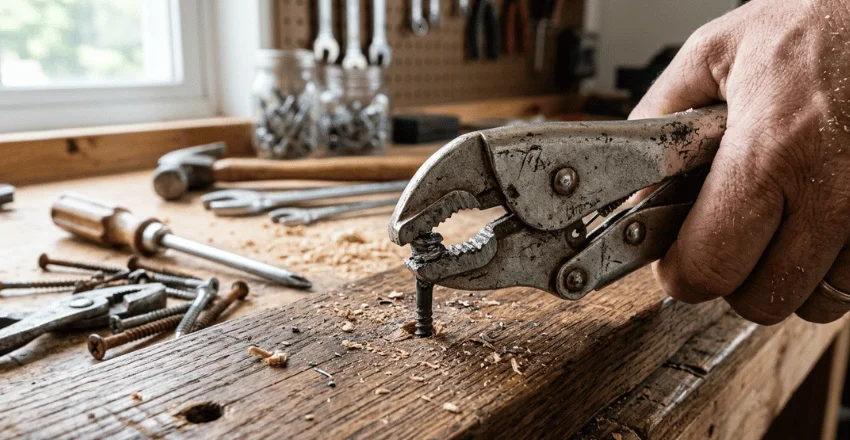
Start at rung one. Climb only when the rung you are standing on has genuinely failed, because each step up destroys options the step below still had. Each rung ends with the signal to stop with that method and escalate, the part most lists of tricks leave out.
- Add friction to the recess. Lay a wide rubber band flat across the head, press the bit through it, and turn slowly under heavy downward pressure. Fine steel wool does the same job and grips a rounded Robertson better. Move on once the band shreds twice with no movement.
- Strike a manual impact driver. This is not a cordless impact driver. You hit the end of it with a hammer, and it converts that blow into a sharp twist while forcing the bit deeper into the recess. Two or three firm strikes free most seized hardware. Move on if the recess widens rather than turns.
- Cut a new slot. Fit a thin cutting disc to a rotary tool and cut one straight groove across the head, roughly 2 mm deep. Keep the disc square and wear eye protection. A wide flat blade in that groove gives leverage nothing else can match. Move on if the head sits too deep for the disc to reach.
- Drive in an extractor bit. Punch or drill a small pilot hole dead centre in the head, then run the reverse-cut extractor counterclockwise at low speed. It bites harder the more the fastener resists. Move on if the extractor slips, or worse, snaps off inside the pilot hole.
- Drill the head off. Pick a drill bit that matches the head diameter, and drill straight down until the head separates from the shank. Whatever you were removing now lifts clear. Grip the exposed shank with locking pliers and wind it out, or drill it away and repair the hole.
Rung five sounds drastic, though it often ends the job fastest on a hinge or a bracket. The shank left behind is usually easier to grab than the ruined head ever was.
When the hole is stripped, not the head
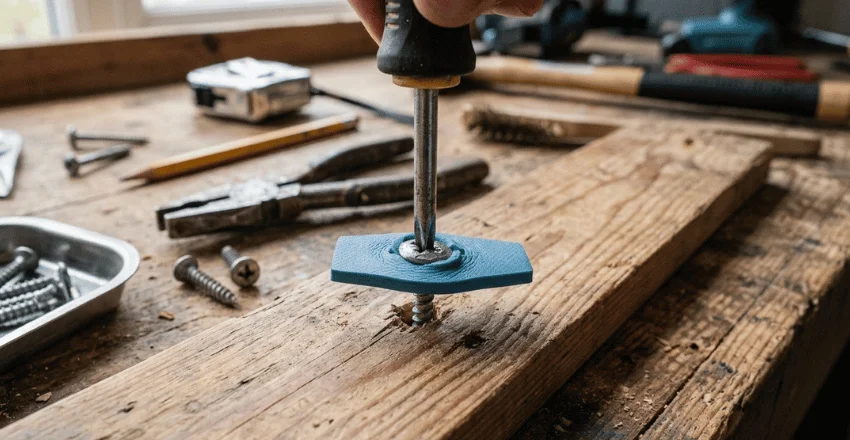
A hole that spins is a wood problem. You are rebuilding material for the threads to bite into, so anything you do to the fastener is wasted effort.
For a small hole, coat two or three wooden toothpicks with carpenter’s glue, tap them in, snap them flush, and leave them for an hour. Drive the original fastener back in, and it holds. Bamboo skewers work better in hardwood.
For a bigger hole, drill it out to 8 mm, glue in a hardwood dowel, then cut the dowel flush. Once cured, drill a fresh pilot hole through its centre. In softwood, that repair usually ends up stronger than the wood it replaced.
Moving up a gauge, from a #8 to a #10, is the quick option where the surrounding timber is still sound. Where the surface has blown out and the repair has to disappear, choosing the right wood filler matters as much as the plug underneath. Filler has almost no holding power on its own, so put real wood in the hole first and fill only the cosmetic damage.
How to stop stripping them again
- Match the bit by size, not by shape alone. Colour-coded Robertson bits make that automatic.
- Set the drill clutch to around 8-10 and let it slip. Finish the last quarter turn by hand.
- Bin worn bits. A rounded tip wrecks more heads than any other single cause.
- Drill a pilot hole in hardwood at roughly 70 percent of the fastener’s core diameter.
- Keep the driver square to the work. An angled bit contacts only one side of the recess.
Your next step
That is the whole of how to remove stripped screw heads: pick the lowest rung that could plausibly work, give it a real try, and climb only when it fails. Most fasteners surrender on rung one or two. Keep a colour-coded bit set in the drawer, and this stays a rare annoyance rather than a monthly one. For more fixes in the same spirit, browse our home improvement repair guides.
Frequently asked questions
A wide rubber band is the classic. Fine steel wool, a small square of leather, or a smear of valve grinding paste all do the same thing. Each one fills the gap between a worn recess and the bit.
Yes, at low speed in reverse with heavy pressure. That works on a lightly worn head. High speed just polishes the recess smooth and makes every later turn harder.
They round out rather than strip, and far less often than Phillips does. An undersized bit causes almost all of it. A rounded Robertson socket usually needs rung three or rung four.
The basic five-piece sets we priced were near CA$15. Larger kits with matched drill bits reached about CA$40 at Canadian Tire and Princess Auto. Any of them beats a ruined workpiece.
Stop drilling immediately. Extractor steel is harder than your drill bits and will destroy them. Drill around the head instead, as in rung five, or hand the part to a machine shop.