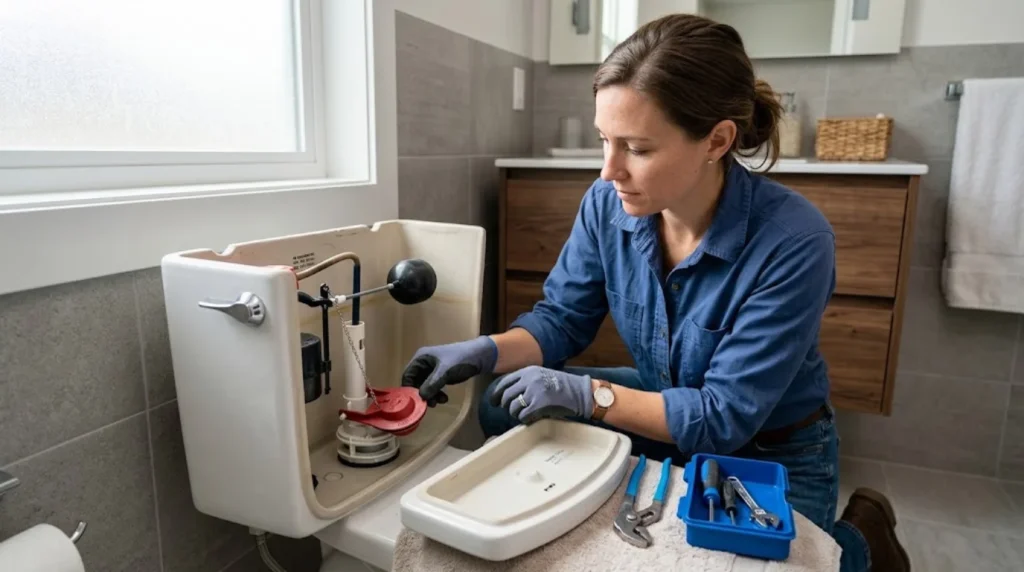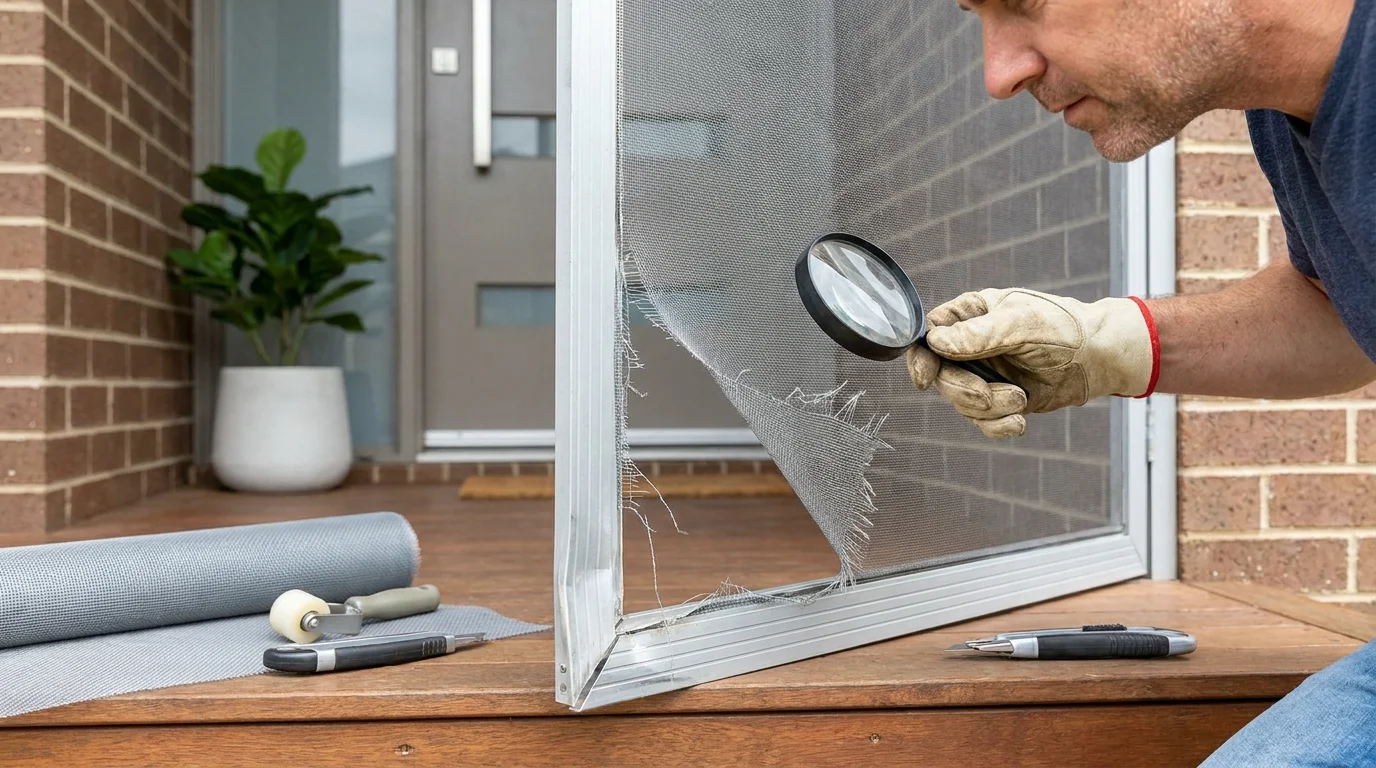
A screen that sags, slams or refuses to latch almost never needs a new door. Five things fail on these doors, and each one has its own cheap fix. Work out which one you have before you drive to the store, because the wrong part is a wasted Saturday. Learning how to repair screen door mesh takes about forty minutes and roughly CA$20 in materials.
The short answer: hook the old spline out of the frame channel with an awl. Lay fresh mesh over the frame and roll it into the channel with a spline roller. Press new spline in on top, then trim the excess. Hardware faults are separate jobs.
Match the sign to the fix
| What you see | Likely cause | The fix | Parts (CAD) | Time |
|---|---|---|---|---|
| Hole, slash or sagging mesh | Spline shrank or mesh tore | Rescreen the panel | CA$20 | 40 min |
| Corner gap, door binds in the opening | Frame racked out of square | Re-square and re-tighten corners | CA$0 to CA$15 | 30 min |
| Door slams, or hangs open in the wind | Closer worn or set wrong for the season | Adjust the pin and valve, or replace | CA$0 to CA$34 | 15 min |
| Slider sticks, jumps the track, grinds | Flat-spotted or seized rollers | Fit a new roller pair | CA$25 | 25 min |
| Door touches but will not stay shut | Latch and strike out of line | Shim or move the strike plate | CA$0 to CA$10 | 20 min |
TL;DR
- Diagnose first. Torn mesh, a racked frame, a dead closer, worn rollers and a misaligned latch need different parts.
- A full rescreen costs about CA$20 at Home Depot Canada. A Toronto company quoted CA$295 to CA$495 to do the same job on a patio slider.
- Measure your old spline before buying. Canadian stores stock everything from 0.125-inch to 0.220-inch, and one size up or down will not hold.
- Fix it before late May. Black fly and mosquito season peaks through May and June across most of the country.
- Combination storm doors need the closer reset twice a year when you swap the glass and screen panels.
What you’ll need
Most of this already lives in a kitchen drawer.
- Spline roller, the small convex-and-concave wheel tool sold beside the mesh
- Fibreglass mesh, sized at least 5 cm larger than the frame on every side
- New spline in the diameter your frame takes
- Utility knife with a fresh blade, plus an awl or a flathead screwdriver
- Robertson and Phillips drivers, a rubber mallet, and a tape measure
- Silicone spray for tracks and rollers, never oil, which holds grit
Start by naming the failure, not the door
Stand outside and open the panel slowly. Does it drag at one corner only? That points at the frame, not the mesh. Does it move freely but bounce off the jamb? That is the latch or the closer.
Then check the frame for square. Run a tape measure across both diagonals of the panel and compare the two numbers. A difference over about 5 mm means the corners have shifted, and rescreening a racked frame just pulls it further out of shape.
Push a finger against the mesh next. Brittle fibreglass that cracks rather than flexes has had its day. Finally, wiggle the closer arm and spin each roller by hand, because anything gritty tells you where to spend your money.
Fix 1: How to repair screen door mesh
This is the easiest of the five. Lay the panel flat on a table or two sawhorses first, because working on a hung door guarantees a wavy result.
- Lift the panel off its track or unscrew the hinges, then remove the handle.
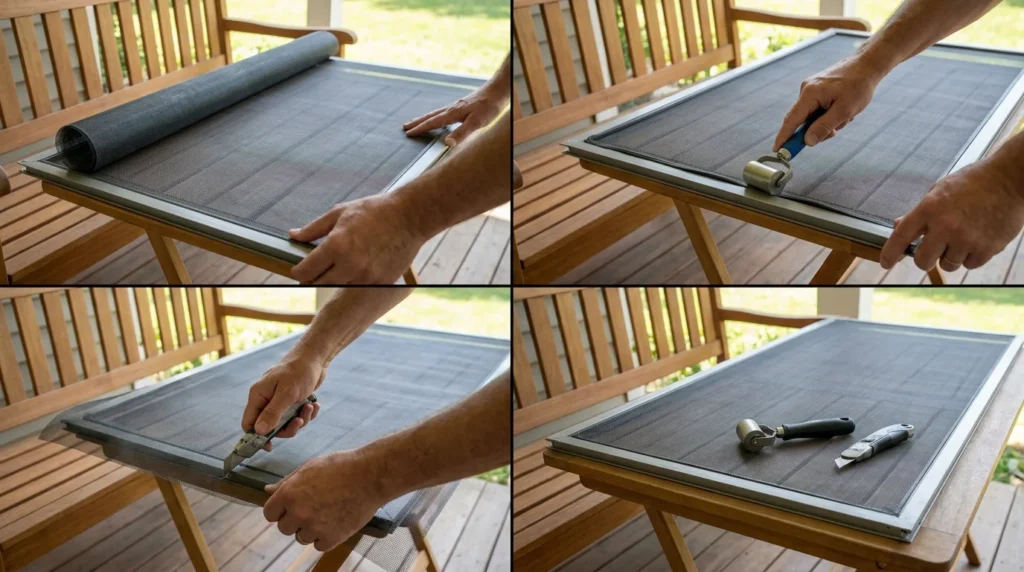
- Hook the old spline out of the channel with an awl and pull it free in one length.
- Peel off the old mesh and vacuum the channel clean.
- Measure the old spline against a ruler, or take a short piece to the store to match it.
- Lay the new mesh over the frame with about 5 cm of overhang on all four sides.
- Press the mesh into one long channel with the concave wheel of the roller, keeping light tension across the frame.
- Roll the new spline in on top, doing the opposite long side second and the short sides last.
- Trim the overhang with a fresh blade held flat against the outside of the spline.
Do not stretch the mesh drum tight. Fibreglass has almost no memory, so an over-tightened panel bows the frame inward and the corners open up within a season. Firm and flat beats tight every time.
Fix 2: Square up a racked frame
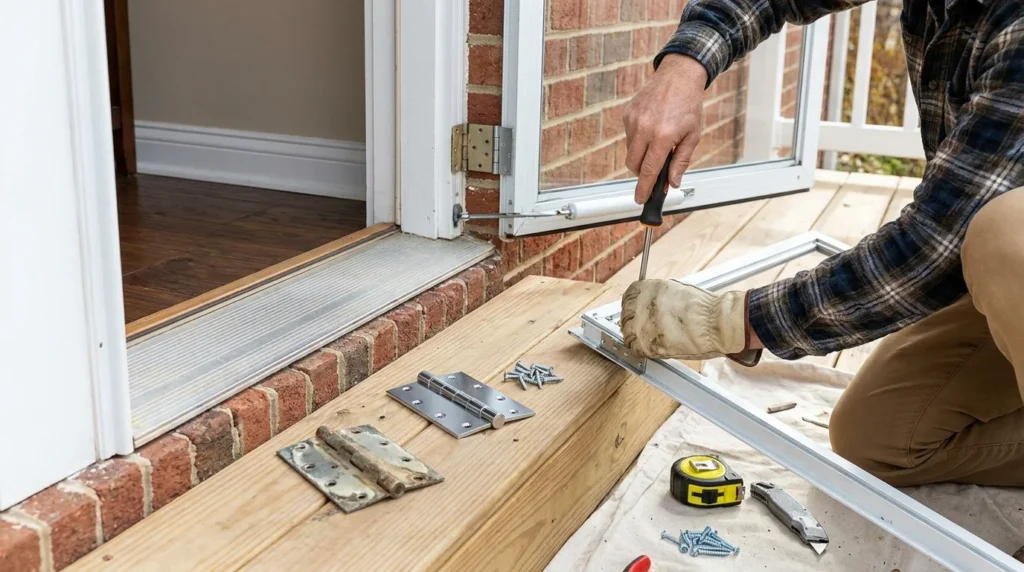
An aluminum panel holds its shape through four corner keys, and those keys loosen. If your diagonals were off, back out the corner screws, lay the frame on a flat surface and push the long corner in until both diagonals match. Clamp it there, retighten, and check again before the mesh goes on.
Wooden frames rack for a different reason. Their mortise joints dry out and open, so glue and clamp them, or add a steel L-bracket inside each bottom corner. A bracket is not elegant, but it survives Canadian humidity swings better than glue alone.
Fix 3: Bring a slamming or dead closer back
Knowing how to repair screen door closers saves the most money of any fix here, because a working closer is usually just set wrong. Every pneumatic or hydraulic tube carries two adjustments. At the outer end sits a small bypass valve screw that sets closing speed. The connecting pin then moves between two holes in the bracket, and that is the seasonal setting most people never touch.
Move the pin to the front hole, closest to the door bracket, once the glass panel goes in for winter. That raises closing pressure so the latch catches against a January wind. Move it to the rear hole in spring, with the screen panel in, and the door slows before it hits the latch instead of cracking against it.
Cold thickens the fluid inside a hydraulic closer, so a door set perfectly in August drifts shut too slowly in February and never latches. Turn the valve screw counterclockwise in small steps until it closes firmly, then reverse it in spring. If the tube leaks oil or the arm feels dead, replace the whole unit for about CA$34. Closer brackets sit in soft aluminum and the screws chew easily, so read up on getting a stripped screw out before you force one.
Fix 4: Replace worn rollers on a slider
Patio sliders ride on four small wheels that flatten with age. A door that grinds, lifts out of its track or needs two hands is almost always running on dead rollers rather than a bent track.
- Back the adjustment screws at both bottom corners fully out to drop the wheels.
- Lift the panel up into the head track and swing the bottom clear.
- Prise the old rollers out of their pockets and note the wheel diameter.
- Snap in the replacements, then vacuum and wipe the bottom track.
- Rehang the panel and turn each screw in evenly until the door rolls with one finger.
Most Canadian patio screens take 1.25-inch wheels, and a zinc two-pack runs CA$24.98. Spray the track with silicone afterwards. Grease and household oil both collect the fine grit that killed the first set.
Fix 5: Get the latch to catch again
A door that touches the jamb but bounces back has a strike plate sitting a few millimetres out of line. Close the panel slowly and watch where the latch tongue lands. Above the opening, below it, or short of it, each points somewhere different.
Short of the strike means the plate needs to come out toward you, so slip a thin cardboard or plastic shim behind it. High or low means the plate moves, so drill fresh pilot holes 3 mm over and plug the old ones with a matchstick and glue. Check the sweep at the bottom too, since a compressed sweep lets the panel hang low enough to miss the catch.
What this costs in Canada
Materials are cheap and the labour is yours. Home Depot Canada sells a complete Everbilt 36-inch by 84-inch fibreglass kit with mesh and spline for CA$19.98, enough for two average panels. Buying separately, a 30 m Phifer spline roll runs CA$14.81 to CA$22.93 by diameter, and rollers or a closer add CA$25 to CA$34.
Now compare that with hiring out the work. One Toronto window and door company quotes CA$295 to CA$495 for an in-home re-mesh on a sliding patio screen. That gap is why the job stays a homeowner favourite, and why a screen shop earns its fee only on oversized or heavy custom panels.
When replacement beats repair
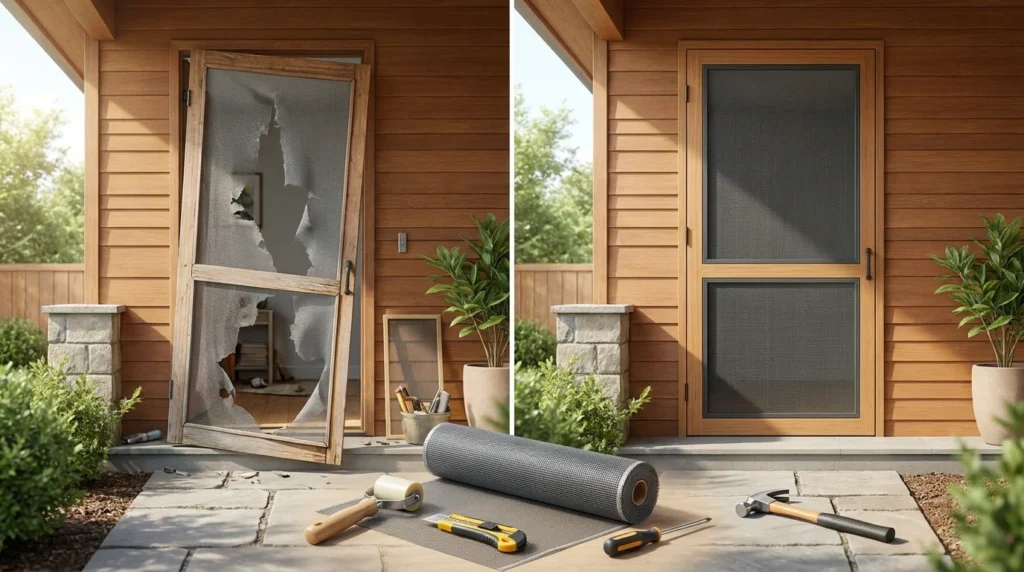
Repair stops making sense when the frame itself is finished. Corrosion pitting through the aluminum, a corner you cannot pull back into square, or wood that crumbles under a screw all mean new parts are going into a dying frame.
For a back door you only use in July and August, a curtain-style option is worth weighing before buying a replacement panel. Our guide to choosing a magnetic screen door covers where that swap works and where it falls short.
Get it done before bug season
Black flies and mosquitoes hit hardest through May and June, which is exactly when a torn panel stops being cosmetic. Spend one evening working through the five checks above, then buy only what your diagnosis calls for. Take the old spline and a dead roller to the store, and you will get the right parts on the first trip.
Frequently asked questions
Pull out a 10 cm piece of the old spline and measure it, or take it to the store. Canadian retailers stock 0.125-inch through 0.220-inch, and a 0.140-inch spline will not hold in a channel cut for 0.175-inch.
Yes, for a tear under about 25 mm. Adhesive patches and clear-drying repair glue both work, though the patch stays visible. Anything larger deserves a full rescreen.
For mesh, yes. Rolling spline against a hanging panel bends the frame and leaves waves in the finished screen. Latch and closer work happens in place.
Standard fibreglass suits most homes and forgives mistakes. Pet-grade mesh costs roughly twice as much and resists claws. Solar mesh cuts heat but dims the view.
Yes, for almost anyone. The tools cost less than one service call, and the same skill covers every window screen in the house.
Because you change the panel. Glass is heavier than mesh, so the closer that handled your winter setup is overpowered once the screen goes in, and the door starts slamming.