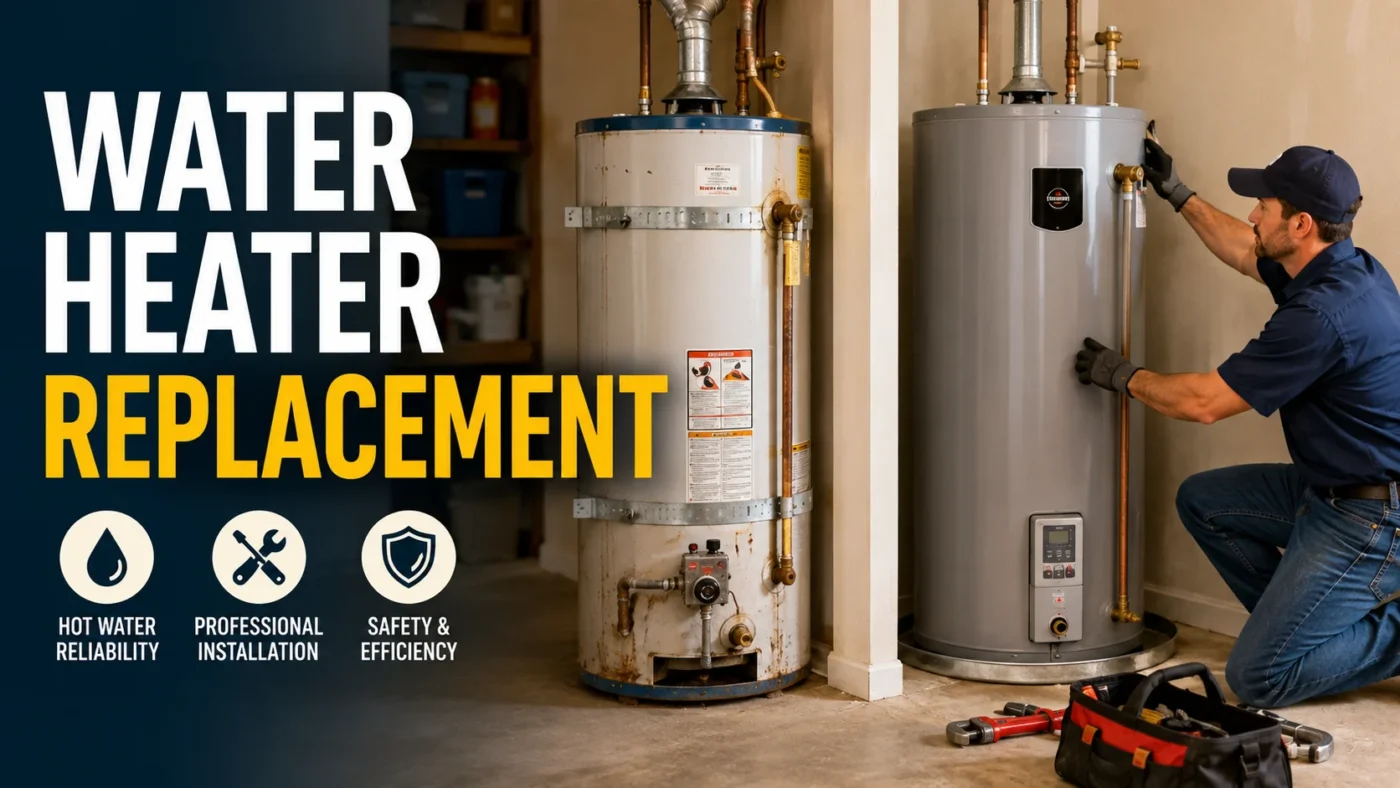
Most Canadians price a hot water tank for the first time while standing in a puddle. That is the worst possible moment to be comparing quotes. This guide gives the 2026 numbers in CAD, the litre sizes Canadian retailers actually stock, and the rental arrangement that quietly costs Ontario and Quebec homeowners the most. There is more on this in Baseboard Heater Costs and Sizing.
Water heater replacement in Canada runs about 1,200 to 2,800 CAD for a like-for-like tank, supplied and installed. Tankless and heat pump models range from 3,500 to 6,500 CAD. Swapping a tank like-for-like takes two to four hours. Most tanks last 8 to 12 years, so price yours before it fails rather than after. We cover this in more depth in Foundation Crack Repair in Canada.
What water heater replacement costs across Canada in 2026
These are installed prices, meaning the unit, the labour, and the haul-away of the old tank. They come from quotes we compared across plumbing firms in Vancouver, the Greater Toronto Area, and Quebec in 2026. Your city, your fuel, and your existing hookups move the final figure more than the brand does.
| Type | Installed price (CAD) | Typical life | Suits |
|---|---|---|---|
| Electric tank, 151 to 227 L | 1,200 to 2,400 | 8 to 12 years | Homes with no gas line |
| Natural gas tank, 151 to 227 L | 1,400 to 2,800 | 8 to 12 years | The default swap in most of Canada |
| Gas tankless | 3,500 to 6,500 | 15 to 20 years | Big families, tight mechanical rooms |
| Electric tankless | 2,500 to 4,500 | 15 to 20 years | Cottages, small suites, point-of-use |
| Heat pump (hybrid) | 3,500 to 6,000 | 12 to 15 years | Warm basements, high electricity bills |
Line items get added when the swap is not like-for-like. Municipal permits run roughly 75 to 300 CAD depending on the city. Running a new gas line adds 300-800 CAD. New venting adds 200-600 CAD. An electrical panel upgrade for a large tankless unit can add 1,500 to 3,000 CAD on its own. Labour alone is usually 600 to 900 CAD.
Any quote that looks 400 CAD cheaper than the others has usually left something out.
Tank, tankless or heat pump: what to buy
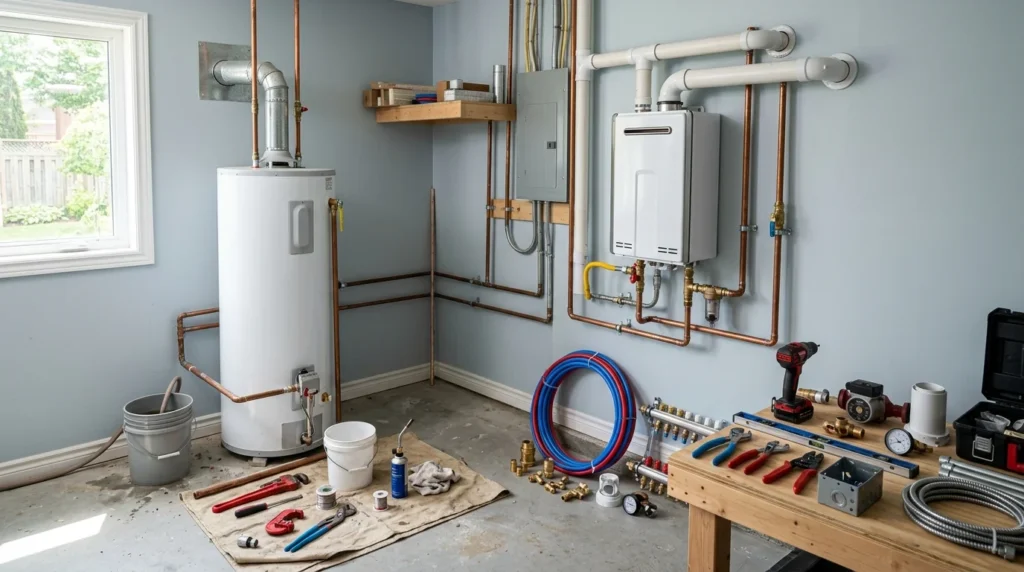
Three technologies compete for the same basement corner, and they are not interchangeable.
Storage tanks are the cheapest to install and the simplest to service. One holds 151-227 L of hot water around the clock, which is why it costs more to run. Standing losses are real, and they run all winter. Elsewhere on the site: Roof Replacement in Canada.
Tankless units heat water only as it flows, so you never run out during back-to-back showers. They hang on a wall and free up floor space. Installation is the catch: gas models often need larger gas piping and a new stainless vent, which is where the 6,500 CAD quotes come from.
Third option: a heat pump water heater moves heat from the surrounding air rather than generating it. According to Natural Resources Canada, water heaters represent 19.3% of the total energy used in the average Canadian household. That same guide notes that an ENERGY STAR certified heat pump model uses up to 50% less energy than a standard electric tank. On a large electricity bill, that is where the extra 2,000 CAD comes back.
Where each one wins.
- Gas tank. Lowest upfront cost, fastest install, cheap parts. Shortest life, and it wastes energy keeping water hot at 3 a.m.
- Tankless. Endless hot water, 15-20 years of service, tiny footprint. High install cost, annual descaling, and it needs power to run during an outage.
- Heat pump. Much lower running cost, provincial rebates available. Needs roughly 28 cubic metres of unheated space around it, hums like a bar fridge, and cools the room it sits in.
Our recommendation for most Canadian households: if the old tank was gas and the venting is sound, replace it with a gas tank and put the savings toward insulation. If your water heating runs on electricity and the tank lives in a basement utility room, the heat pump is the better long-term buy. Choose tankless water heaters only when the household genuinely runs out of hot water, not because it sounds modern.
Sizing in litres, and measuring before you order
Canadian retailers stock 151 L, 189 L and 227 L as the mainstream sizes, with 270 L for big households. Match the capacity to the household rather than to whatever the old tank said.
| Household | Tank size | Tankless flow |
|---|---|---|
| 1 to 2 people | 151 L | Around 11 L/min |
| 3 to 4 people | 189 L | Around 15 L/min |
| 5 or more, or two bathrooms in use | 227 to 270 L | Around 19 L/min |
Measure the space before you order anything. Expect a 189 L tank to stand roughly 150 cm tall and 55 cm across. Even a model that fits the floor area can still foul a joist or a duct. Gas units need clearance at the front for the burner and draft hood, so check the plate on the old tank for the manufacturer’s minimums. Five minutes with a reliable measuring tape is cheaper than a return trip and a restocking fee.
Renting versus owning: the trap in Ontario and Quebec
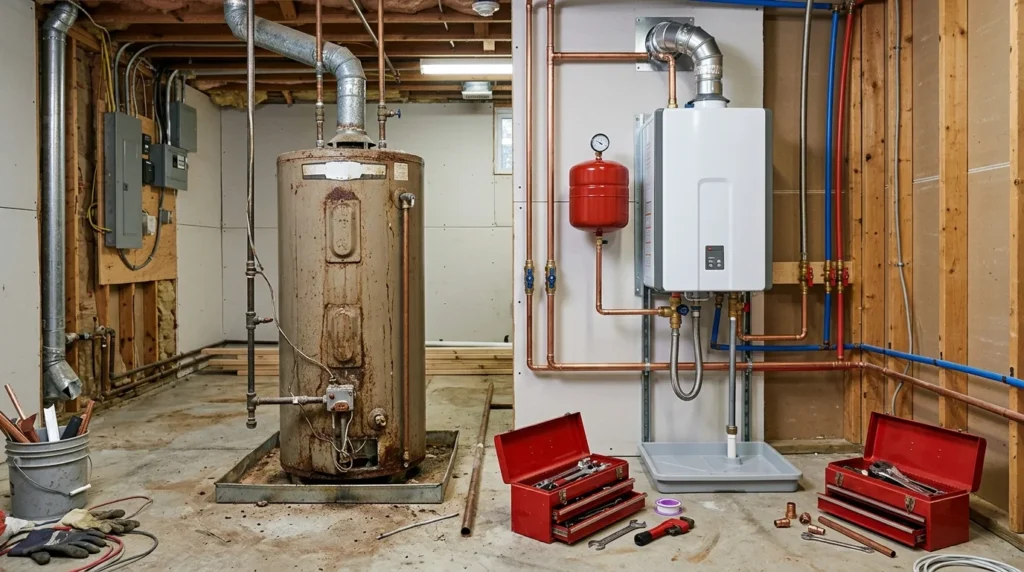
Tank rental is normal in Ontario and Quebec, and unusual almost everywhere else. Renting is easy to like: no upfront cost, repairs covered, a phone number to call. The arithmetic is less kind.
| Renting a tank | Owning a tank | |
|---|---|---|
| Upfront | 0 CAD | 1,400 to 2,800 CAD |
| Monthly | 20 to 55 CAD | 0 CAD |
| Cost over 12 years | 2,880 to 7,920 CAD | 1,400 to 2,800 CAD, plus the odd part |
| Repairs | Included | Yours, typically 200 to 500 CAD |
| Ends when | You buy out or return the unit | You sell the house |
Rental for a tankless system is higher again, typically 40 to 69 CAD per month. Break-even against buying arrives somewhere around year four.
Two details catch people out. First, buyout prices follow a declining schedule set at signing. Buying out a five-year-old rented tank can still cost well over 3,000 CAD. Wait until year sixteen, and it may cost almost nothing. Second, walking away is not free: termination charges of 40 to 200 CAD and pickup charges of 65 to 125 CAD are standard. Ask for your buyout figure in writing before you agree to anything, and check whether the contract transfers to a buyer when you sell.
Signs your tank is nearly done
Tanks rarely fail without notice. Watch for these:
- Rusty or metallic-tasting hot water that runs clear on the cold side. Its glass lining has gone, and the steel is corroding.
- Water pooling under the tank or staining the drain pan. Seams that weep do not heal.
- Rumbling or popping during a cycle, caused by sediment boiling under the burner.
- Hot water that runs out sooner than last winter, with no change in routine.
- Age past 10 years on the serial number plate, which usually encodes the build date.
- A corroded flue or scorching above the draft hood on a gas unit, which needs a technician the same day.
One weeping fitting is not a death sentence. Rust creeping across the jacket and a tank in its second decade together are.
Hard water is why prairie tanks die young
Much of the prairies sits on genuinely hard water. Regina, Saskatoon, Winnipeg, and Calgary all supply water that carries enough dissolved calcium and magnesium to leave scale wherever it is heated.
Scale settles on the bottom of a gas tank and insulates the steel from the burner. Steel then runs hotter. On an electric tank, it coats the elements directly. Either way, a tank rated for a decade can be finished in six or seven years.
You can test your water’s hardness with a hardness strip from any hardware store. If it reads above roughly 120 mg/L, softening the incoming line will do more for the next tank’s lifespan than any warranty upgrade. It is worth knowing what a water softener system costs before you commit. Flushing several litres from the drain valve twice a year helps in the meantime.
What the job involves, and who may legally do it
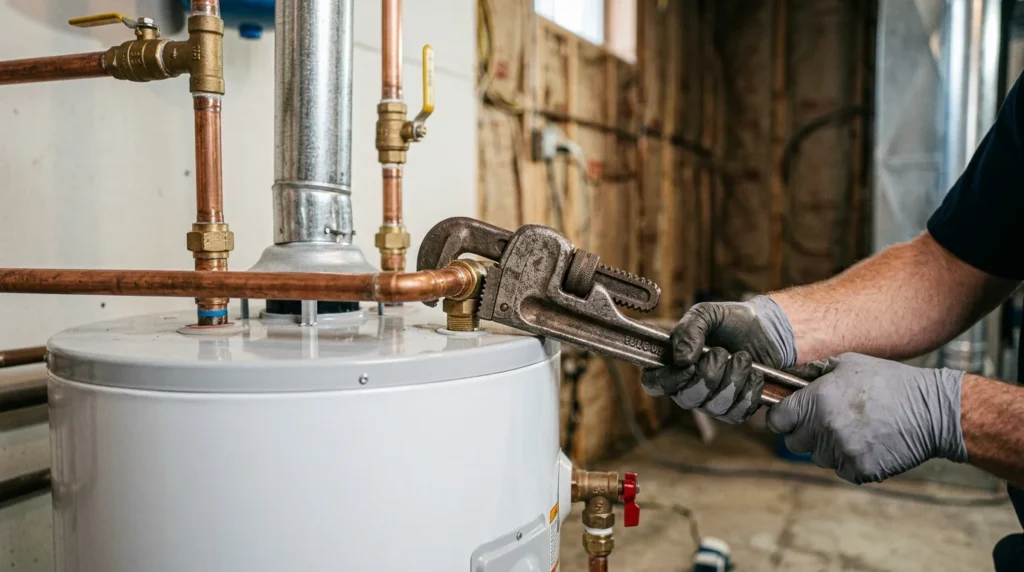
A like-for-like swap is half a day’s work for a licensed crew:
- Shut off the fuel and the cold supply, then drain the old tank to a floor drain or outside.
- Disconnect the water lines, the gas line or the electrical whip, and the venting.
- Carry the old unit out and the new one in, then set it level on the pan.
- Reconnect the supply lines, then fit new connectors and a fresh temperature and pressure relief valve.
- Refill, purge the air, then fire the burner or energize the elements and test the draft.
- Set the thermostat, then label the shutoff valve for whoever needs it next.
Set the thermostat to 60°C, then confirm the tap temperature after 1 hour. Public Health Agency of Canada guidance recommends storing water at 60°C and fitting an anti-scald mixing valve set to deliver 49°C at the tap. Storing it hot suppresses bacteria, while the valve guards small children, whose skin burns in a quarter of the time an adult’s does. Do not simply turn the tank down to 49°C and call it done.
Legal rules vary by province. Gas work is restricted everywhere: in Ontario, the contractor must hold TSSA registration, and other provinces run equivalent licensing for gas technicians. Most municipalities also require a plumbing permit, pulled by the contractor.
Electric tanks are treated more leniently in some provinces. Homeowner permits and inspections are still the norm. Doing gas work yourself voids the manufacturer’s warranty and can void your home insurance, which is a poor trade-off against a few hundred CAD in labour.
Key takeaways
- Budget 1,400 to 2,800 CAD for a gas tank, installed, and 3,500 to 6,500 CAD for tankless or heat pump.
- Sizes in Canada are 151 L, 189 L, and 227 L, matched to household size rather than the old label.
- Renting past year four costs more than owning, and buyout plus pickup charges are the sting.
- Rust in the hot water, pooling and popping mean the tank is finished, whatever its age.
- Hard water on the prairies can take three years off a tank’s life.
- Provincial rebates exist for heat pump models, so check before you buy.
What to do next
Get three written quotes from licensed contractors, each priced for the same litre capacity and fuel, with permit and disposal listed separately. Ask for model numbers so you can compare warranties. Then check your provincial rebate portal before you sign, because the paperwork usually has to start before the work does.
Water heater replacement FAQ
Two to four hours for a like-for-like tank. Add half a day when venting or gas piping changes, and a full day for a first tankless install that needs new pipe and a wall penetration.
Electric tanks are within reach of a confident DIYer in some provinces, with a permit and an inspection. Gas is not. The fuel connection, the venting, and the combustion air all have to be certified, and doing it yourself is illegal in most of the country.
Repair makes sense on a young tank with a failed element, thermostat, or gas valve, since those parts run 200 to 500 CAD fitted. If you own a multimeter, you can check an element and its thermostat in a few minutes, and our guide on how to use a multimeter walks through the readings. Leaking tanks are never worth repairing.
Yes, and they are provincial rather than federal. Better Homes BC runs rebates under CleanBC, funded by the province’s Ministry of Energy and Climate Solutions, and Efficiency Nova Scotia runs its own. Amounts depend on your home, your household income, and your current fuel, so get your figure from the program before you sign a quote.