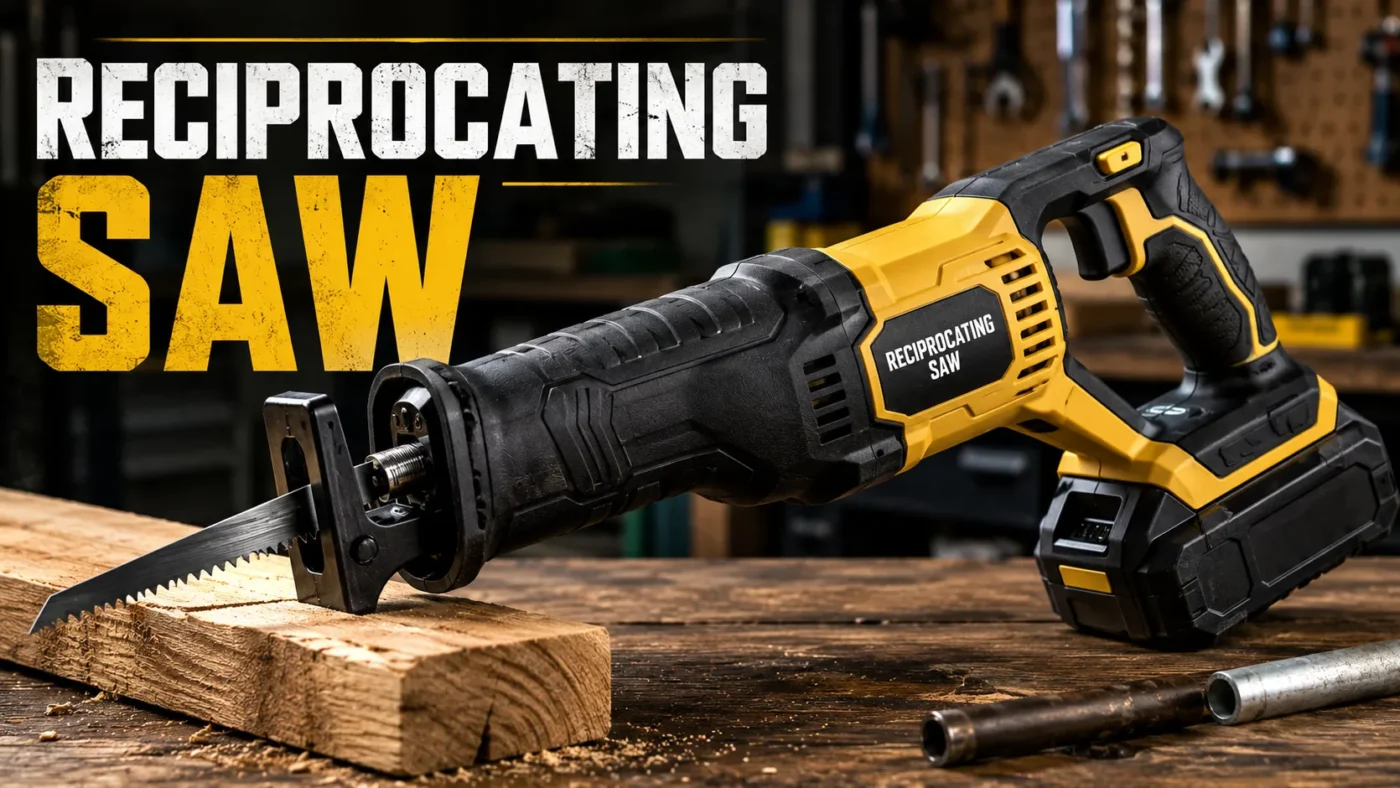
Two people can own the same reciprocating saw and get completely different results. One of them read the blade before loading it, and the other grabbed whatever was in the case. Motion comes from the tool. Everything else comes from the blade: the cut, the speed, the straightness, and whether anything gets ruined. For a closer look at this, see Miter Saw.
So this guide starts with tooth count, works out to blade length and cut depth, and only then gets to which machine you should own.
Short version: match the blade to the material first. Use 6 TPI for framing lumber, 10-14 TPI for plastic pipe, 18-24 TPI for thin metal, and 3-5 TPI for green wood. Then pick the shortest blade that clears the material, and press the shoe down hard against the work before you pull the trigger.
Key takeaways
- TPI is the tooth count over 25.4 mm of blade edge. Coarse teeth for wood, fine teeth for metal, and never the other way round.
- Minimum TPI for metal equals 76 divided by the material thickness in millimetres.
- Assume the blade tip can reach the full blade length past the shoe, so a 300 mm blade in a stud wall is asking for trouble.
- Bi-metal handles almost everything. Carbide-tipped is for stainless, rebar, and hardened bolts. Carbon steel is for clean softwood and plastic only.
- Switch orbital action off for metal, thin stock, and every plunge cut.
- A full-size 18V or 20V cordless model is the right first tool for most homeowners, with a corded machine as the pick for long teardown days.
What a reciprocating saw is for, and where it lets you down
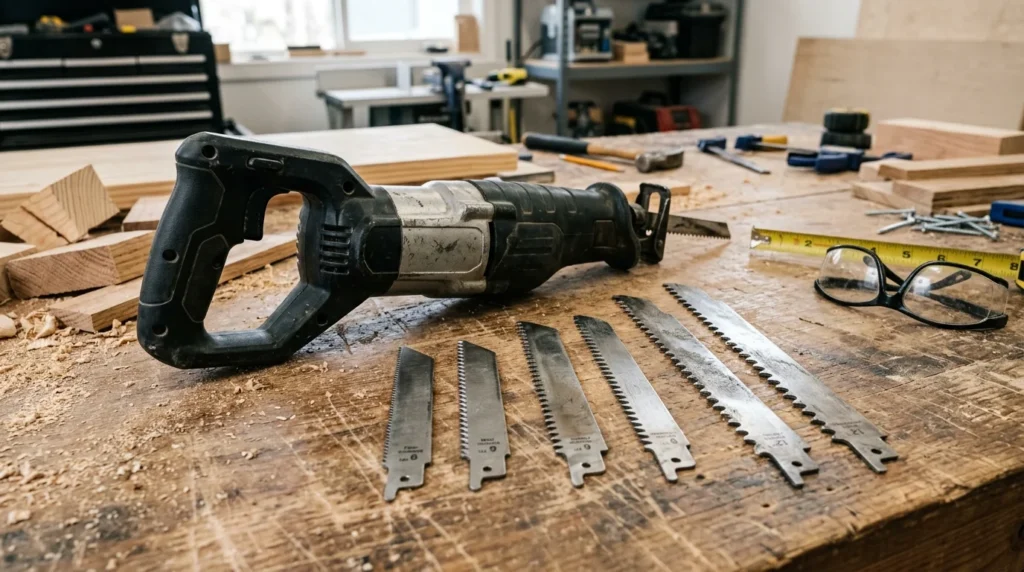
The mechanism is blunt. Inside, a motor drives a straight blade back and forth at up to about 3,000 strokes per minute. Nothing guides that blade except your two hands and a flat metal shoe resting on the work. There is no fence, no depth stop, and no table.
That bluntness is the point. It cuts through a stud, the drywall screwed to it, and the nails inside it in one pass, at an angle no other tool can reach.
Here is what it owns.
- Gutting a bathroom or kitchen, including cabinets with fasteners still in them
- Cutting studs and joists in place, flush to a floor or a plate
- Pruning branches from 25 mm up to about 150 mm thick
- Chopping copper, ABS, PVC and steel pipe in a crawl space
- Taking a deck apart without unscrewing a single fastener
Jobs it will embarrass you on: anything with a visible finished edge, sheet goods, angled trim cuts, and thin sheet metal that flexes and screams instead of cutting. Those belong to other tools. Ask this one for tidy work, and you get a torn, wandering line every time.
TPI by material: the table that decides your cut
TPI is the number of teeth along 25.4 mm of blade edge. Low numbers mean big teeth and deep gullets that quickly clear a lot of sawdust. High numbers mean small teeth that shave metal rather than grab it.
Get it backwards, and both failures are ugly. Coarse teeth on thin metal hook the material, snap teeth off, and bend the blade. Fine teeth in wet lumber pack solid with fibre in about four seconds, stop cutting and start burning.
| Material | Typical thickness | TPI | Blade family | Blade length |
|---|---|---|---|---|
| Framing lumber, studs, joists | 38 to 89 mm | 6 | Bi-metal demolition | 150 mm |
| Nail-embedded wood, old deck boards | up to 100 mm | 6 to 10 | Bi-metal demolition | 230 mm |
| Green branches, wet limbs | 25 to 150 mm | 3 to 5 | Pruning | 230 to 300 mm |
| Drywall, plaster and lath | 12.7 to 25 mm | 8 to 10 | Bi-metal | 150 mm |
| PVC and ABS drain pipe | 3 to 10 mm wall | 10 to 14 | Bi-metal | 150 mm |
| Copper pipe, EMT conduit | under 3 mm wall | 18 to 24 | Bi-metal | 150 mm |
| Steel pipe, angle iron, strut | 3 to 6 mm | 14 to 18 | Bi-metal | 150 mm |
| Stainless, rebar, seized bolts | 6 mm and up | 8 to 14 | Carbide-tipped | 150 mm |
| Cast iron, tile, cement board | any | no teeth | Carbide grit | 200 to 230 mm |
For metal, there is a rule underneath those numbers, and it belongs in your head. At least three teeth must sit inside the material thickness at all times, or the workpiece drops into a gullet and rips teeth off.
Three teeth over 25.4 mm of edge is 76, so the arithmetic is simple: minimum TPI equals 76 divided by the thickness in millimetres. Steel with a 3 mm wall needs 25 TPI, so reach for the 24 TPI blade. On 6 mm plate, the answer is 13, so 14 TPI does it. No blade packet phrases it that way, and it takes two seconds at the truck.
Bi-metal, carbide, or carbon steel
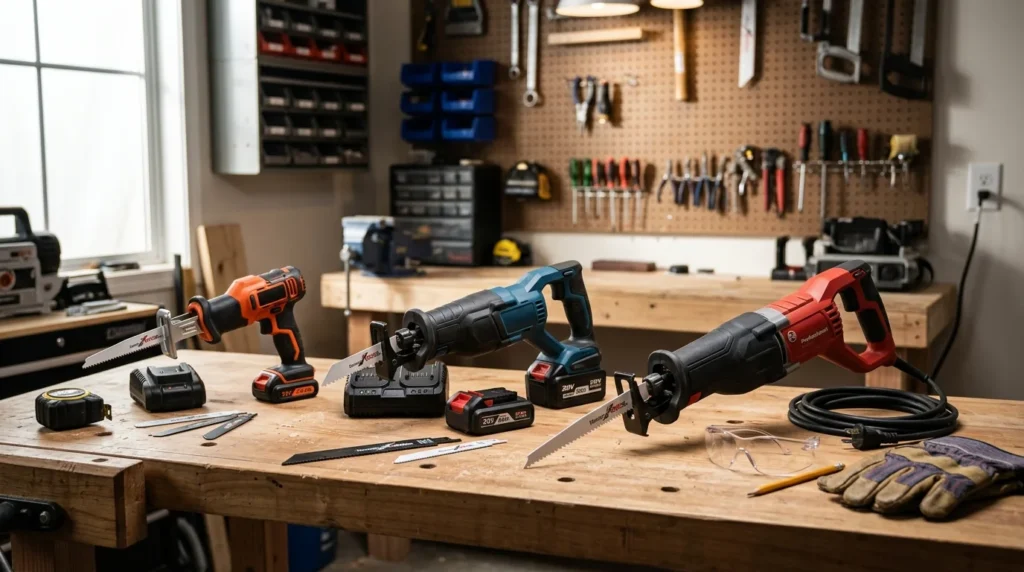
Three blade bodies cover the whole range, and the packet tells you which one you have.
Bi-metal welds high-speed steel teeth onto a flexible spring-steel back. It bends without snapping, withstands a nail strike, and outlasts a plain carbon blade many times over in the same cut. Most of the blades a homeowner needs are bi-metal.
Carbon steel is the soft, floppy one. It is fine in clean softwood, foam, and plastic, where flexibility helps you flush-cut against a surface. Put it into a hidden nail, and it is finished instantly.
Carbide-tipped blades feature brazed tungsten carbide teeth and are the only sensible choice for stainless steel, rebar, hardened fasteners, and cast iron. They last far longer in those materials, and they are the ones you keep in a separate sleeve so nobody grabs one for firewood.
Carbide grit blades are the odd family out. They have no teeth at all, just an abrasive edge that grinds through tile, fibreglass, cement board, and cast-iron pipe. Slow, but nothing else gets through those cleanly.
Blade length, stroke and the pipe behind the drywall
Blades come in roughly 100, 150, 230 and 300 mm lengths, and most people buy far longer than they need because the long one looks more capable. Longer is not safer. Buying long by default is the most damaging habit with this tool, and you measure it in punctured copper.
Here is the rule. Assume the tip can extend to the full blade length beyond the face of the shoe. The stroke, between 19 and 32 mm depending on the machine, pushes that tip forward exactly when you least expect it.
Run the numbers on a normal interior partition. Drywall is 12.7 mm thick, and a stud is 89 mm deep, so you need about 102 mm of reach to cut a stud from the room side. The 150 mm blade overshoots by roughly 48 mm while remaining within the cavity. Fit a 300 mm blade instead, and nearly 200 mm of moving steel ends up in the space where the cable and the water lines live.
So measure the material before you pick the blade, not after. That means reading a measuring tape accurately off the actual assembly rather than guessing at nominal lumber sizes. A 2×4 is 38 by 89 mm, and a floor build-up is whatever the last renovation left behind.
Stroke length matters too, and it is where compact and full-size machines separate. One-handed models stroke 19-22 mm and nibble. Full-size machines have a stroke of 28.6 to 32 mm and take a much larger bite per pass. That is why they clear framing lumber in a fraction of the time.
Orbital action, and when to switch it off
Orbital action adds a slight elliptical lift to the stroke, so the teeth swing up into the material on the forward push instead of scraping straight through. In softwood and demolition work, it is a genuine speed increase, and you should leave it on.
Switch it off for four things: metal of any kind, thin stock, cuts you want to land on a line, and every plunge cut. No exceptions.
The reason is the same each time. That elliptical motion multiplies vibration, and vibration in metal means chattering teeth, a bent blade, and a cut that wanders off the mark. Fine-toothed blades in particular hate it.
Shoe pressure, plunge cuts, and cutting blind
Most people who say the tool is uncontrollable are holding it wrong. The shoe is not a bumper. It is the pivot that turns a bucking machine into a stable one. It only works when pressed firmly into the workpiece for the whole cut. Let it float even 2 mm off the surface, and the reaction force that should go into the wood goes into your wrists instead. That is where the hammering and the wandering come from.
Press hard, keep the shoe flat, and let the blade set its own feed rate. Pushing harder than that just bows the blade and overheats the teeth. Speed comes from teeth, not arms.
For a plunge cut, work through it in order:
- Turn orbital action off, then select a blade at least 50 mm longer than the material thickness.
- Rest the bottom edge of the shoe on the surface, with the blade tip clear of it and held at roughly 15 degrees off the face.
- Start the motor at low speed with the tip just touching, so the teeth score a groove rather than skate.
- Pivot the tool slowly upright on the shoe, letting the blade eat its way in.
- Once the blade is through, bring the machine square and cut along your line at full speed.
Blind cuts into a wall or ceiling deserve one extra step. Before the blade goes in, kill the breaker for that area and check the circuit with a multimeter. A demolition blade cuts through a live cable without slowing down enough for you to notice. Know where the supply lines run as well. A look through a nearby outlet box or a small, drilled inspection hole takes a minute and answers the question.
Two more habits to build. Wear eye protection, since this tool flings nails and shards straight back at your face. And keep the blade clamp clean, because a blade that slips in its clamp is the main cause of kickback risk on a plunge cut.
Corded or cordless for real Canadian jobs
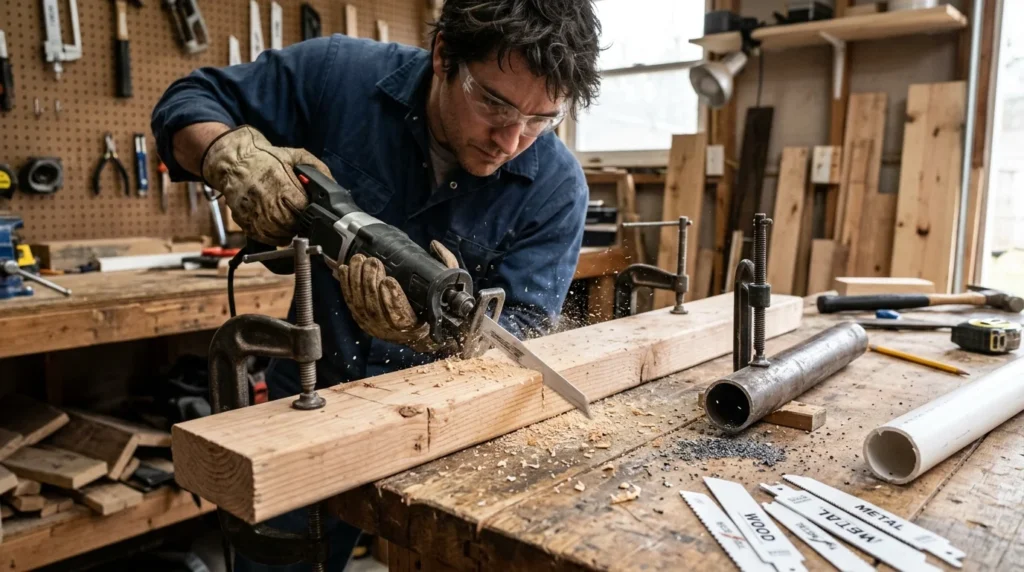
This is one of the last tool categories where corded still wins arguments. Your answer depends on how long your sessions run, how far you are from an outlet, and whether the job is a teardown or 20 minutes of pipework.
| Class | Stroke and mass | Where it wins | Where it lets you down |
|---|---|---|---|
| Compact one-handed, 12V or 18V | 19 to 22 mm, 1.6 to 2.4 kg | Overhead pipe, under sinks, inside cabinets, ladder work | Stalls and overheats in framing lumber |
| Full-size cordless, 18V or 20V | 28.6 to 32 mm, 3.5 to 4.5 kg with a 5.0 Ah pack | Demolition, fence and deck teardown, anywhere without power | Packs run down, and the tool is nose-heavy |
| Corded, 10 to 15 A | 28.6 to 32 mm, 3.2 to 4.0 kg | Cast iron, rebar, hours of steady cutting without a pause | The cord, and no help at the back fence |
Battery life is where expectations break. One 5.0 Ah pack will carry you through a stack of pipe cuts or a few dozen passes in framing lumber. That is not a full afternoon of demolition, so plan on a second pack ready to swap. That is fine for a weekend deck removal in a Canadian backyard. January is different. A cold pack gives up early, and the tool sits in the truck warming back up while you wait.
The verdict: buy the full-size cordless model on whatever 18V or 20V platform you already own. Platform matters more than the badge, and every major brand sells one through Canadian Tire, Home Depot Canada, Rona, or Princess Auto. Own no platform yet? A corded machine rated at 10 to 15 A gives you more sustained cutting power for less mass, and it never quits partway through a joist. Keep the compact one-handed model as a second tool, never a first.
Where to start?
Buy one full-size machine and a small spread of blades rather than a bigger tool and a single blade. These four cover nearly every job a house throws at you.
- Bi-metal demolition, 150 mm, 6 TPI
- Metal, 150 mm, 18 TPI
- Thin-wall copper and conduit, 150 mm, 24 TPI
- Pruning, 230 mm, 3 to 5 TPI
Then measure the material, pick the shortest blade that clears it, press the shoe down, and let the teeth do the work.
Reciprocating saw FAQ
Milwaukee built the first tool of this type in 1951 and called it the Sawzall. The trademark then stuck to the whole category, the way Kleenex stuck to tissues. Every brand builds the same tool under its own name. Blades are cross-compatible because the universal tang fits virtually every machine sold today.
Jigsaws have a base plate that sits on top of the work and a thin blade that cuts downward, which makes them curve-and-detail tools. A reciprocating saw pushes its blade horizontally out in front of the body. It reaches into walls, between joists, and up against surfaces where nothing else fits.
Yes, with a carbide-tipped blade and orbital action switched off. Clamp or brace the piece first, because anything that can vibrate will. On a rusted fastener, you can often skip the cut entirely. Removing rust from metal parts and working penetrating oil into the threads frees more bolts than sawing does.
Use a dedicated pruning blade with 3 to 5 TPI and 230 or 300 mm long. Green wood is wet and stringy, and it packs the solid, fine teeth almost immediately. Late fall and winter are the easier seasons for this, because dormant limbs are drier and lighter to handle.
Usually one of three causes: too coarse a tooth count for the material, orbital action left on in metal, or a shoe that is not held against the work. Ease off. Pushing harder to compensate bows the blade permanently, and a bowed blade never cuts straight again.