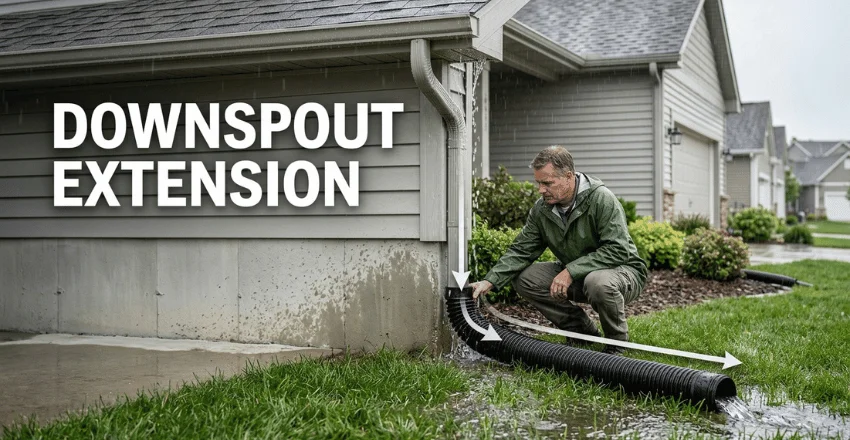
Most wet basements start with a puddle nobody notices, sitting against a foundation wall after a thaw. A downspout extension is the cheapest part of the house that fixes it. The trouble is that half the ones on the shelf are too short for the job Canadian cities actually ask for.
Short answer: a downspout extension should carry roof water at least 2 m away from your foundation, onto ground that already slopes away from the house. Utilities Kingston and the Region of Peel both publish that 2 m figure. A flexible surface extender at roughly CA$9 covers most homes; buried runs cost far more and freeze if laid shallow.
Quick facts before you buy
| Detail | What to expect in Canada |
|---|---|
| Target discharge distance | 2 m minimum from the foundation, further on clay soil |
| Common downspout sizes | 2×3-inch residential, 3×4-inch on newer and larger roofs |
| Surface extender price | CA$9 to CA$30 per outlet at Home Depot Canada |
| Buried run, professionally installed | CA$500 to CA$1,500 per outlet |
| DIY time, surface fit | 10 to 20 minutes, no cutting on most homes |
| Frost depth to clear when burying | roughly 1.1 to 1.2 m in southern Ontario |
| Where it must never drain | A neighbour’s lot, a driveway, a public sidewalk |
TL;DR
- Two metres is the number Canadian municipalities publish, not the vague “a few feet” you see on American sites.
- Roughly CA$9 buys a flexible extender that solves it for a typical bungalow or two-storey home.
- Toronto, Kingston, and Peel all require roof water to be kept out of the sewer, and Toronto’s rule is mandatory citywide.
- Never discharge to concrete or asphalt. In January, that becomes an ice sheet.
- Buried pipe laid above the frost line is worse than nothing, because it locks up during a thaw.
- Surface extenders that hinge or roll come off before the first snowfall.
How far does a downspout extension have to reach?

Two metres. That is the figure Utilities Kingston gives homeowners, and Peel Region publishes the same distance in its disconnection guide. Anything shorter drops water back into the band of soil disturbed when the foundation was poured. That backfill stays looser and thirstier than the ground around it, so it drinks whatever you pour on it and delivers the load straight to your footing.
Distance alone will not save you. Your landing spot has to slope away from the house for the first few metres, or the flow simply runs back along the surface toward the wall you were protecting. Lawn and garden beds work best because they let it soak in. Worst of all is a driveway, which carries every litre somewhere you did not pick.
Walk the route before you buy anything. Measure from the elbow at the bottom of the spout to the point where your ground genuinely falls away, and buy for that distance rather than the shelf price. Any decent measuring tape settles the question in a minute, and it also gives you the cut height if you are disconnecting from a sewer stub.
The five options, compared
The prices below are Canadian shelf prices from Home Depot Canada as of August 2026. Canadian Tire carries the same Euramax flexible line plus the Stealthflow low-profile kit.
| Type | Price (CAD) | Reach | Winter | Best for |
|---|---|---|---|---|
| Flexible vinyl extender | CA$9 | 0.6 to 1.4 m | Remove before freeze-up | Renters, quick fixes, tight side yards |
| Low-profile channel | CA$13 | 0.6 m per section | Stays put, mow around it | Front elevations where looks matter |
| Splash block | CA$10 to CA$20 | 0.3 to 0.5 m | Fine, but too short alone | Pairing with a longer extender |
| Roll-out sleeve | CA$15 to CA$25 | 2 to 3 m | Store it indoors | Lawns you mow weekly |
| Buried solid pipe | CA$18 to CA$36 in materials | 2.5 to 6 m | Freezes if laid shallow | Permanent fixes on well-drained lots |
The flexible vinyl extender wins on price and on how quickly it goes on, and it bends around a gas line or a heat pump pad. Its weakness is that it kinks, holds grit, and becomes brittle after five or six seasons of UV exposure. Low-profile channels look tidier and survive a lawnmower wheel, but each section only buys you about 600 mm, so reaching 2 m means buying three.
Splash blocks are the ones people over-trust. One spreads the flow and protects the sod underneath, and that is all it does. During a heavy summer cell, a 90 m2 roof section can push several hundred litres through one outlet in an hour. No 400 mm block moves that away from the wall.
Treat one as a landing pad, never as the whole answer.
Our verdict: what to fit on a Canadian house
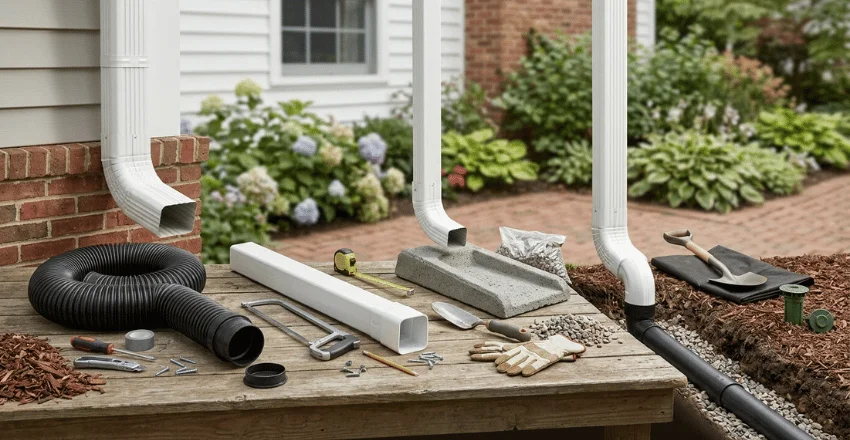
For most homes, buy a flexible extender for roughly CA$9. Add a splash block underneath at the discharge end. You have then covered the 2 m rule for under CA$30 per outlet, which is the right answer for most detached and semi-detached houses here.
Choose the buried option in only two situations. One is a side yard so narrow that a surface pipe blocks the path. The other is a lot you are already trenching for something else. Otherwise, the payoff does not match the cost, and burying adds a failure mode a surface pipe does not have.
Disconnection rules in Canadian cities
Older neighbourhoods were built with the downspout piped straight into the sewer. That works until a storm arrives and thousands of homes push roof water into one pipe at once. Cities have spent two decades unwinding it.
Toronto requires every property owner to disconnect, with exemptions only when disconnection is hazardous or technically infeasible. The city says to measure 23 cm above the sewer connection before cutting, and offers up to CA$500 in help for qualifying low-income seniors and people with disabilities. Kingston made sanitary discharge illegal under By-law 2008-192. Winnipeg addresses downspout runoff through its Lot Grading By-law, which prohibits directing water onto a neighbour’s lot.
Check your own municipality’s page before you cut anything, because details and enforcement both differ. One pattern holds everywhere, though: roof water goes onto your own ground, at least 2 m out, never to a hard surface, never next door.
Fitting a surface extension yourself
- Confirm the size. Squeeze the bottom elbow with a tape measure. Most homes have a 2×3-inch downspout, while newer builds and large roofs use 3×4-inch downspouts. Adapters cost CA$4 if the extender you like does not match.
- Clear the elbow. Shingle grit, needles, and one summer’s worth of maple keys build a plug at the bend. Flush it with a hose until water runs clean.
- Cut only if you are disconnecting. Leave 30 to 45 cm of spout above grade, deburr the edge, and cap the old sewer stub.
- Slide the extender on and fasten it. Two self-tapping screws or a single strap stop it from blowing off in a November wind. Rusted straps and brackets are common on older houses, so address corrosion before reusing them. Our guide to taking rust off metal covers the fastest method for hardware you want to keep.
- Run water and watch. Send a hose down the downspout for 2 minutes, then follow the flow. If it pools anywhere inside 2 m, add a section or shift the discharge point.
- Mark it. Push a short garden stake in beside the end of the pipe. It saves the extender from the mower, and from a snowblower in March.
Burying the run, and why buried runs freeze

Buried drainage is tidy, and it is also where Canadian installs go wrong. Use 100 mm solid-wall PVC rather than perforated pipe, which leaks water back into the soil beside your foundation. Give the line about 1 cm of fall per metre. Finish it at a pop-up emitter set at least 3 m out.
Depth is the part people skip. Frost reaches roughly 1.1 to 1.2 m throughout southern Ontario and is deeper on the Prairies. Pipe laid 400 mm down freezes solid in a cold snap. Send a February thaw into that frozen pipe and the water backs up into the spout. It then overflows onto the wall, which is exactly what you were trying to avoid.
If you cannot reach frost depth, bury shallow on purpose and accept it will be a three-season system, keeping a surface extender ready for winter. Whichever route you pick, the backfill matters: compact it in 150 mm lifts so the trench does not settle into a channel that funnels water back toward the house. Our guide to choosing a tamper explains what to use for a narrow trench like this one.
Quotes for a professional buried run in Canada range from CA$500 to CA$1,500 per outlet. Run length, digging depth, and hard landscaping drive that spread. Materials alone come to CA$18 to CA$36 for solid pipe, plus fittings. That gap is why so many owners dig it themselves, and then dig it too shallow.
The winter and spring-melt routine
Snow country rewards a small seasonal habit. Before the first real freeze, pull hinged and roll-out extenders, hose them out, and store them flat. Ice inside a folded sleeve splits the seam. Leave a rigid extender or a low-profile channel in place, and clear a path in front of it whenever you shovel.
Spring melt is the harder test, and it beats any summer storm in terms of damage. Slow multi-day thaws drop water onto ground still frozen 300 mm down, so almost none soaks in. Refit your extenders as soon as the roof starts dripping. Check too that the discharge point has not become a low spot under a snowbank.
Your next step
Walk your house this weekend with a tape and note where every outlet lands. Any that dump inside 2 m of the wall get an extender. The whole job is usually one trip and under CA$60. While you are looking at how water gets into a house, our guide to resealing tired windows covers the other common entry point.
Frequently asked questions
Usually yes. Grading moves water once it is on the ground. A bare elbow still drops the whole roof load onto one square metre of soil at the wall, and that soil is the loose backfill from construction day.
No. Weeping tile relieves groundwater pressure and is not sized for roof runoff. Feeding it a storm’s worth of water pushes moisture back toward the footing, which is precisely backwards.
Rarely. It protects the lawn and spreads the flow, but a 400 mm reach is nowhere near the 2 m your city requires.
Never do this. Peel Region and Winnipeg both prohibit it outright, and most other municipalities treat it as a grading violation. It is also the fastest route to a complaint from next door.
Match what is already on the wall: 2×3-inch on most older homes, 3×4-inch on newer builds. Spend CA$4 on an adapter if the extender you want comes in only one size.