Finding old wiring in a century-old home can turn a routine renovation, inspection, or insurance renewal into a much bigger question. Knob and tube wiring is still present in some older Canadian houses, particularly properties built before the middle of the 20th century. Its presence does not automatically mean a house is unsafe, but the condition of the system and the way it has been altered over time matter enormously. Also worth reading: Asphalt Sealer.
Canadian homeowners also have practical concerns beyond electrical safety. Insurers may ask about outdated wiring, buyers may hesitate when an inspection identifies it, and upgrading a finished older house can cost thousands of dollars. Understanding what you actually have is therefore more useful than assuming every ceramic knob means an emergency.
Quick answer: Knob and tube wiring is an early electrical system found in many Canadian homes built before the 1950s. It is not automatically unsafe simply because it exists, but age, damaged insulation, ungrounded circuits, alterations, and insurance restrictions can make assessment or replacement necessary. A licensed electrical contractor should inspect any active system.
| Question | Practical answer |
| When was it commonly used? | Mainly in homes from the early 1900s through the 1940s |
| Is it automatically illegal? | No; rules for existing installations depend on provincial requirements. |
| Does it contain a ground wire? | Typically no |
| Can it affect home insurance? | Yes, depending on the insurer and condition of the system |
| Should homeowners inspect it themselves? | Visual clues are useful, but electrical assessment belongs to a qualified contractor. |
| Typical full-rewire budget | Often roughly CA$8,000 to CA$25,000, with difficult homes costing more |
| Best first step | Have the active electrical system professionally assessed. |
What Is Knob and Tube Wiring?
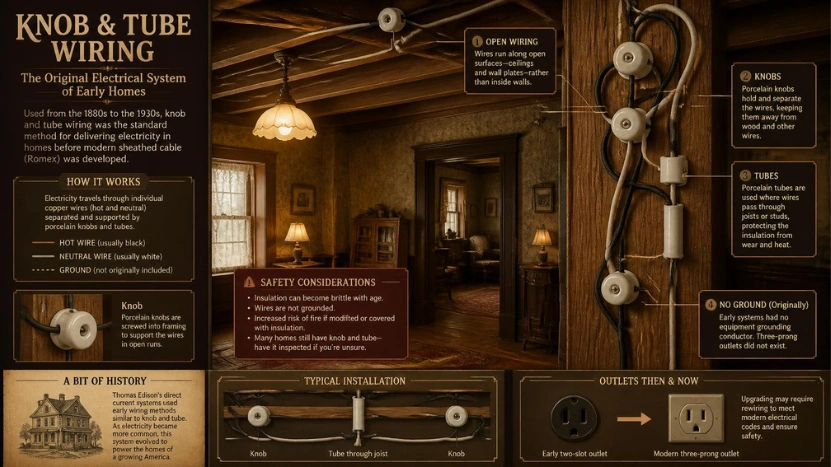
Knob-and-tube, often shortened to K&T, is an early residential wiring method in which individual electrical conductors run separately through a building. Porcelain knobs support the wires along framing members, while porcelain tubes protect conductors where they pass through joists or studs. Ontario’s Electrical Safety Authority guidance on knob-and-tube says the system was used in homes from the early 1900s through the 1940s and is no longer used for new installations.
The construction looks very different from modern residential cable, where insulated conductors and a grounding conductor are normally grouped inside one outer jacket. Traditional K&T circuits generally lack an equipment grounding conductor, and their older insulation may consist of rubberized or cloth-based material. The Insurance Bureau of Canada specifically identifies the lack of grounding and deterioration of old insulation as concerns in pre-war Canadian homes.
Age alone, however, does not tell you the condition of a circuit hidden inside a wall. Some systems have remained relatively undisturbed, while others have been spliced, extended, overheated, covered, or damaged during generations of renovations. That difference is why a qualified electrical assessment is more useful than simply calculating the age of the house.
Is Knob and Tube Wiring Dangerous?
Knob and tube wiring should be treated as an aging electrical system rather than as proof that a house is immediately dangerous. ESA states that existing K&T can be safe when it is properly maintained by a licensed electrical contractor, while also noting that these systems do not provide all the safety benefits found in modern installations. The important question is therefore not simply whether K&T exists, but what condition the active conductors, connections, devices, and circuits are in.
One major limitation is the absence of conventional equipment ground. Modern grounding provides another path for fault current and contributes to protection when electrical equipment develops a fault. IBC notes that old knob-and-tube systems lack this grounding conductor, increasing concern about electric shock compared with properly installed modern systems.
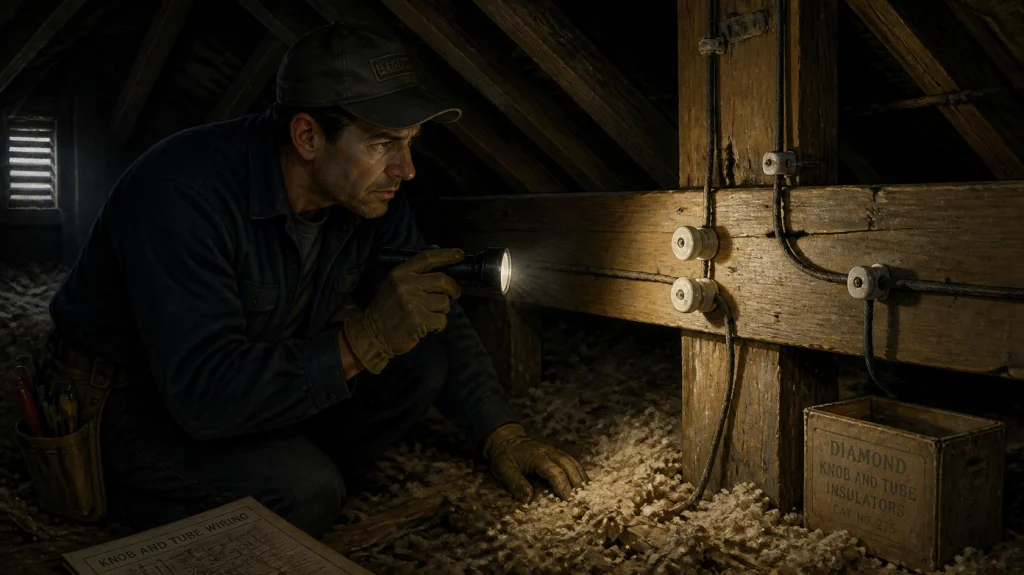
A second concern is insulation deterioration. Decades of heat, movement, previous repairs, and mechanical damage can leave old wire coverings brittle or exposed, particularly around fixtures and connections where conductors may have been disturbed repeatedly. ESA specifically recommends having a licensed contractor check conductors for deterioration or damage rather than assuming age alone determines whether replacement is necessary.
Alterations can create another layer of risk because today’s electrical loads bear little resemblance to those of the early 1900s. A circuit originally intended for a few lights and modest appliances may have been extended repeatedly as owners added outlets, heaters, kitchen equipment, electronics, and other loads. The ceramic hardware may still look intact while the actual concern lies elsewhere in the circuit.
If flickering lights, repeated electrical problems, buzzing, or unusual heat led you to investigate the wiring, HomeCraftly’s guide to how to fix flickering lights safely explains which symptoms can be simple fixture problems and which justify calling an electrician. An older home can contain more than one generation of wiring, so a symptom should not automatically be blamed on visible K&T. Diagnosing the active circuit first prevents expensive assumptions.
Is Knob-and-Tube Wiring Legal in Canada?
There is no useful one-word answer that applies identically across every Canadian province and territory. Electrical codes, permits, inspections, and enforcement are handled through provincial or territorial systems, so homeowners need to confirm the rules where the property is located. Existing legacy wiring and installing new legacy wiring are also two very different regulatory questions.
Ontario provides a useful example of that distinction. ESA says the installation rules for K&T were deleted from the 28th Edition 2021 Ontario Electrical Safety Code, but it also states that the code is not retroactive. In other words, an existing Ontario installation does not become prohibited merely because current construction uses different wiring methods.
That does not mean homeowners should extend old circuits or perform unpermitted electrical work themselves. Renovations can trigger requirements for new work to comply with the rules currently in force, and permitting arrangements differ across Canada. Before changing an older electrical system, confirm requirements with the provincial electrical authority and use a contractor authorized to perform the work in your jurisdiction.
How Can You Tell If a House Has a Knob and Tube?
Unfinished basements, attics, and utility areas often provide the easiest visual clues. Look for small white or off-white porcelain knobs attached to joists, porcelain tubes passing through framing, and individual old conductors travelling separately instead of being bundled inside modern cable. These features are characteristic of K&T, but visible abandoned hardware does not prove the system is still energized.
A house can also contain a mixture of old and new wiring. Renovated kitchens, bathrooms, additions, or basements may have modern circuits while bedrooms and lighting circuits elsewhere remain original. Likewise, a modern electrical panel does not by itself prove that every branch circuit behind the walls has been replaced.
Two-prong receptacles can be another clue, particularly in a pre-1950 house, but they are not a complete diagnosis. Previous owners may have changed receptacles without replacing all the conductors behind them, and concealed wiring cannot be assessed accurately from the faceplate alone. For general meter literacy, HomeCraftly’s beginner guide to using a multimeter explains electrical measurements, but testing or modifying suspected K&T should be left to a qualified electrician.
Knob and Tube Wiring and Home Insurance in Canada
Insurance is often the issue that pushes an otherwise functioning legacy system onto a homeowner’s renovation schedule. ESA reports that many insurers will not provide or renew coverage for some homes with this type of wiring, and some may require replacement before offering coverage. The Insurance Bureau of Canada similarly notes that insurers consider electrical updates when assessing a property and may ask specifically about knob-and-tube or aluminum wiring. You might also like 3 Way Switch Wiring in Canada.
Requirements are not identical from one company to another. One insurer may request an electrical inspection, another may require specified upgrades, and another may decline a property with active K&T altogether. That makes it important to obtain the insurer’s requirements in writing before spending thousands of dollars on a project that may not match what its underwriter wants.
Homebuyers should address this before removing financing or insurance conditions where those conditions apply. Discovering after closing that the preferred insurer will not cover the house can turn an electrical issue into a financing and ownership problem. Sellers can also benefit from knowing the condition and extent of active wiring before a buyer’s home inspection raises the question.
How Much Does Knob and Tube Wiring Replacement Cost in Canada?
There is no dependable national flat rate because rewiring costs are driven more by access and scope than by the porcelain hardware itself. Published 2026 contractor estimates in Ontario commonly place many complete rewires somewhere around CA$8,000 to CA$25,000, although large, finished, multi-story, or difficult properties can exceed that range significantly. These figures are budgeting references rather than quotes, and prices vary by city, contractor, wall construction, permits, electrical service, and restoration work.
| Project situation | Rough 2026 planning range |
| Limited or partially accessible work | CA$3,000 to CA$8,000 |
| Smaller house with good basement/attic access | CA$8,000 to CA$14,000 |
| Typical full-house rewire | CA$10,000 to CA$25,000 |
| Large or difficult finished home | CA$20,000 to CA$35,000+ |
| Major service or panel work, when actually needed | Additional cost |
Accessibility can change a quote dramatically. Running new cable through an unfinished basement and open attic is much faster than fishing cable through original plaster walls in a fully finished three-story home. The number of circuits, receptacles, fixtures, access openings, electrical service capacity, local permit requirements, and whether wall restoration is included also affect the final price.
Ask contractors to separate electrical work from finishing work in the quote. Some electricians make only the openings required to route new cable, leaving plaster, drywall, primer, and paint to another trade. Once electrical work is complete, HomeCraftly’s guide to patching holes in a wall can help explain how routine drywall restoration is handled, although old plaster or heritage finishes may require a specialist.
Should You Replace It or Keep It?
Replacement becomes much easier to justify when the wiring is damaged, deteriorated, improperly altered, creating insurance problems, or standing in the way of a major renovation. It can also make sense when walls are already open because the most disruptive part of running new cable has effectively been removed from the equation. Coordinating rewiring with a renovation may therefore cost less than opening finished walls again several years later.
Immediate total replacement is not necessarily the only conclusion for every untouched legacy installation. ESA’s Ontario guidance specifically says K&T can be safe when properly maintained and recommends an electrical assessment to determine whether deterioration or damage exists. Homeowners should base the decision on the actual condition of their system, insurer requirements, renovation plans, and local electrical rules rather than on blanket claims that every old wire is automatically unsafe.
A professional assessment should also establish how much active K&T actually remains. Some homes advertised as “rewired” still have isolated legacy lighting or bedroom circuits, while others contain only disconnected porcelain hardware left behind from earlier upgrades. Knowing the scope makes contractor quotes far easier to compare.
What Does a Professional Rewire Usually Involve?
A proper project starts with identifying active legacy circuits and determining what electrical equipment those circuits serve. The contractor can then design modern replacement circuits, work out access routes, determine permit and inspection requirements, and confirm whether other equipment genuinely needs upgrading. This planning matters because replacing branch wiring is not automatically the same job as replacing the service or electrical panel.
During the project, new grounded wiring is routed to the affected lights, switches, and receptacles while active old circuits are taken out of service appropriately. Access openings may be required in finished ceilings or walls, particularly when there is no clear route through a basement or attic. Electrical work should then receive whatever inspection or documentation is required by the local authority before finishes are restored.
Keep the paperwork when the project is complete. Permit records, inspection documents, contractor invoices, photographs, and a clear scope of work can be useful for insurers, future buyers, and subsequent renovations. Documentation can also prevent a future home inspector from mistaking abandoned visible ceramic hardware for active wiring.
Buying a House With Knob and Tube Wiring
K&T does not automatically make an older Canadian house a bad purchase. The more useful questions are how much of it remains active, what condition it is in, whether insurance can be arranged, and what a realistic upgrade will cost. A house priced appropriately for an upcoming rewire may still be a better purchase than a superficially renovated house with an unclear electrical history.
Before finalizing the purchase, obtain an electrical assessment and speak with the insurer that will actually cover the property. Do not rely solely on the seller’s statement that “the electrical was updated,” because that phrase may describe a panel replacement, selected new circuits, or a complete rewire. The scope and documentation matter much more than the wording in a listing.
If a renovation is already planned, ask the electrician and renovation contractor to coordinate before walls are closed. Electrical, insulation, drywall, plaster, cabinetry, and painting schedules can overlap, and poor sequencing creates duplicated labor. Planning the rewire early also makes it easier to add the outlets and dedicated circuits a modern household actually needs.
What Should You Do If You Find It?
Start by determining whether the material you found is part of an active electrical system rather than trying to remove or alter it yourself. Arrange an assessment with a contractor qualified under your province’s rules, then ask for the findings in writing and clarify which circuits remain active. ESA specifically recommends a dedicated electrical assessment because it is different from a general home inspection and focuses on the condition of the electrical system.
Next, contact your home insurer or broker and ask exactly what documentation or remedial work they require. Only after you understand both the electrical findings and insurance requirements should you compare replacement quotes. That order helps prevent unnecessary work and gives each contractor the same scope to price.
The Bottom Line
Knob and Tube Wiring is a legacy system that deserves informed assessment, not panic and not neglect. In a Canadian home, the important questions are its condition, the amount still active, the rules in your province, your insurer’s requirements, and the realistic cost of upgrading it. If you discover K&T, have the electrical system professionally assessed first and make the replacement decision with those facts in hand.
Frequently Asked Questions
Not automatically in every existing home. Ontario’s ESA states that properly maintained K&T can be safe and that the Ontario code is not retroactive, although damaged or deteriorated wiring may warrant replacement. Insurance requirements, renovation plans, and provincial rules can still make replacement the most practical option.
Sometimes, but coverage depends on the insurer and the particular property. ESA says many insurers consider these homes higher risk, with some refusing coverage or requiring replacement, while IBC notes that insurers commonly ask about outdated electrical systems when underwriting a home. Ask your insurer or broker for its exact requirements rather than assuming every company follows the same rule.
Traditional K&T does not normally include the equipment grounding conductor used in modern residential wiring. IBC identifies the lack of grounding as one of the concerns associated with this older system. A licensed electrician can determine how the existing circuits and devices in a particular house are configured.
A new panel does not automatically replace old branch wiring running through walls and ceilings. The panel and the branch circuits are separate parts of the electrical system, so the necessary scope depends on the condition and capacity of each. Have the contractor explain separately what is being replaced and why before approving a major upgrade.
The schedule varies with house size, access, occupied rooms, number of circuits, and the amount of wall repair required. A relatively accessible home can progress much faster than a finished multi-story property with plaster walls and limited attic or basement access. Ask the contractor for both an electrical-work schedule and a separate restoration schedule so you know when rooms will actually be usable again.
No, because old ceramic hardware may remain after a previous rewire. Some contractors disconnect obsolete circuits without removing every inaccessible knob and tube from framing cavities, so visible hardware alone cannot establish whether electricity is still present. An electrical assessment should trace the active circuits before renovation or removal work begins.