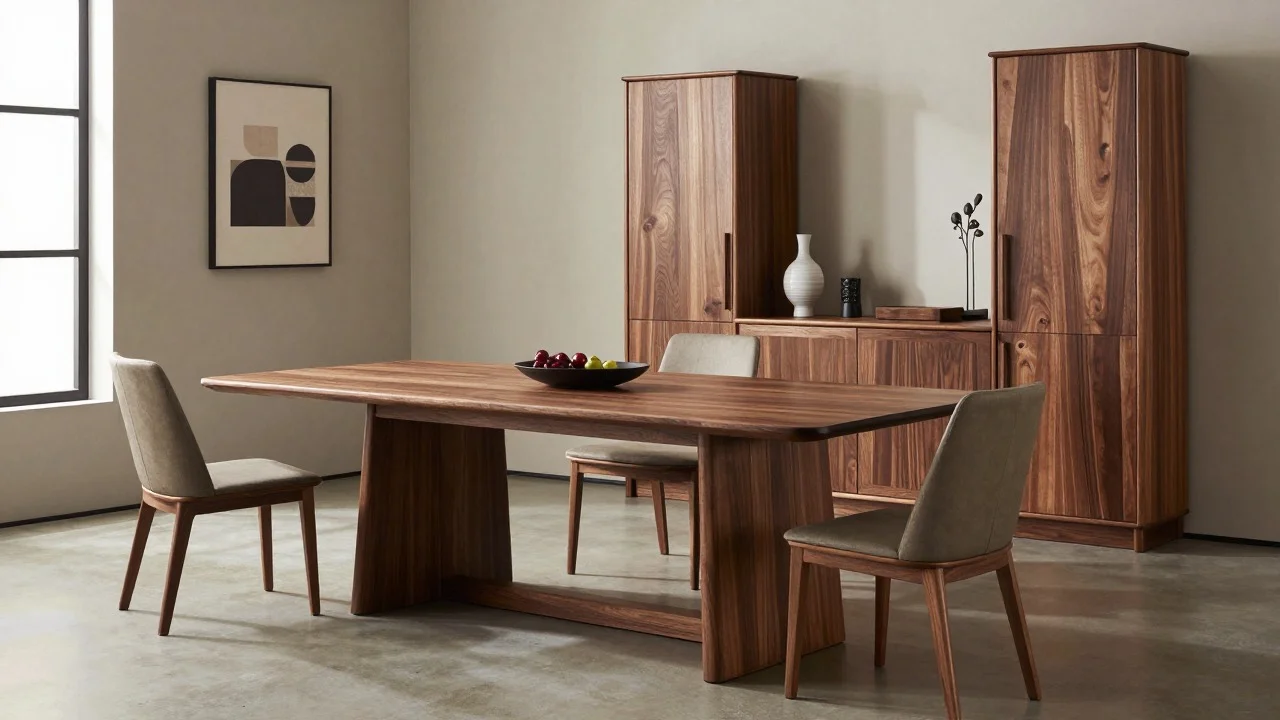
Walnut wood is a naturally dark hardwood prized for furniture, cabinetry, decorative millwork, and other interior projects. Its chocolate-brown colour, fine texture, and distinctive grain make it especially attractive when the material itself is meant to be part of the design. For Canadian homeowners, the key is knowing what you’re buying, because a “walnut” finish or colour does not always mean the piece is made from solid hardwood.
7 Key Facts at a Glance
| Feature | What to know |
|---|---|
| Botanical group | Species in the Juglans genus |
| Common North American species | Black walnut, Juglans nigra |
| Natural colour | Brown heartwood with much lighter sapwood |
| Grain | Commonly straight, with occasional waves or decorative figure |
| Janka hardness | About 1,010 lbf for American black walnut |
| Common uses | Furniture, cabinetry, veneer, panelling, and architectural millwork |
| Canadian context | Native but uncommon in Canada, with a natural range in southern Ontario |
Natural Resources Canada describes black walnut as heavy, hard, strong, decay-resistant, attractive in grain, and easy to work and finish. The federal tree database also notes that the species occurs naturally in southern Ontario but is uncommon in Canada.
Quick answer: This North American hardwood offers a rich brown appearance, good dimensional stability, moderate hardness, and excellent finishing qualities. It works especially well for furniture and decorative interiors where colour and grain matter, although buyers should check whether a product is solid hardwood, veneer, or simply finished in a similar brown tone.
What Is Walnut Wood?
The term describes timber from trees in the Juglans genus, with American black walnut being the main North American commercial species. Its heartwood can range from lighter brown through deep chocolate tones, while the sapwood is much paler. The contrast between the two can create striking natural variation across boards and finished pieces.
In Canada, the tree has a relatively limited natural range compared with maple and several other familiar hardwood species. Natural Resources Canada places its native Canadian occurrence in southern Ontario, while commercial material can also enter the Canadian market from the United States. That distinction matters if Canadian-grown material, local sourcing, or provenance is important to your project.
Colour and Grain: Why This Hardwood Looks Different

The biggest visual attraction is the naturally dark heartwood, which often carries chocolate-brown tones with subtle grey, purple, or deeper brown streaks. Sapwood can be cream or nearly white, so boards may show noticeable colour contrast unless the manufacturer selects or processes them for a more uniform appearance. A clear oil or protective finish can emphasize these variations without hiding the natural grain.
Grain is often straight, but individual boards may include waves, curls, crotch figure, or other irregular patterns. That variation is one reason large table tops, cabinet fronts, and decorative panels can look noticeably different even when they come from the same species. If you want a matching set, inspect the actual boards or product photos rather than relying on a generic colour swatch.
Colour labels on retail furniture deserve extra attention. A listing that says “walnut finish,” “walnut colour,” or “walnut effect” may refer to a stain applied to another species, an engineered panel, or a printed surface. Check the material specification for terms such as solid hardwood, veneer, MDF, particleboard, or laminate before comparing prices.
How Durable Is Walnut Wood for Furniture?
American black walnut has a Janka hardness of about 1,010 lbf, which places it below harder choices such as hard maple. Hard maple is commonly rated around 1,450 lbf, so it offers greater resistance to indentation in demanding applications. Janka ratings are useful for comparison, but furniture performance also depends on joinery, board thickness, construction, finish quality, and daily care.
| Material | Typical Janka hardness | Appearance | Practical fit |
|---|---|---|---|
| Black walnut | About 1,010 lbf | Dark brown, refined grain | Statement furniture, cabinetry, desks |
| Red oak | Roughly 1,200–1,300 lbf | More open and visible grain | Tables, flooring, family furniture |
| Hard maple | About 1,450 lbf | Pale, fine grain | High-wear surfaces, light interiors |
This means the darker hardwood is durable enough for normal dining tables, desks, cabinets, sideboards, beds, and shelving, but it is not immune to dents. A dropped metal object or hard impact can still mark the surface. If maximum dent resistance is your main priority, choosing a harder species such as maple may make more sense than choosing primarily for colour.
Why It Works Well in Canadian Homes
Seasonal indoor conditions are worth considering with any real wood furniture in Canada. Heating during winter can dry indoor air, while warmer months may bring higher humidity, causing solid timber to lose and regain moisture through the year. Quality construction allows for this natural movement instead of trying to prevent it completely.
HomeCraftly’s guide to repairing a wobbly chair explains how seasonal indoor conditions can affect older hardwood furniture and its joints. The same basic principle applies when buying new pieces: solid construction and appropriate joinery matter alongside the species itself. A premium board cannot compensate for weak connections, poorly fitted joints, or low-quality hardware.
For flooring or other large wood surfaces, controlling grit and excess moisture also helps protect the finish. HomeCraftly’s hardwood floor cleaning guide covers practical cleaning habits designed for Canadian homes. Those habits reinforce a useful rule for furniture too: protect the finish first, because surface damage often appears before the underlying timber has any structural problem.
Where This Hardwood Makes the Most Sense
Furniture is one of its strongest applications because a relatively small amount of richly coloured material can become a visual focal point. Canada Wood Group lists black walnut for fine furniture, cabinetry, veneer, architectural millwork, and specialty products. Those uses take advantage of both its decorative appearance and its ability to machine and finish well.
Common household applications include the following.
- Dining and coffee tables
- Desks and home-office furniture
- Sideboards and media consoles
- Bed frames and nightstands
- Cabinet doors and drawer fronts
- Shelves and architectural accents
- Decorative veneer and wall panels
It is particularly effective when you want contrast against pale walls, cream textiles, stone, brushed metal, or lighter timber. A full room of dark material can feel visually heavy, so many interiors use it as an anchor rather than on every surface. That approach also lets a homeowner spend more on a few visible pieces while choosing less costly materials elsewhere.
For DIY furniture or cabinetry, workability is another advantage. Canadian Woodworking notes that European species machine, glue, turn, carve, and finish well, while North American sources give similar assessments for black walnut. If you are shaping boards yourself, HomeCraftly’s router table guide provides a useful starting point for safer, cleaner routed edges.
What to Check Before Buying
Start with the construction description rather than the colour name. Solid boards, real wood veneer over a stable core, and stained imitation surfaces can all look similar in an online photograph, yet their cost, repair options, and long-term behaviour differ. Ask for the species and construction method if the product page does not state them clearly.
Then inspect how visible surfaces are matched. Large tabletops and cabinet fronts look more intentional when adjacent boards have compatible colour and grain, although natural variation should still be expected. Pale sapwood is not necessarily a defect, but you should decide whether you like the contrast before buying a prominent piece.
Finish quality also affects maintenance and appearance. A protective topcoat helps resist spills and everyday handling, while oil-based finishes can emphasize grain and darker tones. If a finished surface becomes chipped or dented, choose a repair product based on the finish and depth rather than assuming every filler will accept stain evenly; HomeCraftly’s wood filler guide explains those differences.
Finally, consider where the piece will live. A dining table in a busy household needs a finish suited to frequent wiping and contact, while a decorative console sees far less wear. Matching construction and finish to the job is usually more useful than choosing by species reputation alone.
Caring for Dark Hardwood Furniture
Remove dust with a soft cloth before wiping the surface, because abrasive grit can create fine scratches over time. Use a lightly damp cloth when needed, then dry the surface instead of allowing water to sit on the finish. Coasters, trivets, placemats, and felt pads reduce the most common sources of avoidable marks.
Keep furniture away from persistent leaks, standing water, and direct contact with hot cookware. Strong sunlight can also shift the appearance of wood and finishes over time, so rotate objects on large exposed surfaces if one area receives much more light than another. Always follow the furniture maker’s instructions before using polish, wax, oil, or commercial cleaners.
Small scratches and dents do not automatically mean the piece is failing. Real timber develops signs of use, while deeper structural problems usually involve joints, fasteners, moisture damage, or major splits. Deal with the cause before trying to disguise the mark with stain or filler.
Is It Worth Choosing Over Oak or Maple?
Choose the darker species when natural brown colour and a refined grain pattern are central to the room. Choose hard maple when greater dent resistance and a pale, clean appearance matter more, and consider oak when you want a stronger visible grain and broad availability. There is no universal winner because the right option depends on appearance, wear, construction, and budget.
Price can also change the decision. Dark premium hardwood typically commands more than common domestic alternatives because clear boards are desirable for furniture and decorative work. Veneer can provide much of the visual character on cabinet panels or case goods while using less solid material, making it a legitimate construction choice rather than automatically an inferior one.
For many Canadian homes, the strongest reason to choose it is simple: the natural colour already creates the visual effect that other light woods often need stain to imitate. That can make a dining table, desk, or media unit feel distinctive without complicated ornament. Focus on honest material descriptions and sound construction, and the purchase becomes much easier to judge.
A Practical Choice When Material and Appearance Both Matter
This hardwood earns its place in Canadian interiors through a combination of natural colour, workable strength, attractive grain, and broad furniture applications. It is not the hardest option, nor does every brown product bearing its name contain solid timber, so careful product descriptions matter. Once you know the species, construction, finish, and intended use, you can compare pieces on real quality instead of colour alone.
For your next furniture or woodworking project, start by deciding where natural grain deserves to be visible and where another material can do the job more economically. Then compare construction details before paying a premium for the label. That approach gives you a home that looks considered while keeping durability, maintenance, and value in balance.
Frequently Asked Questions
Is walnut wood good for furniture?
Yes, it is widely used for furniture because it combines attractive colour, good workability, dimensional stability, and useful strength. Canada Wood Group specifically identifies the species for fine furniture, cabinetry, veneer, and architectural millwork. It is still possible to dent the surface, so construction and finish quality remain important.
Is black walnut native to Canada?
Yes, but its natural Canadian range is limited. Natural Resources Canada describes the species as uncommon in Canada and naturally occurring in southern Ontario. Furniture sold here may therefore use domestic material, imported North American lumber, or a different species, depending on the manufacturer.
How can I tell whether furniture is solid wood?
Read the material specification before relying on colour or grain alone. Terms such as veneer, MDF, engineered wood, laminate, or “finish” indicate that the visible brown surface may not be solid timber throughout. Edge grain, underside construction, end grain, and manufacturer documentation can provide additional clues.
Does dark hardwood scratch easily?
Its moderate hardness handles normal furniture use well, but sharp objects and hard impacts can still leave marks. Protective pads, coasters, and routine dust removal reduce surface wear without covering the material’s natural character. For a heavily used work surface, a harder species or more protective finish may be the practical choice.