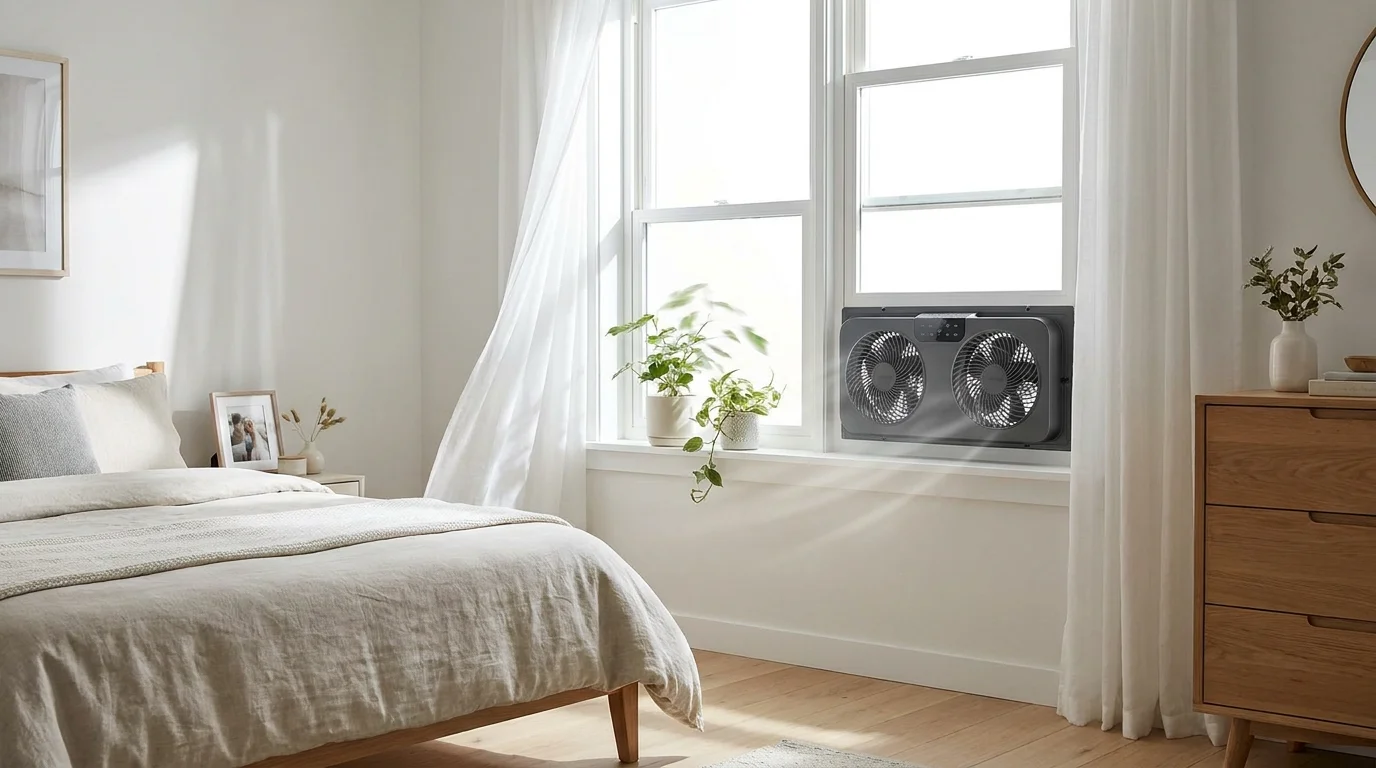
Most people buy a window fan, drop it in the bedroom sash, aim it inward, and wonder why the room still feels stale at midnight. The hardware is rarely the problem. Direction and timing are, and both hang on one number: whether the air outside is genuinely colder than the air inside.
The short answer
Point a window fan outward in the warmest room and let cooler air enter through a window elsewhere in the house. Run it only while outdoor air is colder than indoor air, which in most of Canada means from about 10 p.m. until sunrise. Close everything by mid-morning.
TL;DR
- Blowing out beats blowing in for most Canadian homes, because it clears the hot upper air instead of pushing it around.
- These units move air; they do not chill it. They do nothing once outdoor air is warmer than indoor air.
- Toronto’s July normals are 27 C during the day and 18 C overnight, so the useful stretch is roughly from 10 p.m. to 7 a.m.
- Casement and awning windows will not take a standard box-style unit. Measure before you buy.
- Budget CA$40 to CA$130, and about 3 cents a night in electricity on Ontario off-peak rates.
- On smoky days, run exhaust only or leave the window shut.
Which way should a window fan point?
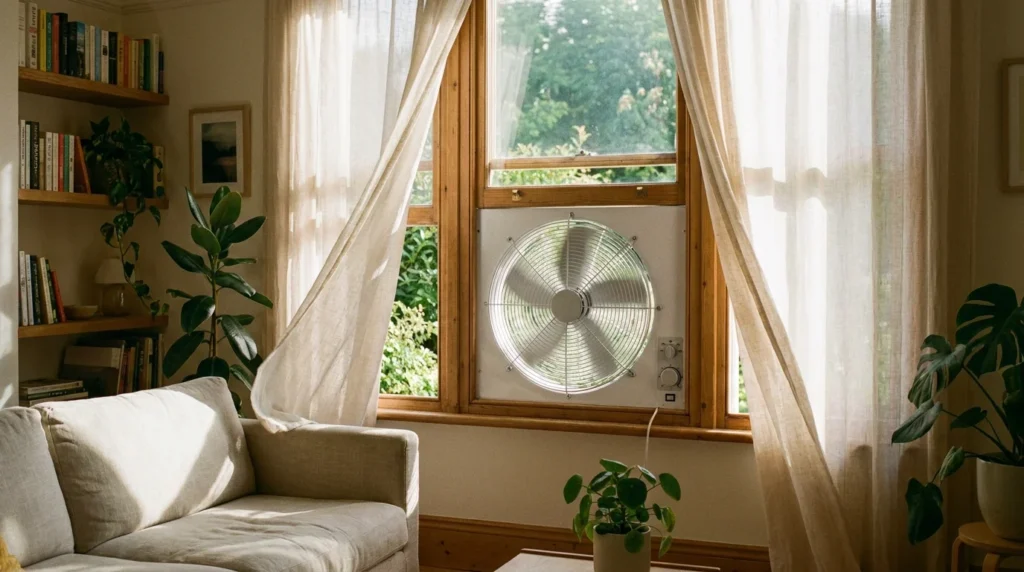
Air moves in a loop. Whatever volume leaves the house has to be replaced from somewhere else. One unit never works alone. It works with the openings around it.
Blowing out is the stronger default. Warm air collects at ceiling height and upstairs. Exhausting from the hottest room drags that heat outside. Replacement air arrives through whichever openings you leave cracked. Blowing in does the opposite job. It floods one room with outdoor air and leaves the rest of the house to sort itself out. That suits a shaded basement bedroom. It suits little else.
| Setup | What it does | Best for | Watch for |
|---|---|---|---|
| Exhaust, blowing out | Pushes indoor air outside and draws replacement air through other openings | The hottest room, upstairs bedrooms, kitchens after cooking | Stalls if you do not open a second window |
| Intake, blowing in | Drives outdoor air into one room | A shaded window on the north or east side | Brings in whatever is outside, including smoke, pollen, and traffic noise |
| Twin push-pull | One unit exhausts while another draws in | Long open floors and cross-ventilation | Two units, two outlets, roughly double the noise |
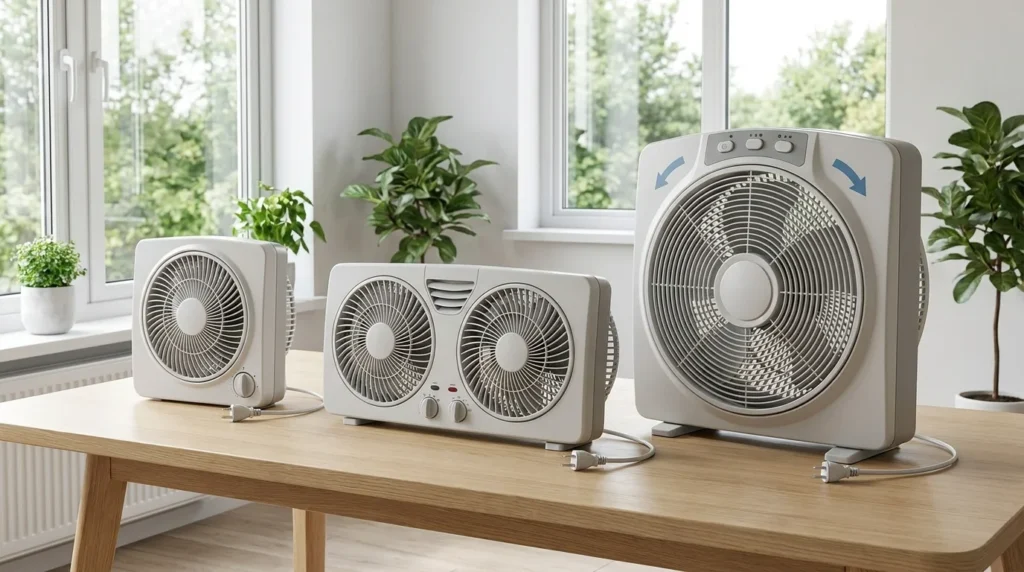
Reversible twin models settle the argument. Each blade set spins either way from a switch or remote, and that is the feature worth paying for.
The rule that decides everything
These units are movers, not coolers. The air arriving in your bedroom is the air off your lawn, plus a trace of motor heat. Once the outdoor reading passes the indoor reading, running one makes the room warmer.
So a Canadian summer hands you a slot, not a season.
| City | July mean daily high | July mean overnight low | Overnight drop |
|---|---|---|---|
| Toronto | 27 C | 18 C | 9 C |
| Ottawa | 27 C | 16 C | 11 C |
| Montreal | 26 C | 16 C | 10 C |
| Winnipeg | 26 C | 13 C | 13 C |
| Calgary | 23 C | 10 C | 13 C |
| Vancouver | 22 C | 14 C | 8 C |
| Halifax | 23 C | 14 C | 9 C |
Prairie readers get the widest slot. Calgary and Winnipeg drop 13 C overnight, so a house flushed at 11 p.m. starts the next day genuinely cold. Vancouver and Halifax get the narrowest. Toronto bungalows baking since noon recover maybe half of what they gained.
Humidity trims the benefit again. Morning relative humidity in July runs about 82 per cent in Toronto, 84 in Ottawa and 91 in Halifax. The night air arriving through your sash is cool but damp. The room reads cooler on a thermometer and still feels sticky.
No amount of extra airflow fixes that.
Will it fit your window?
Box-style units are built for one shape of opening. They want a double-hung or single-hung sash that slides up and down. That leaves a flat sill for the housing and a sash to press down on its top edge.
- Double-hung and single-hung: ideal. Almost every model on the shelf assumes this.
- Horizontal sliders: workable. The unit sits low in a tall opening and leaves a void above it that you have to block.
- Casement and awning: no. The crank handle sits where the housing needs to go, the sash swings outward, and no track exists to clamp against. A slim vertical unit or a tension rod is the only route.
- Fixed and picture windows: not an option.
Casement windows are common in Canadian builds from the 1980s on, so check before ordering. Then measure the clear opening width and the sash height with a tape rather than by eye. Most twin models cover a range like 24-inch to 37-inch, and they rattle loose outside it. Our measuring tape guide covers reading the hook slide, which matters for an inside measurement.
Older homes add one more obstacle. Interior storm panels and aluminum triple-track combination windows leave less clear depth than the frame suggests. Some screens have to come out before the side panels extend.
What you’ll need
- One reversible twin unit sized to your opening, or a single large model
- Tape measure, not a guess
- Weather app showing the hourly overnight low
- Foam strip, a rolled towel, or a cut piece of rigid insulation for the gaps
- Grounded outlet within reach, no extension cord if avoidable
How to set it up, step by step
- Check tonight’s low first. If it will not drop at least 3 C below your indoor reading, leave the window shut and skip the rest.
- Pick the hottest room. Upstairs and west-facing rooms are usually the worst. That is where the exhaust goes.
- Set the housing in the opening. Rest it on the sill, slide the accordion panels out to both jambs, and lock them.
- Lower the sash onto the top edge. It should press down firmly enough that the unit cannot be lifted from outside.
- Block the leftover gaps. Every open sliver beside the panels is airflow you paid for and lost. Foam strip or a folded towel does for a season. If the frame itself leaks, our guide to resealing windows handles the permanent fix.
- Set the blades to exhaust. Blowing out on the highest speed you can sleep through.
- Open an intake window across the house. Ground floor, shaded side, as far from the exhaust as the plan allows. Two windows in one room short-circuit the loop.
- Open the interior doors on that path. Closed bedroom doors are the most common reason a correctly aimed setup moves nothing.
- Shut it all down at sunrise. Windows closed, blinds drawn, and the cool you banked stays banked until evening.
Two units beat one in a long or split-level house. Put the exhaust upstairs and the intake downstairs on the shaded side. The stack effect then does part of the work for free.
When to leave it off
Wildfire smoke has made this a real question rather than a footnote. Air quality warnings now reach Ontario, Quebec and the Prairies most summers. Intake mode on a smoky night pulls that outdoor air straight into the bedroom you sleep in. Run exhaust only, or keep the window closed and circulate indoor air instead.
Leave it off, too, when the outdoor reading sits above the indoor one. Rain blowing at that side of the house is another reason. Ground-floor openings on a busy street deserve a second thought.
A sash resting on a plastic housing is not a lock.
What they cost in Canada
Prices are modest. Home Depot Canada lists a Hampton Bay 9-inch digital twin with a remote at CA$39.98, and its house-brand equivalent matches that. Lasko-class twins with electrically reversible motors and a thermostat sit near US$89.99, roughly 125 CAD landed. Specialist twin models run past CA$180. Amazon.ca, Canadian Tire, Rona, and Walmart Canada all stock the CA$40 tier every May.
Running costs are where the case gets easy. Twin 9-inch units draw about 22 W to 31 W, so nine hours overnight is roughly 0.27 kWh. Ontario’s off-peak rate of 9.8 cents per kWh puts that under 3 cents a night. The ultra-low overnight rate of 3.9 cents makes it about 1 cent. Call it CA$1 to CA$3 across a 90-night season before HST.
A 900 W window air conditioner over the same nine hours burns about 8.1 kWh. That is roughly 79 cents a night off-peak, near CA$71 across the season. Airflow ratings are printed in CFM, which is American. One CFM is about 0.47 L/s, so a 300 CFM unit moves roughly 510 m3/h.
Keeping it quiet and clean
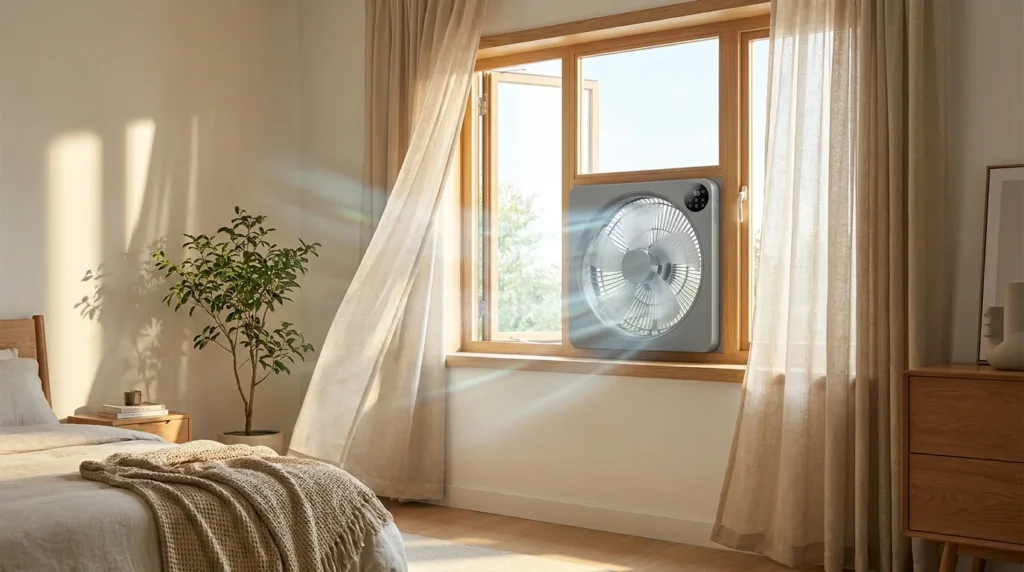
Rattle almost always comes from the panels, not the motor. Tighten them against the jambs and shim the sill with a folded cloth.
Dust is the other performance thief. Blades in an open window collect road grit and pollen all summer. Loaded blade edges lose their bite, so airflow drops while the motor draws the same power. Pull the grille monthly, and our walkthrough on how to clean a fan covers the disassembly without snapping the clips. Store it indoors over winter.
Start with the forecast, not the store
Open a weather app tonight and check the hourly overnight low for your postal code. If it drops well below your indoor reading, free cooling is waiting, and CA$40 of hardware is enough to use it. Measure the opening this week and confirm the sash slides freely. The house can be flushed by the next warm night.
FAQs
Yes, within their limits. They swap indoor air for outdoor air quickly, which cools a room fast when the outside is colder. They cannot take a room below the outdoor temperature, and they cannot dehumidify.
For overnight flushing, yes. It seals the opening and moves air through the house rather than around one room. A box fan on the floor is better for direct breeze on your skin.
Yes. These motors are built for continuous duty. Thermostat and timer models shut themselves off once the room hits your setting.
One properly aimed unit with a second window open beats two badly placed ones. Add a second only when the floor plan is long or split-level.