![Whole House Water Filtration: Test Before You Buy [2026] What to Know First](https://homecraftly.ca/wp-content/uploads/2026/08/whole-house-water-filtration.webp)
Buying a filter before you know what is in your water is how people end up with a CA$1,500 cabinet that fixes nothing. Whole house water filtration treats water where it enters the building, so it earns its price only when matched to a measured problem. In most provinces, the first test is free. Our related guide, replace a door lock, goes further into this.
The short answer: A whole-home system installs on your main line and treats every faucet and appliance at once. Test the water first, then choose. Sediment cartridges catch grit, carbon handles chlorine and taste, oxidizing media pulls out iron and manganese, and ultraviolet light deals with bacteria on a private well.
TL;DR
- Test before you shop. Public health units test private wells for bacteria free, and a paid panel covers metals, nitrate, hardness.
- City water and well water need different equipment, because one is treated already.
- Filtration and softening are separate jobs. Filters do not fix hard water.
- Budget CA$800 to CA$2,000 installed, plus CA$100 to CA$300 a year in cartridges.
- Check the NSF/ANSI numbers against your actual problem, not a generic seal.
What your water is telling you already
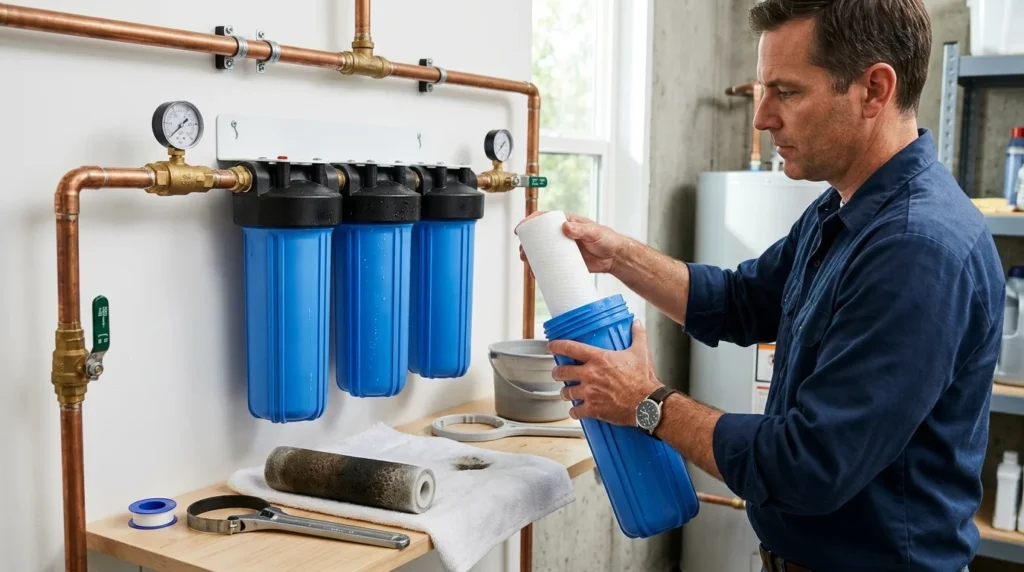
Before any lab gets involved, your fixtures give you a rough diagnosis. Grit in a faucet screen points at sediment, a pool smell in the shower points at disinfectant carryover, and orange staining in the toilet tank points at iron.
Symptom to system, at a glance
| What you notice | Likely cause | What treats it | Typical cost, CAD |
|---|---|---|---|
| Grit in aerators, cloudy water | Sediment and silt | Spin-down prefilter plus a 5-micron cartridge | $70 to $400 |
| Pool smell, flat taste, dry skin | Chlorine or chloramine | Activated or catalytic carbon | $400 to $1,200 |
| Orange or brown staining, metallic taste | Iron and manganese | Oxidizing filter, sometimes with aeration | $300 to $1,500 |
| Positive bacteria test | Coliforms, E. coli | Ultraviolet disinfection, fitted last | $700 to $1,800 |
| White scale on kettles | Hardness | Ion exchange softener, not a filter | $900 to $3,000 |
Sediment is what homeowners spot first, usually because flow at the kitchen sink drops off. Have you rinsed that screen twice already this year? Our guide to faucet aerators explains what the debris is and when to replace the part.
Symptoms narrow the field without confirming anything, because nitrate, arsenic and lead have no taste, colour or smell.
Step one: get the water tested
Nearly every buying guide skips this step, and it changes the answer completely.
If you are on a private well
Roughly one in eight Canadian households drinks from a private well, and nobody treats that water except you. In most provinces, local public health units test well samples for total coliforms and E. coli at no charge. In Ontario, Public Health Ontario runs the program through health unit offices, where you pick up a sterile bottle and return the filled sample.
Take the free bacterial test three times a year, and again after spring melt. Then pay for one broader panel from an accredited private lab, usually CA$150 to CA$400. That panel reports iron, manganese, hardness, nitrate, sodium, arsenic or uranium. Bacteria tell you whether you need disinfection; chemistry tells you which filter to buy.
If you are on city water
Municipal supplies are already treated and monitored, so your question is narrower. Start with your utility’s annual water quality report, which lists hardness and the disinfectant used. That disinfectant matters more than shoppers realize. Cities dosing chloramine rather than free chlorine need catalytic carbon, because ordinary activated carbon strips chloramine slowly and exhausts early.
If your house predates the mid 1970s, ask the city whether your service connection is lead. Many utilities offer free residential sampling, and several subsidize replacement.
What whole house water filtration can and cannot reach
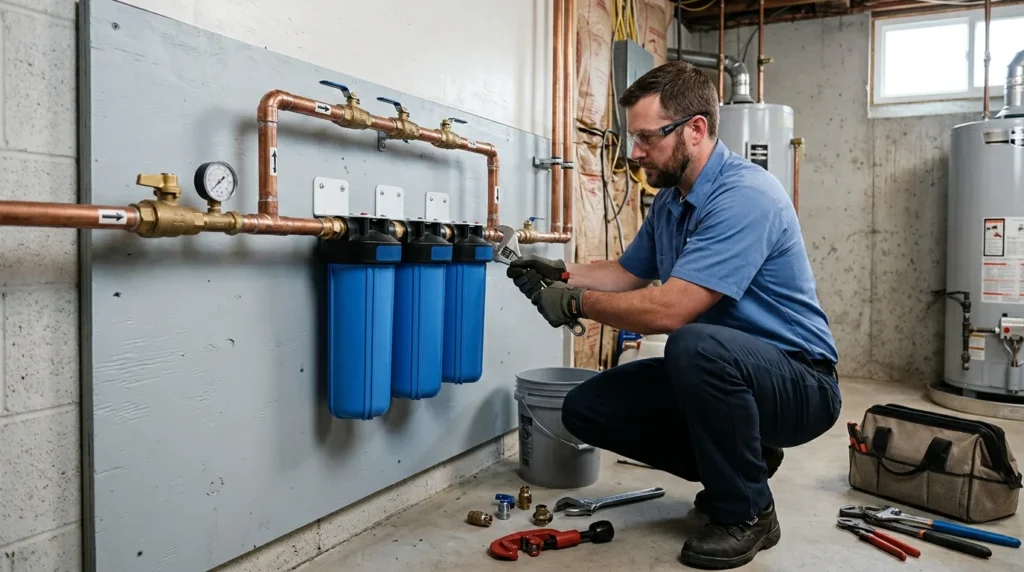
Point-of-entry equipment sits where the supply line enters the house, just past the main shutoff or after the well pressure tank. Everything downstream benefits: the water heater, the laundry and every shower. That is the strength of the design and also its limit.
Lead is the clearest example. Health Canada’s Guidelines for Canadian Drinking Water Quality set a maximum acceptable concentration of 0.005 mg/L for total lead. That 2019 limit is measured at the tap, not at the main.
Where the sample gets taken is the point. Lead in a Canadian home usually comes from the service connection or old solder joints, and much of that plumbing sits downstream of your filter.
The honest answer is a split one. Treat the bulk problems at the main: sediment, chlorine, iron, hardness. Fit a certified point-of-use filter at the drinking tap for lead.
Matching the system to the result
With the lab report in front of you, the shortlist is short.
- Sediment. Start with a 50-micron spin-down screen, which flushes without tools. Behind it, a 5-micron cartridge in a 20-inch big blue housing protects everything else. Well owners should treat this stage as mandatory.
- Carbon. Cartridge carbon suits city water with a chlorine complaint. Backwashing tanks handle higher demand and last years instead of months. Choose catalytic carbon for chloramine.
- Iron and manganese. Air injection or greensand media turns dissolved metal into particles and traps them. Below about 0.3 mg/L of iron, carbon may be enough alone.
- Ultraviolet. UV chambers inactivate bacteria and need clear water to work, so this stage always goes last. Budget for an annual lamp.
- Whole-house reverse osmosis. Rare in homes, expensive, slow. Reach for it only when a lab finds something the other stages cannot touch.
Size the train on flow, not tank volume. A three-bathroom house wants roughly 40 to 50 L/min of service flow, enough for two showers and a washing machine at once. Cartridges are rated in thousands of litres and backwashing tanks in hundreds of thousands, which is why cartridges cost less up front and more every year.
Hard water is a separate purchase
Filtration removes particles, chemicals and organisms. Softening removes dissolved calcium and magnesium by ion exchange, swapping them for sodium in a resin bed. No sediment or carbon cartridge does that, whatever the packaging suggests.
Hardness above roughly 120 mg/L is common across southern Ontario and the prairies, and it is worth treating for scale alone. Pricing is its own topic, so the numbers live in our breakdown of what a water softener system costs. Where a report shows hardness with iron, the order is filter first, softener second.
Certification marks worth checking
An uncertified system is a claim without evidence. Canadian buyers want NSF/ANSI standard numbers and a CSA mark, not the UL mark used south of the border.
Which NSF/ANSI number covers which problem
| Standard | What it certifies |
|---|---|
| NSF/ANSI 42 | Aesthetic effects: chlorine taste and odour |
| NSF/ANSI 53 | Health effects: lead, cysts, mercury, volatile organic compounds |
| NSF/ANSI 44 | Cation exchange softeners, the hardness question |
| NSF/ANSI 401 | Incidental compounds, including pharmaceutical residue |
Read the certified claim, not the sticker. A cartridge certified under standard 42 for chlorine may say nothing about lead.
What it costs in Canada
Canadian retail listings we checked in 2026 put a reusable spin-down prefilter near CA$70 and a two-stage sediment and carbon system around CA$700. Three-stage well systems with iron media run roughly CA$885, and tank-based central units pass $2,600. Installed by a licensed plumber, that setup lands between $800 and $2,000. A UV stage adds $700 to $1,800.
Running costs are the number people forget: $100 to $300 a year in cartridges, $60 to $150 for a UV lamp. Sales tax is added at checkout, so build GST or HST into your quotes.
Skipping it has a price too. Sediment and scale settle in the bottom of a tank heater and insulate the burner, which is why replacing a water heater arrives early in a hard water house.
Installing it in a Canadian basement
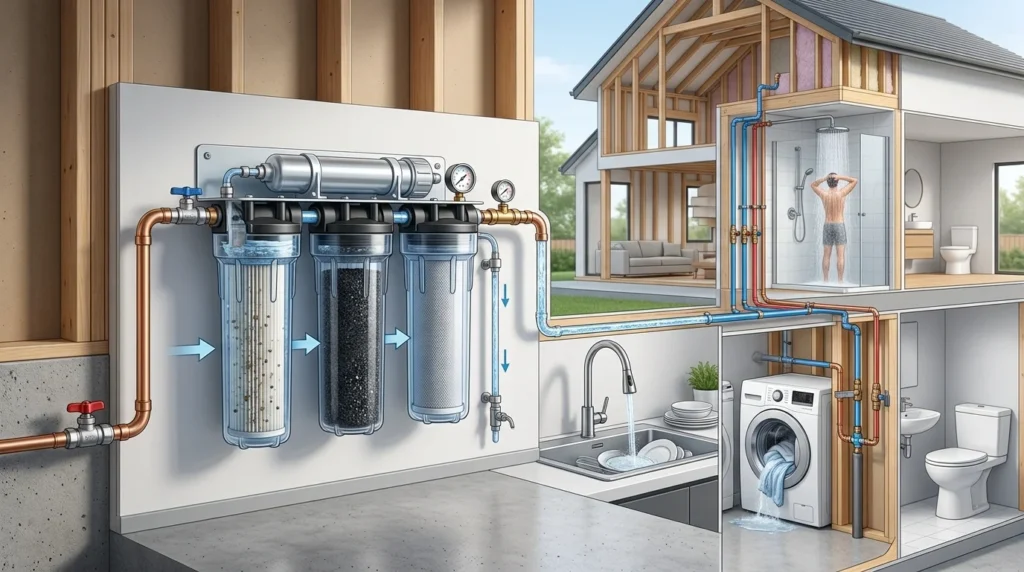
Plan the location before you buy hardware. Filter clusters need a shutoff on each side and a bypass loop, so the house keeps water during a cartridge change. Powered units want a floor drain and an outlet nearby.
Freezing is the local complication. Crawl spaces and unheated garage walls crack housings in a cold snap, so keep equipment inside the heated envelope. Leave about 400 mm of clearance below a 20-inch housing so the cartridge drops out. On a well, filters go after the pressure tank; on city water, past the main shutoff. Cutting into a 1-inch main line is licensed work in most municipalities. Swapping cartridges afterwards is not.
Keeping it working
Neglected filters are worse than none, because a loaded cartridge restricts flow and sheds what it collected. Write the date on each cartridge with a marker.
- Sediment cartridge: every three to six months, sooner after heavy rain.
- Carbon cartridge: every six to twelve months, or when taste returns.
- UV lamp: annually, even if it still glows.
- Pressure gauges: a drop of more than 70 kPa across the housing means change it now.
Retest yearly to see whether the system still does its job. Where pressure at one fixture stays poor after a cartridge change, the blockage is local, and a scaled shower head is the usual culprit. Our walkthrough on replacing a shower head covers that swap.
Your next step
Book the free bacterial test if you are on a well, or pull up your utility’s water quality report if you are on city water. Take that page to two local treatment suppliers and ask each to size a system from those numbers. A system chosen from a lab report beats one chosen from a product page.
Frequently asked questions
On a private well, yes, because nobody else treats that water. On municipal water it is a comfort and appliance-protection purchase rather than a safety one, and it pays off where chlorine taste or scale annoys you daily.
Not reliably. It sits ahead of your interior plumbing, where much household lead originates. Use a point-of-use filter certified to NSF/ANSI 53 at the drinking tap.
Often yes. The main line handles bulk problems; a small under-sink unit handles the finer contaminant list.
A homeowner comfortable with plumbing can fit a cartridge housing on an accessible line. Anything at the main shutoff or a well pressure tank is worth a plumber.
No. Hardness needs ion exchange or a template-assisted conditioner. Many homes end up with both.